0
0

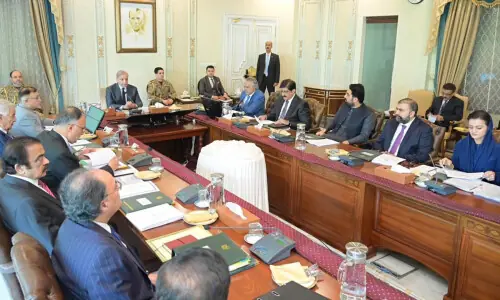
ISLAMABAD, May 26: President Gen Pervez on Thursday called for reviving critical thinking in interpretation of Islamic laws and dispensation of justice in accordance with Islam’s thrust on tolerance, justice, moderation and equity. He was addressing the inaugural session of a three-day international workshop on “Islamic Criminal Law in a Globalized World” organized by the Council of Islamic Ideology.
The president also called for renouncing parochial interpretations, which make laws out of step with reality.
“Islam provides a moral and just perspective based on tolerance, moderation, equity and forgiveness — within this we must endeavour to resolve the issues that confront us — the way of Islam is the path of critical thinking,” he said.
He said the eminent jurists of the Muslim world were, no doubt, men of excellence but they never claimed their works to be final and immutable. “The legal opinions of the scholars of Islam provide us a good historical perspective on the formation and evolution of Islamic laws,” he said.
“Those scholars themselves emphasized that their opinions were not intended to be eternal. They never claimed immutability or infallibility or finality.” Islam, the president underlined, put greater emphasis on “Ilm.” After words Allah and Rub, the word “Ilm” is most frequently used in the Holy Quran. Its use over 800 times defines the vision of Islam.
“Indeed Islam was synonymous with Ilm,” he said, recounting the glorious past of Muslim world, who having learnt the science of paper making before East Europe, produced books on an unprecedented scale and spread knowledge.
“The expansion and spread of knowledge by learned men of Islam made the very foundation of Islamic civilization rest on learning, reason and knowledge.” Gen Musharraf said: “Ilm” did not mean dogma or dogmatism but it meant all knowledge and not religious knowledge alone.
Dilating on the subject, the president said confining the meaning of “Ilm” to religious knowledge alone, is to abandon a very rich heritage of Islam and amounts to denying the history, of which great personalities like Ibne Sina, Al-Kharazi and Al-Beruni are an integral part.
He singled out the achievement of famous scientist Al-Beruni and referring to its geographical relevance stated that a thousand years ago, he made calculations of the radius and circumference of the earth.
These calculations are astonishingly accurate even by today’s estimates, he noted. Gen Musharraf said these men of excellence and numerous others were scholars in the true sense and not mere interpreters of dogma.
When the pursuit of “ilm” was abandoned and dogma and dogmatism took hold, the religion of Islam was cut off from its scientific and rational roots, he observed. “For more than three centuries — three long centuries — the dogmatists blocked the introduction of printing presses in the Muslim world. Decrees were issued which threatened any Muslim, who attempted to learn the science of printing, with the death penalty,” he said recalling the sad state of affairs in the Muslim world at that time.
It is, therefore, no wonder that the Muslim world missed out on its renaissance and was left behind, he said.
“For this we have no one to blame but those amongst ourselves, who laid claim not only to monopoly of truth but also its interpretation. These very obscurantist forces are also at work today.”
Yet, the president said, it remains undenied that Islam emphasizes the role of Ijtehad in matters of interpretation.
Reasoning, opinion and imagination are all methods of interpretation available to Muslim scholars to ensure that “our faith does not lose touch either with the evolution of the society or demands of reality,” he said.
“These are practical methods of solving real problems and issues. All of these are based on knowledge and the exercise of intellect and reasoning.”
However, the president regretted that over a period of time, the opinion of consensus also diminished.
He underscored the dire need for using the Islamic law in its true perspective as a comprehensive drive to address complex questions of governance, rule of law, development etc. “Critical and objective thinking must be restored,” the president stressed.
In this respect, he referred to the Hudood Laws and said these deserve attention of Muslim jurists, particularly in Pakistan.—APP