



 0
0

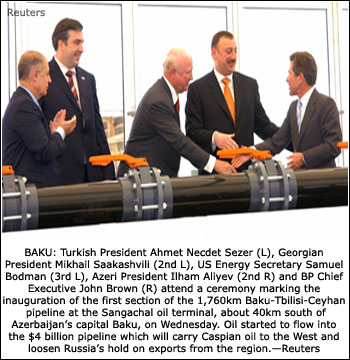 BAKU, May 25: Oil started to flow into a US-backed pipeline on Wednesday which will carry Caspian oil to the West and loosen Russia’s stranglehold on exports from the region. The pipeline, built by a multinational consortium led by British-oil giant BP, will eventually pump more than one million barrels a day from Azerbaijan along a circuitous route through Georgia to the Mediterranean port of Ceyhan, Turkey.
The venture is helping to redraw the geopolitical map of the turbulent Caucasus, reducing the region’s economic reliance on Moscow, and will also give emerging oil giant Kazakhstan an outlet to Western markets that bypasses Russia.
Oil experts say the landlocked Caspian Sea contains oil riches to rival those of the North Sea, but others say it may never fulfil its promise.
“With the start-up of this oil pipeline, the economy of Azerbaijan makes a serious step forward,” said President Ilham Aliyev at a launching ceremony for the pipeline.
Also attending the ceremony were President Mikhail Saakashvili of Georgia, Turkish President Ahmet Necdet Sezer and Kazakh President Nursultan Nazarbayev, all of whose countries stand to gain handsomely from the new pipeline.
US Energy Secretary Sam Bodman, who stood alongside the four heads of state at the ceremony, said: “The Baku-Ceyhan pipeline will play a huge role in world energy policy.”
It will take until the autumn before oil can be loaded into tankers at the Mediterranean end in Ceyhan because BP needs several months to fill up the 1,760-km pipeline.
Kazakhstan, the largest oil producer in the region after Russia, is likely to start pumping oil through the pipeline at a later date by shipping it from its Caspian port of Aktau to Baku by tankers.
WASHINGTON’S BACKING CRUCIAL: Mr Aliyev explicitly recognised Washington’s crucial role in championing the $4-billion pipeline, in the face of opposition from Moscow.
“The realization of this project would not have been possible without constant political support from the United States,” he said.
Since the Sept 11 attacks on the United States,completion of the pipeline has taken on increased importance as US concerns have deepened over dependence on Mideast oil.
The launch of the pipeline is one more step diminishing Russia’s waning influence in a region which was firmly under its thumb in the heyday of the Soviet Union.
“The implications for Russia are a further loss of influence in Azerbaijan and potentially in Georgia too,” said Julian Lee, an analyst at the Centre for Global Energy Studies in London.
Azerbaijan, which currently produces more than 350,000 barrels of oil a day plans to raise output to more than 1 million bpd by the end of the decade.
The start-up of the pipeline gives a boost to Aliyev, who is facing a tricky parliamentary election in November in a turbulent region that has seen several longstanding regimes toppled in popular revolts over the past 18 months. Georgia’s impoverished economy also stands to get a boost from the pipeline and is expected to earn some $50 million in transit fees a year.
A gas pipeline following the same route is due to open next year. “Transit fees from that pipeline will be paid to Georgia with gas. Georgia has previously been dependent on gas from Russia,” said Mr Lee.
Kazakhstan, with ambitious plans to become one of the world’s top oil producers by tripling output to more than 3 million bpd within a decade, needs more pipeline capacity to ship its fast expanding crude production.—Reuters



























