



 0
0

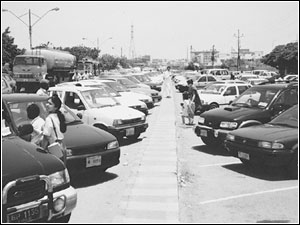 OVER the last few years, the demand for automobiles has surged with banks financing the purchases of cars. Since the capacity of the assemblers and component manufacturers has been limited, the supplies fell short of the demand. The customers do not get the immediate delivery even after full payment. Speculators have fuelled prices further. The waiting period for different cars range between four to eight months.
Any one who needs immediate delivery can buy posh cars in the open market by paying a premium of around Rs100,000. The producers have interest free working capital as customers are obliged to pay the entire amount at the time of the booking and wait for the delivery.
Since the rates of import duties is prohibitive, the import of cars are scarce and consumers are forced to buy locally-made automobiles at higher price while the quality remains suspect.
The industry has enjoyed protection since infancy. It was argued that the automobile industry has significant scale economies and the domestic demand has been low therefore it needed protection for some time. Such an argument would have warranted a decline in prices after the sharp increase in domestic demand but instead, consumers have to pay even more in share of high prices and premium for immediate delivery.
Over the last one week, it has been reported that the auto manufacturers are resisting the suggestions made by the Central Board of Revenue for reduction in the import duty. The auto prices would decline only if the supplies of automobiles increase, either through imports at reduced duty or an increase in the domestic production or both.
Reduction in import duties would put pressure on the domestic producers to improve productivity levels and improve quality. The country would be able to avoid the heavy cost that have been imposed by protection in terms of inefficiency in production and higher cost to consumers.
Duties should also be reduced on motorcycles. We may note that compared to 50 per cent import duty on cars, the duty on motor cycle imports is as high as 90 per cent. Most of the import duties on motorcycles seem to be redundant because the competition from the Chinese built motorcycles have forced the competitors to reduce the prices.
Whereas the maximum import duty on the general imports is 25 per cent, the duty on automobiles has been much higher. Like many other countries, Pakistan is not bound its tariffs on automobiles. Various arguments are put forth to keep the import duties high. Let use examine their validity.
It is argued that car is a luxury product and a reduction in import duty would be unfair. The tax structure should be progressive and the duties be reduced on products consumed by the poor rather than the rich. But does the higher import duties result in higher government revenues or they benefit only the automobile producers? Since there are hardly any imports of new cars and only a few second-hand cars are imported, the revenues through import of cars have been small.
If the tax structure has to be progressive, instead of high import duties, government may use excise duties on both the imports and domestic production of cars. This will yield more public revenues.
It may be argued that reduction in import duty would result in loss of jobs. The industry provides jobs to 110,000 persons but most of the jobs are created in the component manufacturing and the repairs and maintenance of automobiles. Assemblers provide only 10,000 jobs and it is one of the most capital intensive industries. However, the fears are ill-founded. Reduction in duties has to be such that it does not threaten the closure of the industry, it helps in just the removal of the premium on immediate delivery. Why the automobile manufacturers should object to such a reduction in the import duty? It would not involve any loss of output or jobs.
It is also argued that the investment of vendors would go waste and they would be bankrupt. It seems that the producers feel that the duties on the components must be reduced as well if the duty of ‘completely-built-units’ (CBU) is reduced. Since the cost of domestically produced components is low, the duty would continue to be just notional and assemblers should not be bothered about. One may also note that a number of assemblers produce their own components and some of them have their own vendor companies.
For production of the parts and components, Pakistan has been following a deletion policy. Whereas it has been successful in the sense that for the cars the deletion level ranges between 56 to 70 per cent and it has been 81 to 88 per cent for motorcycles, most of the deleted parts are assembled and not manufactured locally.
These deletion levels include the assembly allowances as well. If the assembly allowance is not included it will be around 50 per cent. Whether the deletion was most efficient or not is debatable, but one thing is sure that the country did not benefit greatly from the deletion because the cost of undeleted components has increased sharply. This may reflect transfer pricing going on in the automobile industry.
The deletion policies did not allow the import of the deleted parts. As per the ‘trade related investment measure’ (TRIMS) agreement deletion programmes of all the countries were to be phased out by December 31 2000. Most of the developing countries including Pakistan applied for the extension up to December 31, 2003. Pakistan applied for another extension of two years which seems to have been denied and the measures adopted in 2004-05 budget that can be the basis of tariff based deletion programme is quite welcome.
The 2004-05 budget provided for differentials in imported duties on raw materials, sub-components and intermediaries, sub-assemblies and assemblies, and components the import duty rates are 5, 10, 20 and 35 per cent.
While the import duties have been high and the domestic prices of various cars are also high, two aspects of the prices need to be noted. Firstly, the prices in general are 20 to 25 per cent higher than the world market prices of cars of similar specifications. Therefore at least a part of the 50 per cent duty is redundant. Had the duty been effective, imports of cars would have taken place and premium would have been wiped out.
As a matter of fact, prices in other developing and semi-industrialised countries are lower than those prevailing in Pakistan. For example prices are much higher here than in Thailand. Prices of motorcycles in Pakistan are quite high compared to India and China.
No doubt auto industry is a cutting edge industry and there has been transfer of technology to it. It is an industry where there have been consistent inflows of foreign private investment and there are bright prospects of a further increase in its investment levels.
While Pakistan needs investment, it should not take any action that stops such inflows. What is required is a just solution where the interests of the assemblers, component manufacturers and the consumers are protected needs to be arrived at.
The demand for passenger cars, motor bikes and other automobiles is expected to increase sharply as the per capita income rises and banks continue to finance the purchases of automobiles. Keeping that in view, assemblers and vendors would increase their productive capacity. A policy framework that provides producers with long run profitability is absolutely necessary. Such a framework should build on the strengths of the sector and must ensure efficiency and reduction in the prices.
A detailed long-term policy is necessary for optimizing growth of the industry. The policy should provide an orderly reduction in tariff rates over time on imports of assembled cars and components. Exports of parts and assembled cars should be encouraged so that the cost of production declines.






























