



 0
0

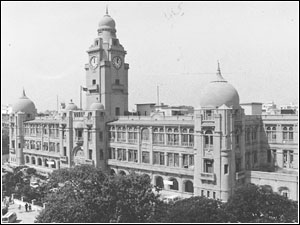 PERFORMANCE of municipal institutions in Karachi has recently come under severe criticism on several counts. Evidences show that the municipal institutions at city, town and union council level have not been able to discharge their routine functions in a satisfactory manner.
Faulty design of Clifton underpass, tragic death of eight people in an apartment fire, power break downs, uncoordinated road repair works, un-programmed replacement of water and sewerage lines along the most busy districts and an overall decline in the quality of life of the citizens are few reminders in this respect.
Malfunctioning in the domain of development, management, operation and maintenance of urban areas in general and public infrastructure in particular is a visible outcome. Countless changes in the fancy name of reforms have been instituted during the recent times – the latest one being the wholesale revamping under devolution plan.
While a detailed analysis of performance is long due as the elected local governments have completed their stipulated tenure, few issues are vital to be reviewed on an emergent basis.
An important aspect that caused a direct impact on the overall performance of municipal institutions is the flawed procedure of decision- making. At the launch of devolution plan, it was harangued by the regime that the local bodies will be free to take decisions in respect of urban development and management. The reality is otherwise.
Key infrastructure projects are undertaken by the federal government with little or no say of the City District Government Karachi (CDGK). Whether Lyari Expressway or the K-III Bulk Water Supply Project, the prerogative of decision-making at all levels has been enjoyed by federal authorities.
For the past few years, no development scheme worth the name could be processed until it was reviewed and cleared by the army authorities. These happenings caused many adverse impacts. Functionaries of the CDGK or Town Municipal Administrations (TMAs) spent more time and effort to prepare convincing arguments – not for the scheme but for the concerned bureaucrat, minister or army general.
In many instances, merits and demerits had to be down played with a skewed or incomplete logic. Since the city is without an integrated master plan, such ad hocism caused a greater havoc.
Quality of human resource, or the lack of it, is another major issue. Most of the functionaries in CDGK and TMAs lack the essential qualifications and experience to deal with their respective departments. Mass transit and public transportation in CDGK are the only two departments which are headed by qualified professionals of the same field. Due to inadequate qualification and experience, most of the municipal officers are not able to discharge even their routine duties.
The situation in the towns is even worse. For example, Karachi comprises 18 towns. Each town has to have a Town Officer – Planning, capable of planning, building and land use control, town development planning and interface with neighbouring. As per statutes, this officer must be a qualified and experienced town planer bearing a valid registration with Pakistan Council of Architects and Town Planners (PCATP). It is most disappointing to note that none of the 18 towns have a suitable officer appointed for the post.
Either the post is lying vacant or occupied by a differently qualified or unqualified incumbent. Thus it is not surprising that the various city areas are being swarmed by encroachments, haphazard construction, physical developments without planning control and thoughtless policies for urban land use changes. This state of affairs is not confined to CDGK and TMAs alone.
In Karachi Building Control Authority, the top slot is occupied by a non-technical person through lateral appointment. The state of affairs in building control is not hidden from the people. Mal-administration reached to such an extent that on one occasion, the Sindh High Court had to ask the Ombudsman to undertake a fact finding exercise to establish the scale of maladministration in KBCA.
Violation of standard practices in municipal functioning on frequent instances create numerous negative outcomes. This problem exists in several forms. In some cases, the procedure is followed only in theory while the actual situation remains unchanged. For example, the municipal authorities have undertaken many anti-encroachment drives to dislocate hawkers from busy market places. The hawkers re-group and return to there original business sites.
Scientific studies to establish the issues related to this affair are never undertaken. Building plans are submitted to KBCA and other land/building control institutions. The architects who are well-versed in developing approvable drawings present half truths in those submissions. Actually built spaces are different from the allowed provisions. The violations are either regularized after unofficial or official payments of penalties.
The issue of more than 700 buildings in various parts of Karachi South became quite controversial a few years ago. Citizens take it as a norm to bypass procedures for routine works such as obtaining a water connection, leasing a plot/house in a kuchchi abadi or seeking approval of any sort from the concerned department for starting an enterprise. There are also examples where high-value contracts are awarded without competitive bidding.
Merit in postings and appointments is often bypassed. Previously, appointments to each mid-career position above grade-16 were made through independent selection boards. In some cases, municipal officers would come from civil services. Now appointments can be made laterally without any criterion or merit. Political appointees are a routine affair in local bodies.
Some times the organizations collapse due to financial burden and incompetence of such individuals. Over 4000 employees were inducted in the Karachi Water and Sewerage Board (KWSB) during late 1990s.
This mostly drone-like work force created a severe financial drag on the cash strapped KWSB. Karachi Transport Corporation had to close down mainly due to impotence of its staff and its inflated number. Those who perform well and discharge their duties satisfactorily are seldom recognized. No wonder that high quality human resource is not attracted to join the municipal cadre of services in any form or capacity. Even consultancy assignments are mostly bagged by the routine conventional type consultants without an iota of creativity in their outputs.
Municipal functioning is also affected due to unavailability of departmental strengths. Lack of essential information is one important shortcoming. Record rooms of municipal bodies, with few exceptions, are only filled with routine case files.
Background information, baseline data previous information, project reports and relevant archival materials are seldom available. Whenever the president or prime minister order for a presentation on a project, a rumpus is caused in the concerned department. Hurriedly collected information is transferred to computer graphics with confusing figures and images.
Often the whole assignment of presentation making has to be outsourced to an outside computer operator. Storage of records, retrieval system of data and inter connected data bases are yet to be evolved in CDGK. A welcome change has been the creation of websites. However, the internal records related to revenue/land and other domains need to be digitized/computerized to increase working efficiency.
Adopted approaches for capacity-building have been found as mostly incongruent to the job needs. Some times, municipal officers are sent abroad for training in various fields. In many cases, the training is totally irrelevant to the type of issues dealt locally. Compulsion to undertake such training programme evolves from the budget heads of donor supported programmes.
It has been found that donor agencies insist on sending key officers on foreign trips for various reasons. A sizable portion of the budget is thus spent in a first world country that is part of aid giving consortium. The officer becomes extremely obliged after a comfortable sojourn abroad. In lieu of this favour, he looks after the interest of the donor agency under all odds. And the training institutes in those countries gain direct benefit.
In 1994-95, the chief minister of Sindh and his coterie were invited to Paris to discuss KWSB’s privatization. After a few days in that beautiful city, the said Chief Minister was all praise for privatization.
Few years back, a group of engineers from the defunct KMC were sent to UK for studying waste management under an Asian Development Bank project. Soon after return, these engineers were transferred to different units with no business related to waste management. Capacities thus built were lost to insensitive administrative practices.
Issues of capacity-building at all the levels of local government are vital. They must be addressed on top priority. The foremost issue is to streamline the jurisdictions of respective institutions. Flow of authority at various tiers has to be carefully addressed. To begin with, the federal and provincial governments must encourage the CDGK to undertake decision making at least in respect of execution of assignments. This move will be greatly beneficial for building up the capacity at various levels.
An institutionalized forum is needed where all the tiers of the government can be represented to discuss the coordination of development and management works. Programming of development assignments may be handled by this coordination mechanism.
Capacity of professionals and administrators must be upgraded. On job training, input from universities and local institutions and exposure to various areas in the country may be an option. Unless the capacity to deliver the stipulated assignments is developed in CDGK and TMAs, it will be difficult to counter the interference and tutelage of federal and provincial governments.






























