



 0
0

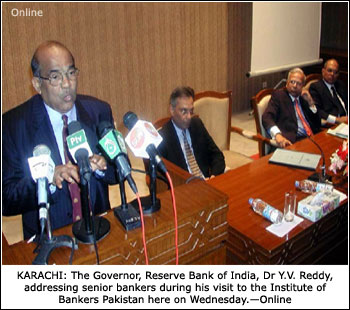 KARACHI, May 18: The Governor, Reserve Bank of India, Y.V. Reddy, said here on Wednesday that the RBI had decided to set up an independent banking codes and standards board of India. He said the purpose of setting up this board modelled after the mechanism in the UK was to ensure that “a comprehensive code of conduct for fair treatment of customers are evolved and adhered to”.
Mr Reddy, who had flown to Pakistan to attend the annual meeting of the Asian Clearing Union, was invited by State Bank Governor Dr Ishrat Husain to address a galaxy of senior bankers in Karachi. The ACU of which both Pakistan and India are members met in Lahore on April 16-17.
Delivering a lecture on “reforms in the Indian banking industry” at the Institute of Bankers Pakistan, Dr Reddy spoke about advancement in prudent banking and increase in bank profits as a result of the reforms. He said that the percentage of gross non-performing assets (NPAs) to gross advances for the Indian banking system reduced from 14.4 per cent in 1998 to 7.2 per cent in 2004. The return on assets (RoA) of the banks rose from 0.4pc in the year 1991-92 to 1.2pc in 2003-04.
“Considering that globally the RoA has been in the range of 0.9 to 1.5 per cent for 2004, Indian banks are well placed,” he boasted. The banking sector reforms also emphasized the need to review the manpower resources and rationalize the requirements by drawing a realistic plan so as to decrease the operating cost and improve the profitability. During the last five years, the business per employee for public sector banks more than doubled to around Rs25 million in 2004.
“We lay considerable emphasis on appropriate mix between elements of continuity and change in the process of reform, but the dynamic elements in the mix are determined by the context,” said the Indian central bank chief. “While there is usually a consensus on the broad direction, relative emphasis on various elements of the process of reform keeps changing, depending on the evolving circumstances.”
Dr Reddy said the RBI annual policy statement for the current year reiterated the concern for common person, while enunciating a medium-term framework for development of money, forex and government securities markets; for enhancing credit flow to agriculture and small industry; for action points in technology and payments systems; for institutional reform in cooperative banking, non-banking financial companies and regional rural banks; and, for ensuring availability of quality services to all sections of the population.
The most distinguishing feature of the policy statement relates to the availability of banking services to the common person, especially depositors. The policy draws attention to the divergence in treatment of depositors compared to borrowers. It says: “While policies relating to credit allocation, credit pricing and credit restructuring should continue to receive attention, it is inappropriate to ignore the mandate relating to depositors’ interests.
Further, in our country, the socio-economic profile for a typical depositor who seeks safe avenues for his savings deserves special attention relative to other stakeholders in the banks.”
The quality of services rendered has also invited attention in the current policy, said Dr Reddy and made a quote from the policy statement: “Liberalization and enhanced competition accord immense benefits, but experience has shown that consumers’ interests are not necessarily accorded full protection and their grievances are not properly attended to.
Several representations are being received in regard to recent trends of levying unreasonably high service/user charges and enhancement of user charges without proper and prior intimation. Taking account of all these considerations, it has been decided by the RBI to set up an independent banking codes and standards board of India.”






























