



 0
0

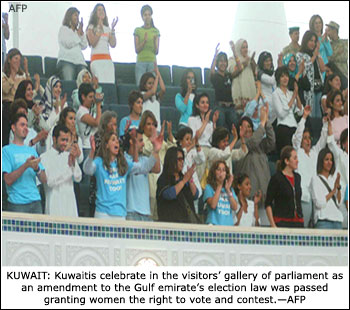 KUWAIT, May 16: Kuwait’s parliament passed a law on Monday granting women the right to vote and run in elections for the first time, after pressure from the pro-Western Arab state’s government. “We made it. This is history,” prominent activist Roula al Dashti told reporters. “Our target is the parliamentary polls in 2007. I’m starting my campaign from today.”
Outside parliament, young women and men danced and cheered, while passing drivers hooted horns in support. Parliament speaker Jassim al Khorafi said the legislation had been passed by a majority of the all-men parliament. There were 35 in favour, 23 against and one abstention on a vote that had met fierce resistance from Islamists, conservative tribal MPs and others.
The United States has been pressing its allies in the Middle East to bring in political reform, saying a lack of freedom and democracy had fostered militancy. The Kuwaiti government wanted the bill passed before a likely trip by the prime minister to Washington next month.
A similar decree for women’s political rights issued by Amir Sheikh Jaber al Ahmad al Sabah was narrowly defeated in 1999 by Islamist and conservative lawmakers, who wield enormous influence in the assembly.
Prime Minister Sheikh Sabah al Ahmad al Sabah said the government now had the right to appoint women to the cabinet. “This is a celebration for democracy even though it is 45 years late,” said Jassim al Gitami, a former MP and head of the Kuwaiti Human Rights Association.
Women activists said it was too late for women to vote and run for municipal elections set for June 2, after parliament earlier this month delayed a vote on the issue. Islamists, in agreeing to the law on Monday, stipulated that there must be separate polling stations for men and women.
Islamist MP Faisal al Muslim said he was one of those who voted against the law. “This is a very conservative society. An MP position in parliament would make women responsible for the masses and that is anti-Islamic,” he said.
Kuwaiti women, traditionally more liberal and educated than their Arab counterparts but long lagging in political rights, had been pressing for years for a greater say.—Reuters




























