



 0
0

 ANDIJAN (Uzbekistan), May 14: A military crackdown in the eastern Uzbek city of Andijan left several dozen dead as hardline President Islam Karimov blamed Islamic extremists on Saturday for the violence and denied responsibility for the bloodshed. At least 40 to 50 bodies littered the streets, and troops roamed the city in armoured vehicles, backed by helicopters, in search of gunmen, while witnesses spoke of up to 300 dead and accused soldiers of firing indiscriminately.
But in Tashkent, Mr Karimov said only about 30 people had been killed. “No one gave government forces the order to fire,” the president said in his first public comments since the violence.
Lutfula Shamsutdinov, a member of the Apelyatsiya human rights group in Andijan, said he had witnessed soldiers “loading 300 bodies into three trucks and a bus in the street opposite the cinema.”
“I have seen 200 bodies. It’s a real war,” resident Abdul-Vakhid Gasurov said, while another resident, who only gave his first name, Bakhodir, claimed to have seen more than 300 bodies near the mayor’s office.
However no independent verification was possible with hospitals releasing no information. Authorities in the Central Asian state clamped down on the media with international broadcasters blocked, a number of journalists arrested and others advised to leave Andijan.
On the city’s main square some 200 people gathered to pray for the dozens killed in two days of unrest and others began to bury 14 of the dead.
BORDER CLOSED: Uzbekistan on Saturday closed its border with Tajikistan following the closure of the border a day earlier with Kyrgyzstan.
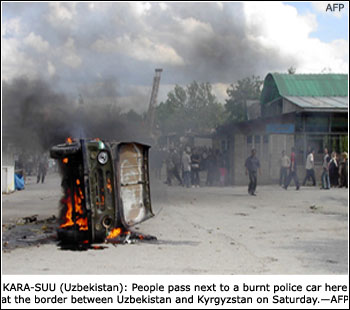
In a border village with Kyrgyzstan, fleeing refugees trying to cross the frontier set a police vehicle on fire and pushed another into the river dividing the town of Kara-Suu, before pushing into Kyrgyz terriotory.
Mr Karimov described the turmoil as part of a plot by the outlawed Hizb ut-Tahrir Islamic group to seize power in the ex-Soviet republic and elsewhere in Central Asia.—AFP




























