0
0

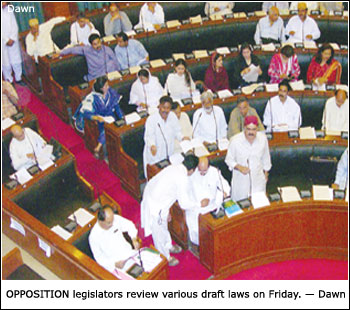 KARACHI, May 13: The Sindh Assembly on Friday, after deferring other items on the order of the day, set out to carry on legislative business and succeeded in getting through with three bills unanimously, besides laying the Sindh Water Management (Amendment) Ordinance 2005 and introducing three government bills before the Assembly.
Speaker Syed Muzaffar Hussain Shah announced that the governor of Sindh had given his assent to the two bills, namely the Sindh Information Technology Board (Amendment) Bill-2004 and the Sindh Special Assistants (appointment, powers, functions, salaries, allowances and privileges) Bill-2003.
The three bills passed into law unanimously were piloted by Law Minister Iftikhar Ahmad Chaudhry. The Bill No.7 of 2004 amends the Sindh Civil Servants Act-1973 under which disabled persons would now be eligible for a job in grade-1 to 22 as per their quota of two per cent. Before the amendment, they were eligible for a job in grade-1 to 15.
The Bill No. 1 of 2005 amends the Sindh Boards of Intermediate and Secondary Education Ordinance-1972 for the establishment of the Mirpurkhas Board of Intermediate and Secondary Education and is aimed at providing the required facilities to the concerned students and reducing workload on the Hyderabad board.
Through the Bill No. 5 of 2004, amendments have been made to certain laws relating to private universities and educational institutions in the province and ensuring uniformity of laws in all private educational institutions. The mover of the amendment to the previous amendment was Ms Shazia Marri. Her suggestion was endorsed by Syed Qaim Ali Shah and Nisar Ahmad Khuhro. The law minister, through a motion, incorporated her suggestion in the bill which was adopted by the house unanimously.
Through the fresh amendment, discrimination between Shaheed Zulfikar Ali Bhutto Institute of Science and Technology and 17 other universities, including Ziauddin Medical University, was undone. The amended law allows the government to appoint an outsider as chairperson.
One of the two other bills on the day’s agenda related to promotion and protection of the interests of consumers and the matters incidental thereto. The other one pertained to the establishment of the Indus Institute of Higher Education in Karachi. The bills were deferred for consideration till Monday so that the objections raised by opposition benches could be removed and the bills could be adopted unanimously.
The three government bills which were introduced in the Friday session were: Bill No 12 of 2004 seeking amendment to the Sindh Animals Slaughter Control Act-1963; Bill No. 2 of 2005 calling for amending the Removal From Service (special powers), Sindh, Ordinance-2000; and Bill No 4 of 2005 envisaging the establishment of the Pakistan Institute of Management.
Earlier, while the house was deliberating upon the bill on the establishment of the Mirpurkhas board, leader of the opposition Nisar Khuhro said that mere setting up education boards was not enough, and stressed the need for improving quality and standard of education. “We feel ashamed when foreign universities refuse to recognize our degrees,” he regretted.
Minister for Mines Irfanullah Khan Marwat said that the present decline in education had started when a person being not even middle pass had been appointed education minister in Sindh.
Supporting his contention, Home Minister Rauf Siddiqui added that a non-matric had also been appointed as governor.
Mr Khuhro replied that the minister and governor in question appeared far better than some of the incumbent graduate ministers.
Saifullah Dharejo of the PPP questioned the utility of educational institutions without making qualified people available to them. In this context, he made mention of the Ghulam Mohammad Mahar Medical College, Ghotki, where professors were not available.
Education Minister Dr Hamida Khuhro said that the government was taking measures to improve standard of education.