0
0

 CONTINUING the previous year’s practice, the Karachi City Nazim presented the draft budget before the City Council on April 30, 2005. The Rs42.9 billion budget earmarks more than Rs24 billion for developmental works and Rs18 billion for current expenditures.
A sum of Rs6 billion has been allocated for Tameer-e-Karachi Programme with federal, provincial and the city governments making equal contribution. The budget was received with mixed response by different quarters. Some critics have questioned the disproportionately high volume of the budget. They are of the view that the Rs42.9 billion figure will be very ambitious to achieve. Political opponents regard this move as a means to gain political mileage for current Nazim and his associates.
Denying all such allegations, the Nazim has shown his resolve to help acquire the allocated funds and achieve corresponding targets. The city budget is perceived very differently from its actual status. Instead of treating it as a broad-based compilation of revenue and expenditure descriptions, it is often looked upon as a vision document containing the wish-list of the regime.
Sometimes ambitious development projects are included. Such attempts render the entire process doubtful. There are many important issues that need to be reviewed in reference to the budget-making approach in the context of the overall urban development perspective.
Preparation of the City Budget is an important technical exercise that requires exhaustive ground work by multitude of departments, technical and financial experts and even external reviewers. Merit criteria of a sound city budget comprises relative accuracy in computation of financial values; inclusion of all the existing and potential heads of revenue and expenditure; appropriate translation of policy framework laid down by the regime into workable budgetary formats; correctness of budget totals and figures; cautious review of the probabilities of capital receipts; scrutiny of taxes for recoveries and solid justification of the expenditures for developmental and non-developmental heads.
Whereas each of these factors require a massive factual spadework, the indications reveal a different scenario. City Nazim has expressed his fear about the possible back tracking of the provincial government from its contribution to the Tameer-e-Karachi Programme. This may become a blow to vital development plan that focuses on the repair and maintenance of the ailing infrastructure of the city. Resolution of policy disputes, if any, must have been done before finalizing this vital component. Similarly inter-governmental coordination becomes all the more important for the preliminary accuracy of financial commitments announced in such exercises.
Another ambitious figure is the probable receipts of over Rs2.9 billion from the Water and Sanitation Department (Karachi Water and Sewerage Board). Past trends show a dismal record of revenue recovery. The WSD-CDGK has over 1.1 million registered consumers. However less than 10 per cent of this number are paying clients that put an enormous pressure for facilitating the routine operations of water and sanitation services.
Before incorporation into the CDGK some two years ago, the total annual budget used to be less than Rs3 billion. Now it has risen to Rs7 billion. What magic has made this figure swell to almost double the value is yet to be spelled out!
The City Nazim focused on the size of the budget. From Rs20 billion in 2002-03, it has risen to over Rs42 billion. A common assumption would entail a progressive rise in the revenue base of the city. However this aspect is largely unclear. It will require a detailed analysis of the various taxation and revenue heads to understand the trends of rise or otherwise.
The budget description is silent about the revenue generation performance of the CDGK. Besides a sizable chunk of developmental funds are outlined on the basis of commitments from other tiers of the government. This is a grey area since the actual release of funds will be dependent upon various considerations.
Political relationship between CDGK and the upper tiers, availability of funds with the federal or provincial governments, developmental preparedness to absorb the committed funds and fulfilment of procedural pre-requisites for the release of funds are few important factors that influence inter-governmental transfer of funds. Past trends have shown anomalies on various counts. Therefore it will be in the interest of the CDGK not to attach too many hopes in this reference.
An interesting feature of budget announcement is the citation of “all good” factors only. The budget is never unveiled with an objectively formulated performance review. At best it is a bundle of promises studded with figures and assumptions. This measure renders the budget largely unscientific. A professionally developed performance evaluation document will enable the CDGK management critically review the priorities before finalizing the allocation heads.
It will also be useful for the lower tiers of the local government to understand the city level situation thereby incorporating it into their respective budget overlays. It may be remembered that objective review of performance that leads to a self-analysis is always useful to understand the strengths and weaknesses of a system.
When the devolution plan was put in place by the chief executive of the country in 2000-01, the stated aim was to devolve the power and authority to the lowest tier of governance. Experiences in urban governance have shown that the technical and managerial capacity of local institutions cannot be built without financial autonomy. Study of Karachi’s ongoing development scene depicts a heavy involvement of federal government.
This appears at two scales; direct contribution to the urban exchequer and federally-initiated and managed projects. On both the counts, the capacity building of CDGK is hampered. In terms of revenues, it is obvious that CDGK has to operate within the narrow working space allotted by the federal government.
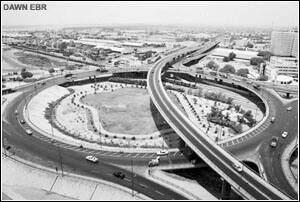
Despite being the representative government of the largest and most resource-rich city of the country, the CDGK cannot tap all the financial avenues which may generate funds for the much needed urban infrastructure management. Existence of federal projects such as Lyari Expressway simply express the inbuilt dilemma in the limited application of the devolution concept.
The budget has brought some good news for the cash strapped union councils. A sum of Rs1.1 billion is kept for the various developmental works in the 178 city union councils. This lowest tier of governance has faced numerous problems in carrying out its routine functions. Scarcity of funds, lack of access to qualified human resource and absence of basic management capacity have been the continuing ailments facing the union councils.
As the elected representative were not even given honoraria against the discharge of routine works, they suffered from lack of motivation. The situation at the level of towns has been found to be similar. Lyari Town is an example where shortage of funds has deeply affected the on-going works. One can only hope that the committed funds will eventually be released as per guidelines of disbursement.
One aspect which was down played in the budget speech was the Karachi Development Plan for the post- 2000 period. It goes without saying that no modern city can satisfactorily function in the absence of a master plan. To develop a socially appropriate and technically sound planning process, a competent planning agency is the first pre-requisite. Some mention of the plan is elusively detected in the Tameer-e-Karachi Programme. But apparently it is not enough.
For the sustainable progress and development of Karachi, the planning process must be prioritised. Loss of previous land resources is only one of the countless hazards that have emanated due to the absence of legally valid master plan. It may be put on record that while some token effort has been made to revive the planning process in 2004, it has seemingly reduced the otherwise continuous task to a one-time packaged exercise.
Time has come to address the pressing important urban development and management issues on priority. Creation of a potent planning agency within the framework of CDGK is a foremost need. To create performance monitoring mechanisms, the CDGK must institute the preparation and circulation of quarterly reports. This approach shall be beneficial for its stock tacking as well as identifying any short coming in the performance. And finally the placement of city districts in the governance structure must be revisited by the federal and provincial legislature.
With the technical assistance of National Reconstruction Bureau, fresh approaches must be developed to enhance the autonomy of the CDGK so that it manage routine urban development and management without interference from the upper tiers.