



 0
0

Urgent needs of Civil Hospital
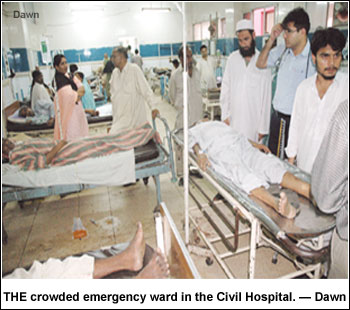 There is commotion at the casualty ward of the Civil Hospital, Karachi. Two accident victims have just arrived and with them a team of concerned family members. Amid stretchers being carried, doctors rushing to and fro from bed to bed, and over and above the wails of the women, there appears no sanity anywhere.
With more than 800 patients a day coming in, which include critical accident cases, firearm injuries, acute strokes, acute shock and those going through acute myocardial infarction, it is assumed that the CHK emergency centre is the life line for many. But if one were to visit the existing casualty ward, or rather the four ‘rooms’ [hovels, more like], it would baffle the most imaginative mind as to how patients could be treated in a place which functions out of four dilapidated rooms that are a thoroughfare for all even while critical procedures are taking place.
Servicing close to 0.3 million patients a year, CHK’s existing emergency structure defies logic. The disorderly arrangement, ill-equipped with machines, is not where one would expect medical services are being given to the 800 or so converging at its doors in critical conditions. But even then, documented figures of 2004 record that the number of patients that received emergency treatment at the CHK was 285,000 while the emergency obstetric and operating areas included 15,000 patients.
It is no small feat that despite many shortcomings, medical aid is still being provided at the CHK casualty ward, to a large number of people who stream in from not only all over Sindh, but also from Balochistan and Punjab. The influx into Karachi’s work force from these areas [Punjab and Balochistan] makes it feasible for their relatives to seek medical help in CHK and as such the hospital is now more a national facility although it was originally designed just for Karachi’s populace. Housing 1700 beds and 66 departments, the Civil Hospital is situated in the heart of the city. It is attached to the Dow Medical College and is considered to be the flagship of the Sindh Health Services. But despite an increase in the number of patients over the last 10 years with both acute medical problems and those who have sustained injuries – from 150,000 to 300,000 – no increase in staff or facilities to deal with medical emergencies and trauma has taken place.
Now, for the first time, plans for a new building have been outlined due to the perseverance of the current Medical Superintendent [MS], Dr Saeed Quereshy, who, after wading through bureaucratic red tapism, finally hopes to launch the project for a comprehensive, purpose-built accident and emergency centre, with updated medical facilities, as early as possible. Dr Qureshy elaborates, “Modern strategies of healthcare delivery require the provision of proper and custom-designed accident and emergency facilities. It is also necessary to have a trauma centre available to the population in a tertiary care facility where all surgical sub-specialties are available. And looking into these areas, a new building design has been approved where updated medical facilities will be provided specially to the lower strata.” The proposed centre which will be able to treat critically ill patients on a fast track basis, saving more lives than it does at present, is going to be a 10-story construction with the primary facility of housing all emergency equipment, services and specialized care units under one roof. At present the system is disorderly to say the least. Because of lack of proper planning, most facilities were constructed on an ad-hoc basis and as such there is no proper connection or communication between the casualty and the main hospital building, and stretchers are actually brought on to the road before the patients are transported into the hospital or when they need to be taken for specialized treatment, tests etc. Built over sewage lines, the filth that ensues should rather not be defined, as open sewage lines make it almost impossible for hygiene to be maintained.
Dr Qureshy adds, “the existing space available is both inadequate and improperly designed for current needs, particularly regarding the management of trauma patients. The medical and paediatric emergency facilities are in a pitiful state at present and desperately need to be brought in conformance with internationally acceptable standards of healthcare. The inpatient facilities dealing with general and specialized surgical care are also abysmal and require modernization.”
With the idea of providing optimum accident and emergency treatment for the patients coming in from interior Sindh, Balochistan and Punjab which are over and above the 14 million residents of Karachi, the new emergency ward will be providing, specialized treatment in this complex eventually to 450,000 patients. With terrorism and traffic accidents on the rise, the influx of patients involved in such incidents has increased tremendously over the past decade already and the new ward proposes to deal efficiently with accident victims, where major trauma patients will be separated from minor trauma patients as the new centre would be having the provision to treat about 110,000 trauma patients per year.
A vital aspect that is lacking at CHK casualty ward presently is the medical ICU which should ideally have facilities to deal with respiratory failure and acute heart conditions. The patients that come in with these symptoms, require immediate help and with no such machinery at hand, the medical staff becomes helpless and as such mortality rate is high. A medical intensive care unit facility for 2500 patients per year is also included in the new casualty ward plan, which is an urgent requirement.
The Civil Hospital, Karachi has been a victim of politics and thug dealings for very long. Political factions have reigned over its management and have run rough-shod over staff during ethnic conflicts. Security is a big issue even during emergency treatment as many incidents have taken place where relatives of patients have manhandled and fired on medical staff if critical patients could not be saved. This issue alone requires immediate measures where medical service areas are made separate from the waiting area so that doctors are not threatened by gun-toting relatives.
At present most of the departments at the hospital are running on donations by ex-students and doctors who have channeled resources from corporates, expatriate class fellows, pharmaceuticals and individual Samaritans who provide medicines and who have installed state-of-the-art equipment.
With patients streaming in from all over Pakistan, it is only fair that the federal government should forward funds for the running of the Civil hospital at Karachi as it is the only hospital which provides specialized round-the-clock facilities totally free of charge.
In fact, private hospitals don’t even accept patients without substantial down payments even though the law states that medical assistance is not to be denied to any victim (despite the fact that the largest private hospital foundation was allotted free land for its huge complex). It is hoped that CHK’s new building plan estimated to be completed in two years sees fruition, since the well being of Karachi’s poor citizens is once again the delicate issue here and provincial and federal politics should not jeopardize this project designed to give free succour to the needy.
French referendum keeps EU on tenterhooks
BRUSSELS is rife with scare-stories and nightmare scenarios of seriously bad times ahead if French citizens vote against the new European Union constitution in a public referendum set for May 29.
Officials warn that a French ‘no’ will trigger a continent-wide crisis by weakening the 25-nation bloc, bringing plans for further EU enlargement to a halt and putting an end to EU efforts to play a stronger global role. France’s rejection of the EU constitution will mean the “political breakdown” of the EU, French Foreign Minister Michel Barnier warned recently.
Recent opinion polls showing a swing in public support for the constitution have eased some EU concerns about the future. A French vote in favour of the new EU treaty will certainly lift some of the current gloom in European capitals. But it does not mean that European leaders can sit back and relax for the next few years.
Public concerns about the future direction of the EU, the state of the bloc’s economy and plans for further expansion - issues currently dominating the French debate on the constitution - will not disappear overnight.
Europeans - even in countries with a tradition for being pro-EU - no longer automatically support EU policies. And European leaders who have long driven the EU as an elitist project, with little regard for popular sentiment, will finally have to respond to the very real fears of their citizens.
Some of these worries have more to do with perception than reality. French citizens - and increasingly their German neighbours who also go to the polls in regional elections in North Rhine-Westphalia on May 22 - are convinced that EU policymakers like European Commission President Jose Manuel Barroso are imposing an “ultra-liberal” agenda which puts business and free markets ahead of the continent’s tradition for protecting the welfare state.
French President Jacques Chirac has reportedly banned Barroso from appearing on French television, fearing that his intervention in the pre-referendum debate could strengthen the hand of the “no” camp.
Fretting over globalization is not a new phenomenon in France. But the entry on May 1 last year of 10 new member states - eight of which are former communist nations which have espoused free markets with enthusiasm - has strengthened such fears.
In fact, many in western Europe now view EU enlargement with more concern than they did a year ago. French and German voters are convinced that the low-cost eastern European nations are stealing their jobs, investment and tax revenues and undermining their welfare states.
Demands to stop the so-called “delocalization” of EU companies to the east and to prevent “social dumping” by eastern workers are creating strains in a Union where all countries, rich or poor, are supposed to live in harmony as equals.
With unemployment rates at their highest level since World War II, calls for higher barriers to keep out low-paid workers from the east are especially strident in Germany. Fear of eastern workers is also the issue in France, where the unemployment rate is 10.1 per cent and more than one in five workers under 25 are out of work.
And it is not just past EU expansion that is causing public alarm. A French rejection of the new EU constitution will almost certainly put plans for further enlargement of the bloc to include Bulgaria, Romania, Croatia and Turkey on ice for several years.
European Union policymakers appear are at a loss, uncertain about how best to deal with their citizens’ fears. French politicians warn that a “no” vote will reduce France’s influence in the EU and in the wider world. Others caution that EU decision-making and its global rise will come to a halt.
Few, however, have pointed to the real benefits of the EU, namely that the western part of the continent has lived in peace for over five decades, the single currency is a success, old state-dominated telecommunication and transport monopolies are a thing of the past and that younger generations of Europeans can travel and live in a frontier-free Union.
Ironically while the EU is a model and an inspiration for countries seeking to reinforce regional ties - and increasingly recognized as a global player by its key partners - many Europeans continue to view the Union with unease and suspicion.
EU policymakers insist that Europeans must stop fretting and become more confident and upbeat about the future. But surely that depends on how quickly Europe’s leaders can stop scaremongering and focus instead on becoming good and effective EU salesmen.



























