0
0

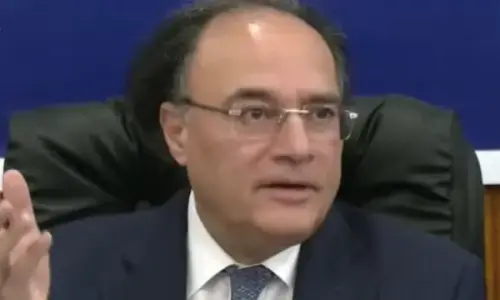
ISLAMABAD, April 2: A special task force headed by a retired judge of the Supreme Court will investigate the sudden crash of the KSE-100 index by more than 25 per cent since March 16, Securities and Exchange Commission of Pakistan (SECP) Chairman Dr Tariq Hassan informed the Public Accounts Committee (PAC) at the parliament house here on Saturday. The task force will identify the major players who benefited billions from the manipulative practices in which small investors lost heavily.
“The task force would determine who received how much,” said the SECP chairman while briefing the PAC about the “crisis in the stock exchange and the measures taken by the authorities to control it”. The SECP chief also apprised the committee about the causes of sudden plunge in the KSE Index with a ripple effect on stock markets in Lahore and Islamabad.
Mr Hassan said the task force, to be headed by Justice Saleem Akhtar, would determine the factors that led to the crash, identify the responsible persons and institutions and take strict action against those found involved in the manipulative practices. He said the SECP would further strengthen the risk management measures.
He said the stock exchanges were embarking on a process of demutualization to represent the interest of all the stakeholders. He said the carryover transaction (COT/badla) would be phased out completely by June 3 this year, and it would be replaced by margin financing.
Later, an SECP official gave a presentation to the PAC in which the reasons behind the market decline were blamed on deliberate manipulations which needed to be investigated.
“It is also possible that the market participants deliberately sold shares in the market in order to create a bearish sentiment and put pressure on the SECP with regard to its reform agenda covering phase-out of COT (and) abolishment of group account in CDC,” said the commission.
In what would form some of the terms of reference for inquiry by the task force, the SECP said the excessive buying positions by several brokers in the futures market, who were not able to get an exit opportunity due to the continuous decline in the market, needed to be investigated.
Another point of investigation would be about the sellers in the March futures contract who were carrying hedged position from ready market and then decided not to square up their positions. Withdrawal of funds by the financiers and how the downward circuit-breakers blocked the exit opportunity from the market were other points which needed an investigation.
About trading activities in the futures market, the SECP apprised the committee that futures market was a relatively new concept in the country which remained low over the last two years. However, trading in the market started picking up since January 2005.
“In March 2005, heavy volumes were witnessed over the futures counter. It came to our knowledge that some major operators, banks, DFIs and NBFCs, have purchased shares in the ready market and subsequently sold them in the futures market,” said SECP.
The SECP said majority of the sellers in the futures market “were big operators whereas the buyers were small brokerage houses. The bearishness in the market reduced the liquidity and as a result the buying institutions decided not to square their sale positions to settle.”
An analysis of the downfall in the market presented before the PAC revealed that downfall in the index was due to substantial decline in share prices of OGDC, PTC, PSO, POL, NBP and PPL. The PAC was told that OGDC alone pushed the index down by 44 per cent, PTC by 15 per cent, PSO by three per cent, POL by two per cent and NBP by four per cent.