0
0

Public sector involvement in public transport
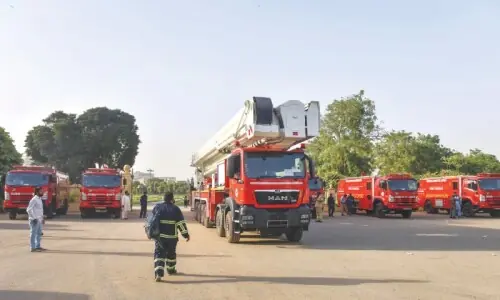
The private bus company, whose fleet of white buses bore the only semblance of a modern transport system in the twin cities, announced suspension of its operations last week, after four and a half years of acrimonious controversy over its monopoly run on five designated routes, a controversy which the Supreme Court had ruled in October 2004, apparently against the company.
So it is back to the drawing boards, since it is apparently obvious that the franchise bus system is not the solution to the modern transport needs of the twin cities.
A day after Varan Tours officially announced it was ceasing operations, the district government claimed that a new transport system would be introduced soon in which commuters, especially the old and the handicapped, would be provided "all sorts of comfort".
Subsequent press reports however indicate that the relevant authorities, district and provincial, are still in quite a knot about the kind of public transport system that is needed to replace Varan Tours.
Meanwhile, tens of thousands of commuters in the twin cities are having to make do with the hundreds of individually operated vans, wagons and coasters, some of which have been put back on the routes which the 150 Varan buses had previously mono polized under the franchise agreement with the provincial government.
Hundreds of smaller vehicles, as opposed to 150 big buses, naturally means not only greater traffic congestion on the roads but also more pollution in the twin cities.
In fact, one of the reasons cited for Varan's closure is the fact that it was not able to put 500 buses on the roads, as was apparently required by it to do so. This implies that the commuter capacity in the twin cities is equal to at least 500 big buses.
One can imagine just how many more smaller vehicles the city administration will need to put on the roads in order to make equivalent the capacity of 500 big buses, and how much more traffic congestion and pollution this will generate.
Apart from the capacity problem, the large number of individually operated small vehicles constitute a fragmented transport service which can hardly be a modern solution to the transport needs of growing metropolitans like Rawalpindi and Islamabad.
Ten years ago in 1995, a transportation study of the greater Islamabad-Rawalpindi area carried out by the ministry of communications, the National Transport Research Centre and a foreign consultant company had already concluded that the system of a large number of individually operated small vehicles did not provide for a well-coordinated and efficient transport system that could cater to the overall needs of an increasingly growing number of commuters.
The 1995 study discussed two optional future public transport systems for the twin cities, viz., a bus only system or a mixed light rail/bus system. Ten years down the road, neither system is in place.
Another 10 years on and the traffic problems in the twin cities can be expected to accelerate out of control if there is no political determination to evolve clear cut policies on transportation planning for the twin cities.
Apart from the lack of political determination to deal with a problem that apparently only concerns the lower class (the public transport system in the twin cities, as in other cities in the country, has been described as a "down-market system"), the failure to establish a reliable and relatively efficient public transport system can be attributed to two other major reasons.
One is the stiff resistance being put up by the thousands of small vehicle owners and other "stakeholders", to any revolutionary change or reform in the public transport system. Second is the reluctance of the public sector to become more involved financially in the provision of public transport.
As is evident from the experience of many cities abroad which have an efficient and reliable mass public transportation system, the government does not only have responsibility for overall planning and supervision of public transport, the public sector must also become more actively involved financially in the provision of public transport.
In the twin cities, however, the public transport system is totally dominated by the private sector. Public transport does not constitute a financial burden at all for the city administrations, since non-subsidized fare revenues pay for the operations run by the private sector. But it is generally accepted elsewhere abroad, and the Varan experience has shown too, that the private sector alone is unable to provide a modern, efficient and reliable public transport system without increasing the fares beyond the reach of the common man.
This is precisely the logic behind the concept of "franchise" agreements. The public sector does not want to provide subsidies to help keep public transport fares low, yet it wants the private sector to provide a cheap but yet efficient and reliable transport system.
The compromise result is the franchise agreement between the provincial government and the big bus companies, giving the latter monopoly rights on certain routes to enable them to make a worthwhile minimum rate of return.
So long as the public sector refuses to be financially involved in the provision of public transport, a more reliable and efficient yet cheap public transportation system is unlikely to emerge for the growing number of commuters in the twin cities.
Without such a new public transportation system which can serve the "down-market" as well as the "middle-market" commuters, the congestion on the roads and car parking spaces in the twin cities can only be expected to worsen with time.
Pakistan: an Islamist challenge?
The US media and quite a few of their intelligence experts almost untiringly keep repeating their prognostications regarding 'Islamist' zealotry in Pakistan as a challenge to President Pervez Musharraf's 'strategy' of 'enlightened moderation'.
The latest to join the ranks of the Cassandras happens to be the director of the US Defence Intelligence Agency, Vice-Admiral Lowell Jacoby. The admiral told the Senate Intelligence Committee recently that the 'extremist Islamist' politicians would gain greater influence in Pakistan.
The admiral was of the view that the 'majority of the population' in Pakistan held a 'favourable' view of Osama bin Laden. Interesting. Osama bin Laden, who?
Not many in Punjab or the interior of Sindh would have even heard of Osama not to speak of the threat he is supposed to pose to global peace. Pakistan's problem province Balochistan has trouble enough.
This is overwhelmingly political and economic without any religious overtones. None of the Baloch sardars invoke Islam while spitting fire against the government's mega projects like the Gwadar port and the coastal highway.
Trouble in and around the Sui gasfields and elsewhere and the periodic flare-ups between the Bugti, Mengal and Marri sardars remain a part of the endemic centre-province tussle.
It does become a matter of national shame and gross violation of human rights when it comes to the rape of a lady doctor on duty in a Sui hospital and the official prevarication in dealing with it.
As for the NWFP, the Pathan, despite his popular image as a fanatical jihadi fighter, in the tradition of the Mehdi of Sudan, remains firmly wedded to Pakhtunwali, his traditional code of honour and life.
In the matter of local laws and customs, he would rather adhere to Pakhtunwali than to the canon law. Women are disinherited under the Pakhtunwali contrary to the Sharia, which allows them one-fourth of the family property.
Pakhtunwali, in spirit, underscores the basically secular character and customs of the Pathans. Its three main pillars are, badal (revenge), nanawatae (sanctuary) and melmasti (festivity).
In fact, their jihadi spirit in essence is germane to their traditional code of chivalry and tribal hubris. They must have a duel with a friend or foe on a matter of honour when wise counsels fail.
As for Al Qaeda and Taliban, the origins and emergence of both owe to external factors -- essentially mercenary and foreign-inspired -- than Islamic. But for the US-aided and armed proxy war against the Soviet Union (1979-1989), Al Qaeda and Taliban would have been either totally non-existent or a minimal force hardly to be reckoned with.
As for the 'fundamentalist' threat to Pakistan, it has historically drawn its strength from patronage by a politically weak government of the day rather than from the people at large. The mullahs suffered the military regimes of both Ayub Khan and Yahya Khan.
Hardly any religion-based party, whether Barelavi or Deobandi, is known to have raised a finger against Yahya's plutocracy or Ayub's undisguised secularism, at least until his use of the Kalima in his address to the nation on Sept 6, 1965, the day India invaded Pakistan. The Jamaat did not hesitate to certify the Islamic contents of Yahya Khan's draft constitution framed by Justice A.R. Cornelius.
The 'Islamists' since Zia's 11-year theocentric rule have become a part of Pakistan's socio-political landscape. However, the MMA's great compromise in accepting the Seventeenth Amendment underscored their ideological flexibility to meet their political ends.
The Musharraf regime may not have turned the corner in Pakistan's transition from a theocentric to a politico-economic order based on his 'strategy' of enlightened moderation.
There should be little fear or concern, however, for Pakistan ever going the Taliban way. Pakistanis as a whole are good Muslims backed by a long record of an essentially secular political order unlike Afghanistan.
After Musharraf who sounds more like a rhetorical than a rational query. The American admiral would still maintain that Musharraf "remains at high risk, although no known attempts on his life have occurred since December 2003" - a typical example of a fixed idea or perception attaining a kind of pathology, an obsession not easy to shed.
In Pakistan, an Islamic republic, the 'Islamist' element must stay as a political force. However, to conjure up the prospect of its ever becoming a decisive, defining force in the affairs of the state would be paranoid, plain and simple.
The writer is a retired brigadier of the Pakistan Army.