0
0

Economic cooperation with Iran
It cannot be called a breakthrough, but Wednesday's agreement between Pakistan and Iran on the gas pipeline could turn out to be seminal. The agreement is bilateral, but the two countries have decided in principle that the gas pipeline from Iran will be extended to India.
Talks between the three countries have been scheduled for March 19 in Islamabad, and let us hope a tripartite agreement will be signed. The delay in the pipeline project stems basically from India's insistence on a guarantee from Pakistan of uninterrupted supply.
Given the current normalization process, one hopes India will shed its inhibitions on this score. A gas pipeline from Iran to India across Pakistan is in the interest of the three parties.
Pakistan will not only get gas from Iran, it will also get a substantial amount of money in foreign exchange from the gas flowing to India. In Prime Minister Shaukat Aziz's words, Pakistan is prepared to give "an energy corridor" to India. This will constitute a major confidence-building measure between the two countries.
Also signed in Tehran were two other agreements, besides a memorandum of understanding. One agreement sets up a joint investment company with a paid-up capital of 25 million dollars.
To be operational in 90 days, it will help boost investment and economic cooperation between the two countries. Another agreement concerning the export of Pakistani fruits to Iran and a protocol for amending the existing preferential trade agreement should help boost trade between the two countries.
At present, it is at a low 400 million dollars, and the two sides hope to push it to a yearly one billion dollars. The committee formed to remove tariff and non-tariff barriers should help achieve this objective.
Of special significance is the 200 million dollars Iran will give to Pakistan for the development of infrastructure. Iran already supplies 20 megawatt of electricity to Pakistan, mostly for Balochistan, and it has now been decided to raise it to 50mw.
The prime minister's three-day visit to Iran took place against the background of the US-led pressure on Tehran in regard to its nuclear programme. At present, Iran is engaged with three European powers for resolving the question of uranium enrichment. However, there have been indications from the US and Israel of possible strikes against Iran's nuclear installations. As a friend of Iran and the US, Pakistan is interested in a peaceful solution of the issue.
However, Mr Aziz made it clear that he was not on a mediatory mission and that Iran was quite capable of tackling the problem on its own. The two sides also discussed security issues, and Iran said it appreciated the role Pakistan was playing in the war on terror.
As neighbours and as two countries which have such close cultural ties, Pakistan and Iran have traditionally enjoyed friendly links. However, there were moments in the past when their relationship was characterized by distrust and mutual suspicion. One reason for this was Islamabad's close ties with the Taliban.
This had put a damper on their relationship. Happily, that phase is behind us, and the two countries have an identity of views on Afghanistan. Both now support the Karzai government's efforts to fight terrorism and consolidate representative government in the country.
Situated strategically, Pakistan and Iran are in a position to contribute to the region's peace and economic development by maintaining friendly relations and deepening their cooperation in economic and security matters.
Triggering an arms race
Pakistan's concern over reports that India intends to purchase the Patriot anti-missile system from the United States is well founded. The Pakistan government contends that the move would trigger an arms race in the region and may also threaten the on-going peace process.
As things stand, India enjoys a disproportionate arms superiority viz-a-viz Pakistan. The purchase of the sophisticated anti-missile system will only further add to this imbalance and put pressure on Pakistan to acquire additional weaponry in an effort to correct the situation.
The ensuing arms race will not only hamper on-going talks on normalization of relations but also cost both countries enormous resources badly needed to tackle the problems of poverty, underdevelopment, poor literacy and health care affecting millions of people.
One wonders what role the United States has in this as on the one hand it is playing an important task in supporting the on-going peace process between the two countries and on the other it is planning to supply sophisticated arms to India in an option that will seriously upset the security situation in the subcontinent.
In the current atmosphere of rapprochement, both Pakistan and India need to visibly demonstrate their commitment to peace by not going in for any major arms purchases which may further upset the imbalance that exists in the region.
The Pakistan foreign office spokesman makes a point when he asks what threat perception to India would justify the planned arms purchase when that country is engaged in a peace dialogue with both Pakistan and China, two countries with which it has fought wars in the past.
Both Pakistan and India have nuclear and conventional weapons in place which so far have acted as a strong deterrence to any military adventure by either side. With India enjoying a vast superiority in terms of military might over Pakistan, one would expect it to show some restraint in terms of arms build-up, especially at a time when the chances of peace and normalization of relations between the two have never been brighter.
Lahore fire incident
The fire that engulfed the congested Icchra bazaar in Lahore on Wednesday evening killed three people and caused damage estimated in millions of rupees. Over 2,000 people, mostly women shoppers, were reportedly caught in the ensuing panic, creating a stampede-like situation.
Over a hundred shops, at least two shopping malls and several roadside stalls were completely gutted. According to an eye witness, a stray kite with a metal string attached to it fell on a transformer, causing it to explode into a fireball.
Some shopkeepers and area residents, however, have blamed the Lahore Electric Supply Company for the fire, saying bundles of criss crossing live wires in the busy bazaar were waiting for a disaster to happen. Residents say they had drawn LESC's attention to the potentially dangerous situation but the utility took no corrective action.
This was the second major fire to hit a commercial district in Lahore in five days, and one of several in a year's time. The pattern thus emerging points to short-circuiting as the culprit, the cause of which has often remained shrouded in mystery.
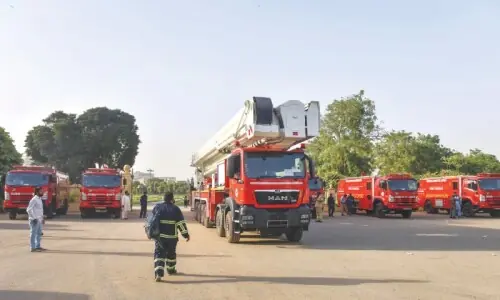
While some of the blame for heavy losses must be put on LESC's failure to put in place proper safety mechanisms, and on the inadequate fire-fighting infrastructure of the city's fire brigades, businesses and individuals too must own up their share of the blame.
Hardly any plaza or business establishment in our urban centres makes a provision for fire-related emergencies; these are in fact non-existent. If such provisions were made as part of building plans, loss of life and damage to property could have been controlled far more effectively.
For big cities like Lahore and Karachi, for instance, where businesses, trade houses and wholesale markets tend to be in congested parts of the city, the need for ensuring proper safety measures for fire emergencies cannot be over emphasized.