0
0

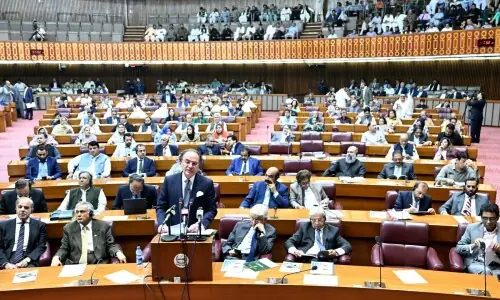
ISLAMABAD, Feb 4: The government told the Senate on Friday it would pursue dialogue to end the unrest in Balochistan and had no intention to launch a military operation in the province.
Interior Minister Aftab Ahmed Khan Sherpao and Pakistan Muslim League (PML) secretary-general Mushahid Hussain gave the assurance at the end of a three-day debate dominated by opposition complaints of deprivations in the province and alleged mishandling of the situation by the government, particularly after the alleged gang-rape of a lady doctor that had sparked the recent spate of attacks on gas and other installations.
Both the minister and the ruling party secretary-general called for dealing separately with the alleged gang-rape, which the opposition blamed on an army officer, and Balochistan's other complaints. They assured the house that the government was sincerely moving ahead on both counts.
Opposition leader Raza Rabbani said he was ready to accept the suggestion, but had doubts about the government intentions, and called for an immediate withdrawal of troops sent to Sui after the gang-rape incident of Jan 2 night, as a pre-condition for a possible end to the boycott of a parliamentary committee on Balochistan by Baloch nationalist parties. But Mr Sherpao, speaking after a meeting between President Pervez Musharraf and Prime Minister Shaukat Aziz in Rawalpindi to discuss the Balochistan situation, said that security forces would remain in Sui for the protection of the (gas) plant.
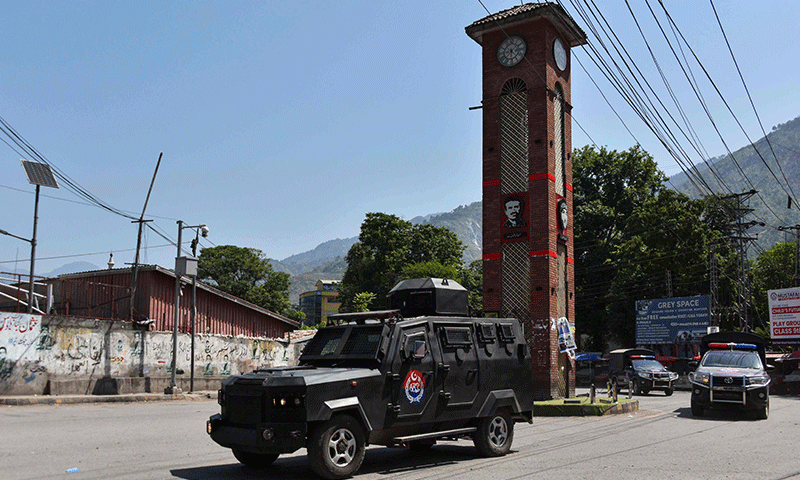
He said attacks in the area had become a daily routine since Jan 15, but the government did not plan to retaliate by a military action. "There shall be no military operation in Balochistan," he said. But he added that "protection of vital institutions will be ensured at all costs" and development projects in the province "will continue unhindered". "The government will pursue a sincere political dialogue and seek a solution of all problems of Balochistan," the minister said while winding up the debate.
Mr Sherpao asked the house to wait for a tribunal's report on the gang-rape incident and called for cooperation with the parliamentary committee led by PML president Chaudhry Shujaat Hussain that is seeking to find a solution to the problems of the province.
Mr Mushahid Hussain, who heads a sub-committee of the main parliamentary committee probing immediate problems of Balochistan, acknowledged that the management of the Sui gas-field operators, the Pakistan Petroleum Limited, appeared to have tried to 'cover up' the alleged gang-rape incident, but he quoted President Musharraf as saying that there should be a fair inquiry and nobody, whether a soldier or a civilian, should be above the law.
The leader of the house, Wasim Sajjad, heads the other sub-committee dealing with long-term problems of Balochistan such as grievances about provincial autonomy. Mr Hussain, who called Balochistan 'a victim of criminal neglect', said his sub-committee had almost completed its recommendations after a study of the situation. He, however, did not give its details.
He urged the boycotting members from Balochistan to come back to the committee and assured the house that the government was seeking to settle the issue as part of what he called "a broad national reconciliation policy'.
He rejected as wrong the notion often propounded by some in the past that a strong centre symbolised a strong Pakistan and said "actually strong provinces are a symbol of a strong Pakistan". But he said that while there should be maximum possible provincial autonomy, Balochistan should be open for development and "there should be no no-go area". He dismissed fears of a military action and said that at all government meetings he had attended "not one person...not one general or a civilian said there should be military action".
"Our attitudes have to change and this change has come. The way forward is reconciliation," he said and added: "We want a solution of the problem and we need cooperation of all to seek such a solution."
Mr Rabbani blamed the government's handling of the Sui incident for what he called a confrontation between the people and the army and said: "This is a wrong trend...for Pakistan's integrity, for the federation and the institution (of army) itself." But, he said, the situation could be retrieved even now through a meaningful dialogue by addressing the problems of Balochistan and other smaller provinces.
RABBANI'S PROPOSALS: Mr Rabbani proposed as part of a 10-point formula that the future National Finance Commission awards should be based not only on the population of provinces but their sizes, revenue generation and backwardness should also be taken into consideration.
His other nine points were: Review of the formula under which royalty is paid to provinces for their natural resources, government should define its stand on provincial autonomy, restructuring laws and policies about civil armed forces, withdrawal of forces from Sui, doing away with pickets in Balochistan, implementation of all resolutions of the Balochistan assembly, stopping construction of cantonments in the province, and presence of independent observers at the inquiry of the gang-rape incident and possibility of cross-examination of the witnesses.