0
0

Tsunami sorrows silhouette city
For somewhat obvious reasons, writing the first column of a new year makes one imagine that there is a licence to sound at least a trifle philosophical about time. And then question how the outgoing year fared, and what are the hopes and resolutions for the new year.
A dear friend of mine insists that there is nothing special about a new year and we tend to overdo in taking notice of it. It is simply one day making way for another, one night merging into time and letting a new day dawn. That's the explanation, and I dare say there is a cynicism in this. It is the cynicism that interests me!!
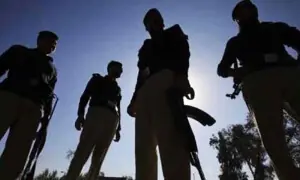
However, this time, I find my own cynicism somewhat subdued, and mellow, and find that the end of 2004, and the mood of the new year was clouded and coloured by the tsunami sorrows. As if they were, and still are, silhouetting the mood of everything else. Not just the international news channels, but even our own TV channels and officialdom are very much in tune with the tsunami theme. Consequently there are relief measures underway, both in the private and public sector. The impact of this catastrophe is very perceptible in Karachi too. Perhaps not enough, says a voice within.
Of course, tsunami fears and nightmares have had their shadows stretched over Pakistan, and more so in Karachi. In fact one of the questions that was asked related to how did Karachi and adjoining coastal areas escape the disaster. Was this is a chance? An act of Allah's blessings? That the warning was enough.
In fact, on December 26, the terrifying day the monstrous tsunami struck those countries, (so close to us, bear in mind) there were potent fears and thoughts of whether it would strike again, and this time Karachi, too, in its deathly embrace.
Writing this reminds me of the times when the Met office folks had warned Karachiites in particular about a cyclone that was to possibly hit Karachi. I think such alerts had been aired more than one occasions. The city was worried, to say the least. I can recall how hundreds of men, women and children raced to the Clifton beach, and stood atop the Seaview walls. That was perhaps brave, but also naive and foolish. I remember what a Karachiite had remarked then, and it is a comment that I have never forgotten.
So when this tsunami hit Indonesia, Sri Lanka, India, Somalia the day after Christmas, it naturally gave rise to a degree of anxiety about Karachi. There is always the thought at the back of the mind of those who live in this city that Karachi is unprepared and ill-equipped to handle an emergency on a big scale. Not citywide, but even something much much less. The thing to wonder is whether Karachiites would be able to come together in an emergency or a crisis. Whether that goodwill exists and can it be demonstrated on time.
Tsunami sadness in Karachi was indeed perceptible in the last week of 2004, and one did wonder whether it was an end to the year that was in keeping with the general mood of the common man.
One is not too sure whether the common man had a good deal or even a fair deal in the outgoing year. Having said that raises the question of whether the new year that has begun is going to be any better. The usual optimism, and the usual pessimism provide conventional answers.
What came as a surprise to me on the last day of 2004 was that the police and the local administration announced a red alert for December 31. One would have imagined that bearing in mind the spiralling loss of life and property, and the unhappiness and the trauma that it had resulted in for millions of people, there would be no need for this red alert. This is to believe that people would not come out on the streets after dinner, and create all that mess, as they celebrated the new year eve. That is to imagine that Karachiites would genuinely avoid the festivity that has come to be a regular feature of new year eve merrymaking.
In passing, one may mention that the new radio channels (on FM) are an interesting aspect of the changing entertainment scene, and some of these have music which assumes that the young people are holidaying and partying every weekend.
That red alert meant not only security measures in a city where insecurity has many known and unknown faces. And it meant road closures and barriers, and especially for the routes that went in the direction of Seaview and Clifton. Perhaps also Boat Basin.
I have often wondered about the residents of these two localities and how they feel about the city converging on their homes. Not just on a new year eve but also on Independence Day, or Eids or other such public holidays, everybody seems to head in that direction. It mirrors that the inadequacy of such recreational places ('spots' is a word I avoid opting for) in Karachi is obvious.
Yes, the inadequacies and shortcomings of Karachi; what will be done about them in 2005? What was done about them in 2004? Karachi did improve, let us be fair, in the last year. But was that enough? That's a question we will always for a city whose population is always growing, for ever adding to the suffocation of the metropolitan city's infrastructure. The question that any local government will have to live with is this: how much will it take to meet Karachi's needs even on a modest scale?
One says this keeping in mind that the next local bodies elections, due in 2005, are now scheduled for this quarter of the year. The programme alone is going to determine much of the mood of the city henceforth. Given the kind of relationship that prevails between the local and provincial government, and the polarization of political parties, and viewpoints, and the intolerance that exists on almost on all issues, it is anybody's guess about the kind of political climate that is going to unfold in the weeks ahead.
What has unfolded so far includes the protests of the opposition parties and platforms on the subject of the President's uniform, and the insistent hope and a stubborn interpretation that there is a strong possibility of countrywide general elections in the new year.
This makes one ask two questions: Does the common man want general elections? And, will those elections deliver a better life style, or even democracy? Indeed, the common man is cynical, and skeptical. And as is customary to be optimistic about the year, (2005 this time) let us assume that there does exist this 'optimism'.
A Karachiite I spoke to about the new year said that for him it was always a time to become nostalgic and recollect the happy times that he has had. And he quoted from Pericles who says "wait for that wisest of all counsellors, time." Then he began recalling the Karachi of yesteryears, and how he had lost, with time, so many of his friends.
'Lahore Lahore Aye, Maaut Maaut Aye'
They belonged to different mohallahs of the old walled city of Lahore. In one fateful day, on the Third of September, 1879, the city lost 41 sons out of 69 killed. Their great grand children, now old men in their eighties, remember the respect they once commanded. They had a nameplate outside Mohallah Qassaban, inside Delhi Gate, that was removed in the 1920s after Jallianwala. They were the cannon fodder of the British Empire, unsung, forgotten, the ones who never came back.
In the old city they sing a couplet that goes: "Sarkar kay deewanay, jissay Kabul mein na mannay". This couplet I had heard a number of times in my youth, and recently on one of my walks through the old city, I happened to share a cup of tea with old Baba Rehmat, who lives in Tehsil Bazaar, near the old mosque. I often use him as a sounding board for old stories, and every time he comes up with a unique explanation.
When I asked him about the couplet, he referred to a massacre of the "Lahore regiment" as he put it in Kabul, 20 years after the 1857 War of Independence. He calls it the 'wadah ghaddar'. "The moghals had become eunuchs, what else did you expect", he said scornfully. I researched the incident, met the great grand children of four Lahori soldiers, and the story makes remarkable reading, for we have lost just so much without learning anything from our losses. The decline continues.
The story of the 41 soldiers belonging to the old walled city out of the 69 Indians who never returned from Kabul in 1879 was told for years. They belonged to the 21 Guides Cavalry and 48 Guides Infantry, which were elite regiments of the Indian Army. The 41 belonged to four basic mohallahs, 11 of them from Mohallah Qassaban inside Delhi Gate, nine from Chohatta Rajah Dina Nath in Delhi Gate (now renames Chohatta Qazi Allah Dad), and 15 from Chuna Mandi Bazaar nearer the Masti Gate end, and six from Kocha Chabaksowaran.
All these mohallahs had in the past produced soldiers for the Moghal and Sikh armies, and had rich martial tradition. Even today some of the finest officers of the Pakistan Army, Navy and Air Force belong to the old walled city; they have that special guile, educated and street smart.
First a bit about the fight, then about the actual soldiers, and lastly about what faded memories still exist in the city's winding lanes. The British Residency was in the Bala Hissar in Kabul. In May, 1879, a Treaty was signed between the British and Amir of Afghanistan, Yakub Khan. Under the terms of the Treaty a British Mission was to be established in Kabul. Their safety was guaranteed by the Treaty and the word of the Amir. The Residency was set up in July 1879, and a small detachment of cavalry and infantry belonging to the 21 Guides Cavalry and 48 Guides Infantry, elite regiments belonging to Lahore, were sent as a security measure.
On the 3rd September 1879, without warning, Afghan soldiers attacked the Residency and were joined by almost the entire civilian population of Kabul. Urgent messages were sent to the Amir, claiming protection. The messages were ignored. It was to be a fight to the end.
The attackers promised amnesty, which none of the staff in the Residency believed. The attack started even before the time given was over. The worst fears of the Lahori soldiers were proven right. And so four British officers and 69 men from Lahore and its environs faced a raging attack by over 10,000 armed men.
The first to fall was the British Envoy, Major Sir Pierre Louis Napoleon Cavagnari, KCB, originally belonging to the 1st Bengal Fusiliers. Aged just 38, he was an experienced soldier and was serving as the Assistant-Commissioner in the Punjab, based in Lahore. With him was killed Surgeon Ambrose Kelly of the Indian Medical service.
After studying medicine and surgery in Dublin, in 1869 he was commissioned to the Bengal Medical Service and served in the Lushai expedition. He was posted to the 1st Punjab Infantry in 1872. He was working in Lahore when he was selected to join the Embassy to Kabul and was killed treating the wounded in the first wave of attacks.
As the Residency staff regrouped, they were led by the one remaining British officer, a 23-year old dashing soldier by the name of Lt. Walter Richard Pollock Hamilton, V.C., of the Guides Cavalry. At Fatehabad he led the Guides in a charge and was awarded the Victoria Cross. He was selected to command the 75 men of the Corps of Guides who accompanied the British Embassy to Kabul. He was killed defending the second wave of attack. With him dead, command was taken over by the Lahori soldiers.
The Afghans offered amnesty to the Muslim soldiers. The answer from the Lahori soldiers was the battle cry "Ya Ali Haider", and an even stranger one the Afghans had never heard, and it was "Lahore Lahore Aye, Maaut Maaut Aye". Regimental researchers were to note this unique battle cry, a cry that was only used again in the 1965 War with India by the Punjab regiment soldiers in the defence of Lahore.
So the third wave of attack started in which the last remaining British officer to be killed was a uniquely gifted 32-year old British "political officer" by the name of William Jenkyns. Educated at Cambridge, in 1876 he was Interpreter and Secretary to the Embassy at Peshawar for the conference with the Amir of Afghanistan. In 1878 he was a Political Officer with the army in Afghanistan and spoke fluent Pushto. Thus all British officers were dead and the men from Lahore were left to face the final onslaught.
Afghan records tell us that they stood fighting to the last man. One account of the battle tells us that when their bullets had finished, they fixed their bayonets, gave their battled cries and faced the enemy. After 12 hours of fighting the few remaining men fixed bayonets and charged out to their deaths. Over 600 Afghan dead bore witness to the heroic resistance of this small force from Lahore. From this emerged the ballad in Punjabi: "Marrna aye tey dass lay kay marriay". Even today this myth of every Lahori soldier taking ten of the enemy is perpetuated in the regiments of Pakistan and India. Its roots are grouted firmly in the reality of the Kabul of 1879.
When on their own, the men were led by Jemadar Jewand Singh, who belonged to Mohallah Qassaban. He was assisted by Daffadar Hira Singh of Mozang. The cavalry sowars who charged in the final analysis were all from inside the old walled city, they being Gul Ahmed, Khair Ullah, Akbar Khan, Muhammad Akbar, Miroh Badshah, Ghulam Habib, Mahomed Amin, Mahomed Hassan, Amir Hyder, Pars Ram, Amar Singh, Wazir Singh, Ratan Singh, Harnam Singh, Deva Singh and Farrier Amir Ullah.
From the infantry were Jemadar Mehtab Singh, Havildar Hussain, Naik Mehr Dil, Bugler Abdullah (of Tehsil Bazaar and great grandfather of Baba Rehmat), Lance Naik Jangi. Among the sepoys were Sonu, Shibba, Sirsa and Tota all of Chuna Mandi. Then there were sepoys Roedad, Akbar Shah, Said Amir, Alam Shah, Mir Baz Khan (all from Kocha Chabbaksowaran), Hamzulla Waddah and Humzulla Chootha, two brothers from Chootha Rajah Dina Nath.
The list goes on and on. Last on the list is 3rd Class Hospital Assistant Rahman Bakhsh, who also worked in a Lahore hospital, and went to Kabul for the money and adventure. His great grandson, ironically, still lives inside Bhati Gate and works in Mayo Hospital, Lahore. But then who remembers all these exceptionally brave soldiers who refused to surrender. Even the families of these martyrs now have little recollection, except for the stories they have heard. Probably in a few years even the songs and ballads will die out.
It matters not who the rulers were, for we have had foreign rulers for almost 1,000 years. The men who died belonged to our soil. In a way, even today, the rulers seem foreign to the poor. The least we can do is to erect a monument for the 'Unknown Soldiers' of our city and land, so we never forget all those, irrespective of time, place, belief and circumstances, who helped shape our history.
A friend remembered
I had been praying for weeks for my friend Ahmed Bashir who was lying in hospital with a dreaded afflication. But my prayers had no effect and he passed away into eternity.
In one of my columns last month, I wrote about his illness and I had made bold to reach the second floor of the VIP block of the Services Hospital to see him. Unfortunately, he was not in his room at the time and I did not have the strength to keep waiting for him. I came back disappointed.
Although I had known Ahmed bashir for many years, he came close to me during my days with The Frontier Post in Lahore. He had been writing columns in other newspapers of the country, mostly under fictitious names like Ahmed Khan Kharal and Bulleh Shah, but when he started writing for The Frontier Post, he started appearing under his own name.
He was a fearlessly open person with the courage of expressing what he honestly felt. He had seen many ups and downs in life. Soon after graduating, he tried to enter the film world of Bombay. Facing failure, he reverted to writing for magazines. He spent many days in Bombay in the company of Mumtaz Mufti, Meeraji and Raja Mehdi Ali Khan.
Equally fluent in English and Urdu, he later worked for the daily Imroze of Lahore where he came to be regarded as a pioneer of feature writing in Urdu. He often got into trouble because of his radical views yet he enjoyed the respect of the intelligentsia.
A local Urdu daily arranged a reference in his memory. Presided over by Intezar Husain, the sitting was attended by a large number of people. The proceedings were conducted by Sarfraz Syed. Speaking first, he disclosed that Ahmed Bashir also had an indepth knowledge of music and composed poetry under the name Bashir Roomani. Speaking next, Shahid Bukhari said that the late writer strove all his life for the rights of the downtrodden and went all out to condemn feudalism.
Others who spoke on the occasion included the shop story writer, Sughra Sadaf, novelist Salma Awan, Neelma Durrani, Prof Afzal Tauseef, Sofia Bedar, Sarwat Mohyuddin and Iftikhar Majaz. His sister, Parveen Atif, and daughter, Neelam, were also there and spoke about the departed soul.
A former editor of the defunct Mashriq, Aziz Mazhar, came up with a lot of information about Ahmed Bashir. Praising him for his frank and open statements, he recounted his 1972 visit to Moscow together with the late ZA Bhutto. He said that his observations of the social conditions prevailing in that country at the time led him to predict its ultimate downfall. He further said that even while working for the People's Party newspaper, Musawat, he spoke out his mind to Benazir Bhutto and criticised the policies of the party.
Winding up the proceedings, Intezar Husain narrated many stories of the days he had spent working with him in the daily Imroze and The Frontier Post.
* * * * *
It was on the last afternoon of the previous year that the local chapter of the Pakistan Academy of Letters (PAL) arranged a critical review of the literature produced during 2004. Besides Urdu, Punjabi and Seraiki, the writings in English were also included. The eminent scholar, Prof Dr Khurshid Rizvi, was specially invited to preside over the sitting.
Dr Salim Akhtar who had been asked to speak about the books produced in Urdu expressed his disappointment at whatever had appeared in the market. Not a single book, he said, could be pointed out as outstanding. Most of the books were of poetry which did not touch any high standard. He regretted that there was hardly any trace of a worthwhile novel during the year.
Talking about Punjabi publications of the year, Prof Jamil Ahmad Pal said that about 120 books had been published in the language, most of which were of poetry by expatriates. However, some worthwhile collections of stories had also been published. In this connection he specially referred to the books produced by Azhar Javed, Nadir Ali, Parveen Malik and others.
Covering the slot for Seraiki, Prof Musarrat Kalanchvi said that this ancient language was widely spoken in the sub-continent and that it could safely rub shoulders with other languages. She said that although poetic works published during the year out number others, yet some good collections of short stories had also been published, besides travelogues and books of humour.
Dr Mirza Hamid Baig spoke briefly about the English books published during the year. He pointed out that it was not only Bapsi Sidhwa but many other writers in the language had also made their mark.