0
0

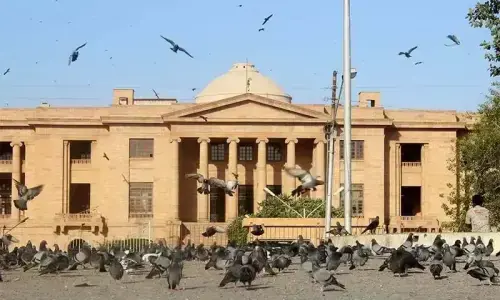
KARACHI, Jan 4: The Sindh High Court has ordered all parties to the petition moved by the relieved nazims of the four bifurcated districts of the province to maintain status quo , thereby, effectively restraining the Election Commission from holding elections to the offices of nazims and naib nazims of the eight newly-created districts.
The interim order was passed on Tuesday by a division bench, comprising Justices Sarmad Jalal Osmany and Zia Pervez, as it took up a joint petition by the sacked nazims, Khursheed Ahmed Junejo of Larkana, Pir Shafqat Shah Jilani of Mirpurkhas, Malik Asad Sikandar Khan of Dadu and Mir Shabbir Khan Bijarani of Jacobabad and naib nazims Nazir Ahmed Bhugio of Larkana and M Mohammad Yunus of Mirpurkhas.
Advocate Abdul Hafeez Pirzada, earlier, strenuously argued for an order against fresh polls pending the petition, otherwise the petitioners would be presented with a fait accompli, like prime minister M. K. Junejo in the 1988 Saifullah case wherein the Supreme Court withheld consequential relief because an appeal had already been made to the electorate.
The attorney-general and the advocate-general were both on general adjournment. There was nobody to represent the Election Commission or the National Reconstruction Bureau.
Deputy Attorney-General Nadeem Azhar informed the bench that according to his information, the notices were received by them only on Monday. The attorney-general, who is abroad, is due back home on Jan 10.
AG Anwar Mansoor Khan later appeared and filed para-wise comments on the petition. He said the government decision and action were entirely legal and all aspects had fully been examined. They were taken in the public interest and were neither arbitrary, nor whimsical, he said.
Mr Pirzada, senior counsel for the petitioners, said the provincial government was the main respondent and others were by and large pro forma parties.
The petitioners were duly elected by validly inducted union council nazims of their respective districts in 2001 under the Sindh Local Government Ordinance (SLGO), 2001, and the Sindh Local Government Election Ordinance of the same year. They had been arbitrarily removed about eight months before the fresh local government polls.
The impugned notifications, the counsel said, had been issued under Section 186 (2) of the SLGO, but the condition precedent to action under the provision was absence of a validly constituted local government caused by a natural calamity or circumstances beyond human control.
"This jurisdictional fact which empowers government to replace an elected setup by an unelected person or persons is missing in the instant case," he added.
The only other SLGO provisions available for removal of nazims and naib nazims, the counsel stated, were Sections 23 and 24 of the SLGO that provide for internal recall by the district council concerned by a no-trust move and external recall for misconduct by a resolution of the provincial assembly.
There was no allegation against the petitioners and the impugned notifications only said they had ceased to hold office 'by operation of law'. In fact, they were ousted by an executive order.
Mr Pirzada said the SLGO was an overriding law and local government constituencies could be changed or varied only under it and not under the Land Revenue Act, whereby the new districts were created.
He said he did not want to allege mala fides, but the fact was that all the relieved nazims belonged to the opposition PPP. Though the creation of new districts was not an issue in the petition, the government action, he maintained, amounted to 'gerrymandering'.
The government action, he said, was also hit by the principle of proportionality. It was not a proper exercise of power or discretion, he added. The proceedings will resume on Wednesday.
HEARING ADJOURNED: Meanwhile, a petition challenging the bifurcation of the Larkana district was on Tuesday adjourned to a date in office. The petition has been moved by former nazim, Khursheed Junejo, through Advocate Nafees A. Siddiqi, who was busy before the Supreme Court on Tuesday. It was placed before another bench, comprising Justices Sabihuddin Ahmed and Amir Hani Muslim.