0
0

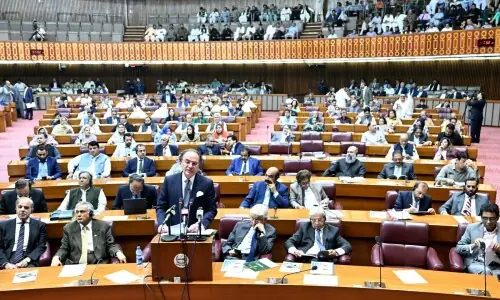
ISLAMABAD, Dec 2: Opposition parties held a rare sway in the Senate on Thursday, throwing the ruling coalition into disarray as they won a vote for a probe after a minister confessed giving a wrong reply , and pressed on their criticism of the country's top intelligence outfit.
Parliamentary Affairs Minister Sher Afgan Niazi bore the brunt of the opposition as well as some members of the ruling Pakistan Muslim League (PML) members' attack, which denied him enough support to block either the inquiry by Senate's Privileges Committee about the reply he had given in the house on Wednesday or a belated debate about the role and recruitment policy of the Inter-Services Intelligence (ISI).
An apparent revolt within the ruling party forced all members of treasury benches to vote for the opposition's move for a special committee probe into Mr Niazi's statement that his reply to a question in the Senate on Wednesday about dropped charges of the National Accountability Bureau (NAB) against PML secretary General Mushahid Hussain was deficient and gave wrong dates.
This happened after the Senate acting chairman Khalilur Rehman had declared the inquiry move defeated by a voice vote, which was challenged by the opposition to force an actual count of votes.
Both leader of house Wasim Sajjad and Mr Niazi had opposed the probe demand made by opposition Democratic Alliance leader Raza Rabbani after the minister assured his own inquiry to find out and penalise those who supplied wrong information, but failed to convince the opposition and most of their own colleagues on the treasury benches.
First only Mr Mushahid Hussain and former information and broadcasting minister Nisar Ahmed Memon stood up from their seats as did the entire opposition when the chair called for a count of the supporters of the inquiry demand. Some more members on the treasury benches stood up hesitatingly but then all followed suit.
In what appeared to be only face-saving remarks, Mr Sajjad said that since Mr Mushahid Hussain too wanted a probe into the matter by a Senate committee, all members of the treasury benches would back him.
SECOND DEFEAT: The government suffered its second defeat of the day when the chair ruled for continuing the discussion on ISI's recruitment policy, rejecting Mr Niazi's argument that the debate on the question had already been wound up by Minister of State for Defence Zahid Hamid on Tuesday and no more speeches were required.
The government had agreed to the debate on Tuesday to let the opposition air their views on the question after they had boycotted the proceedings last week when the house passed the Federal Public Service Commission (FPSC) (Amendment) Bill that allows the ISI to recruit its civilian officers without reference to the FPSC.
The bill was passed by the National Assembly on September 23. Most of nine opposition members who spoke in the debate on Thursday - compared to three ministers - before the house was adjourned until 10 am on Friday, criticized the ISI role in the country's politics and called for the top spy agency to be made answerable to parliament.
Education Minister Javed Ashraf, a former ISI director-general and a retired army lieutenant-general, rejected what he called "baseless allegations" about ISI's involvement in the hijacking of an Indian airliner to Kandahar in southern Afghanistan in December 1999, the country's nuclear programme or heroin trade.
He said the ISI had been recruiting all its staff until the year 2000 when a presidential ordinance "by default" brought recruitment of its officers of grade 16 and above under the purview of the FPSC along with those of government ministries, divisions and departments.
Both Mr Ashraf and Mr Niazi, who later wound up the debate, said the new bill was necessitated to undo a mistake and restore the old procedure which, according to them, was similar to those followed by intelligence agencies in many other countries including the United States and India.
"No intelligence agency can work if its personnel are known to people," the education minister said.
Minister of State for Defence Zahid Hamid said recruitments in the ISI were being made by a panel of highly qualified persons through an elaborate procedure of interviews, tests and security clearance rather than at any anybody's whims.
Democratic Alliance leader Raza Rabbani said the new law would negate transparency and proposed that a six-member parliamentary committee - three members each from the Senate and the National Assembly - scrutinise ISI recruitments.
He said the Pakistani society had been "intelligencised" by intelligence agencies whom he accused of involvement in political activities ranging from the 2002 presidential referendum and general election to the election of the Senate chairman in 2003.
Prof Ghafoor Ahmed said he would have no objection to secrecy about ISI recruitments if the names of the agency's head and other senior officers were not known to people. But, he said, these officers were well known and "their offices have become election offices".
Raza Mohammad Raza of the Pashtunkhawa Milli Awami Party accused the ISI of interfering in the country's politics and foreign policy and said the entire military should be delinked from politics and made subservient to parliament.
Earlier, several senators from both the treasury and opposition benches rose on points of order to complain about a variety of matters including alleged insecurity for women senators at the parliamentary lodges in Islamabad, Prime Minister Shaukat Aziz's absence from Senate sittings and allegedly fake Ph.D. degrees offered by unspecified organisations.
Minister of State for Interior Shahzad Waseem promised improvement of security arrangement at the parliamentary lodges after PML Senator Pari Gul from Balochistan complained about some incidents including allegedly suspicious knocking at the door of a woman senator's flat and some youths being seen running away at another occasion. The education minister told the house that the Higher Education Commission would not recognize fake degrees.