Powell's exit: implications
With the departure of US secretary of state Colin Powell, the leading voice for restraint and moderation in the Bush administration, the neo-conservatives and hawks have consolidated their hold on American foreign policy.
Though in public, Powell continued to defend the Iraq war, in private - according to people who know him - he had never been fully comfortable with the manner in which the war was initiated and followed up.
As a soldier-statesman, he was particularly frustrated by his eventual exclusion from Iraq war planning. He was the architect, as chairman of US Joint Chiefs of Staff, of American strategy in the Gulf war in 1991 to oust Iraq from Kuwait. His plan, known as the Powell doctrine, stressed the need for overwhelming force and a clear exit strategy.
On November 12, Powell described as " my two burdens" the continuing turmoil in Iraq and the unending violence between Israel and the Palestinians. One of the reasons for his eventual departure from the state department is believed to be his advocacy of a tougher line with Israeli prime minister Ariel Sharon.
Many Democrats and Europeans fear that the departure of Colin Powell from the US state department may mark the expansion of American arrogance in world affairs. The Bush administration in the second term may like to stress, in the words of the Economist, the "hard-edged ideological hawkishness" even more.
The appointment of National Security Adviser Condoleezza Rice to replace Colin Powell is expected to achieve a number of objectives. It will establish Bush's political control over the state department which, during the Powell days, was seen by the hawks as resisting the president's more aggressive policies.
The choice of Rice to run the state department seems to have been made as much for her personal loyalty to Bush as for her hawkish foreign policy views. She is not an ideologue but a hard-boiled realist, a firm believer in the use of American power.
It was Ms Rice who declared, when three important European nations refused to support the Iraq invasion, that the United States should "punish France, ignore Germany and forgive Russia."
As national security adviser, Rice was the moving spirit behind the National Security Strategy (NSS)in September 2002 which later on came to be known as the Bush Doctrine. The NSS envisions a world in which the United States enjoys permanent military dominance over all countries, friends and foes alike.
It also brazenly declares that the US "has no intention of allowing any foreign power to catch up with the huge lead the United States has acquired since the fall of the Soviet Union."
The NSS, in a way, espouses the Monroe Doctrine on a global scale. It asserts Washington's right to intervene wherever and whenever it perceives a threat of terrorism or mass destruction to exist.
With imperialist overtones, the NSS gives the United States not only the right to judge who is a terrorist and which state is supporting terrorism but also to launch pre-emptive strikes without waiting for the go-ahead from the UN Security Council.
Rice's appointment is likely to tilt the balance in the Bush cabinet towards the neo-conservative and hawkish elements. Her critics argue that while Rice was national security adviser, she used to be the "swing vote" between Colin Powell on the one side and Dick Cheney and Donald Rumsfeld on the other. On most occasions, her support for the latter decided the issue and that support has now paid dividend where she is concerned.
Some optimists, however, believe that the appointment of Rice may actually provide an opportunity for renewed diplomacy. They argue that a change in foreign policy will be brought about more by ground realities than by any change in the thinking of policymakers in Washington.
Both President Bush and his new secretary of state want to improve America's dismal image in the world and repair damaged relations with former allies. Bush has also said that he will do all he can to create a Palestinian state.
President Bush will be travelling to Europe after his inauguration and may utilize that opportunity to mend fences with "old Europe". The three big issues are at the moment and the bone of contention between Europe and the United States are problems linked to these countries Israel, Iraq and Iran. The problems linked to these countries are hard to solve and easy to disagree with. Therefore the future of trans-Atlantic alliance continues to be enigmatic. But there are strong reasons for scepticism. If the intention is to restore the trans-Atlantic alliance and solve the Palestinian question, then Colin Powell would have been a far more suitable person because of his credibility and known moderation.
According to a report in The Guardian, Powell had wanted to stay on for the first six months of Bush's second term to help shepherd a new Middle East peace process, but his wish was not granted. Alternatively, Bush could have nominated a more Powellite figure to the post than hard-liner Rice.
Rice's nomination tends to confirm the view that the US foreign policy will now be run by a group of like-minded conservatives (or hawks?) without being distracted by Powell's voice of restraint and moderation. Some analysts fear that in the next four years there may be more shows of brute force for "saving" the world from terrorism.
Some observers believe that Powell's departure and Rice's promotion may also be a prelude to some sort of purge in the CIA and the state department. The CIA has not been forgiven by the Bush administration for failing to support Vice-President Cheney's attempt to link Saddam Hussein to Al Qaeda.
The September release of National Intelligence Estimate, laying out dark scenarios for Iraq, was considered an act of insubordination by the CIA intended to damage Bush in the election.
The new CIA director, Porter Goss, has installed partisan aids at the top and some senior officials have been fired. He has issued a diktat that the CIA's mission is to " support the administration and its policies."
At the state department, key posts are likely to be filled with neo-conservatives and fellow travellers, while officers close to Powell may find their leads on the chopping block.
Some indication of Rice's thinking about US foreign policy will be available when she chooses her deputy in place of Richard Armitage who has also resigned. If her choice falls on the "punchy" under-secretary for arms control, John Bolton, it will mean that she has her own foreign policy agenda to pursue and intends to mould the state department according to it.
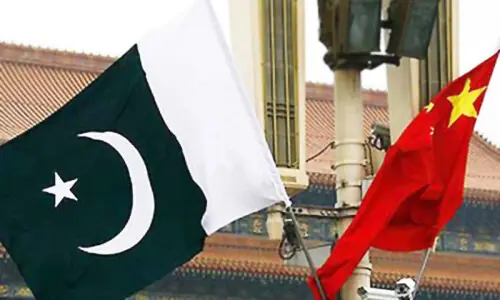
During Bush's second term, Pakistan may miss the genial, un offensive approach of Colin Powell. Being himself a soldier-statesman, he seems to have developed a good equation with President General Pervez Musharraf.
Pakistan foreign office spokesman has described Powell's association with South Asia as "a productive experience for both Pakistan and the United States." Also, he has described him as "a good friend of Pakistan" who paid special attention to South Asia, Afghanistan and war against terrorism.
It may be recalled that India was rattled by Powell's announcement bestowing the status of a major non-Nato ally on Pakistan. India expressed its disappointment at the US failure to have informed it about the plan though Mr Powell had held discussions with Indian leaders before leaving for Pakistan where he made the announcement.
India is likely to feel more comfortable with Condoleezza Rice who has described the strategic partnership between Washington and New Delhi as going beyond "security, proliferation or regional issues."
The writer is a former ambassador.
Why is Musharraf in a hurry?
Without mentioning the names of former prime ministers Benazir Bhutto and Nawaz Sharif, I asked President General Pervez Musharraf why he did not allow leaders living abroad to participate in the affairs of Pakistan and its development.
This was during a meeting with him at Islamabad last month. He was visibly upset and ended the conversation with a counter-question: Would their participation be in the interest of development?
I am broaching the subject at this time because the Pakistan government is in the midst of making concrete proposals on Kashmir and expecting India to respond to them. Musharraf is in such a hurry that there is a threat practically every day to go back to square one. Kashmir is an important matter. The concurrence of the two leaders is essential.
No doubt, the military is in full control and there is no challenge to Musharraf's authority. But he should not forget that both Benazir and Sharif command a large following even in their wilderness.
In a freer atmosphere, they may register a much larger support. They are a reality which Musharraf cannot wish away. With the release of Asif Zardari, Benazir's husband, from prison after eight years, the scenario may change. There can be an increasing support for civilian rule. Musharraf may face tough opposition, particularly when his move to retain the uniform is gathering storm.
What Musharraf says on Kashmir is his point of view and that of the military in Pakistan. Political leaders like Benazir and Sharif do not agree with him. Nor do most of the people.
A referendum, if held on this point, may surprise Musharraf. But then the referendum is not his way to determine things in Pakistan. The rigged referendum in favour of his presidency is too recent to be forgotten.
I wish Islamabad had torn a leaf out of New Delhi's book. The Janata Dal government kept both the Congress and the BJP informed about what transpired between pime ministers Inder Gujral and Sharif at Male.
Subsequent governments have taken the opposition into confidence on their talks with Pakistan. In matters like Kashmir, the whole of Pakistan should be involved and, as such, a bipartisan policy is necessary.
Foreign Minister Kurshid Kasuri is right when he says that nobody can take the credit away from former prime minister Atal Behari Vajpayee for initiating the "peace process."
In the same way, no Pakistan government can minimize the role of Sharif in pushing forward the peace process. He invited Vajpayee to Lahore and signed a joint declaration. Similarly, the Benazir-Rajiv Gandhi accord was a step towards India-Pakistan detente.
Reports are that both Benazir and Sharif have not reacted favourably to Musharraf's proposal. In the face of opposition from main political parties, what does New Delhi do? Sharif told me at Jeddah last year that they would not accept any solution on Kashmir that the military regime had brokered.
Moves to separate Shabaz Sharif from his brother Nawaz Sharif, even if successful, do not mean much. The real question is to involve political parties. The Muslim League (Nawaz Sharif) is not at Shahbaz's command.
The Musharraf government is banking on the Muslim League (Quaid), the King's Party, for endorsement of the Kashmir solution in the Pakistan National Assembly and the Senate. But it has only a wafer-thin majority. Whatever is decided has to have the consensus, both the Pakistan People's Party and the Muslim League (Nawaz Sharif) agreeing to it.
It is strange that Musharraf says with a flourish that all Kashmiris, whatever their views, should participate in the talks. But this should hold good for Pakistan as well.
All shades of opinion should be associated with the proposals that Musharraf is making or the ones which India may be offering at some stage. The military-led government in Islamabad does not represent the Pakistani opinion. Ultimately, civil society has to accept it.
That a prime minister is a civilian does not change things. He is only Musharraf's nominee. While in India, Shaukat Aziz could not add even a comma to Musharraf's proposals, although he was eloquent in re enunciating them. What progress is possible when Islamabad sticks to its old line that the movement on confidence-building measures has to keep pace with the advancement on Kashmir?
Musharraf's impatience with India is not understandable. It is a democratic country and has to follow the norms laid down by the constitution. People's wishes are supreme. He can get away with anything in Pakistan but not Prime Minister Manmohan Singh who is answerable to parliament.
Any proposal on Kashmir will need the endorsement of both the houses and it has to be within the precincts of the constitution, unless political parties decide to amend it. Such a course is difficult to imagine because parliament passed a unanimous resolution during P.V. Narasimha Rao's rule that India should get back the territories it has lost. Both Pakistan and China were in view.
However, it is time that India had a policy on Kashmir. So far it has none. New Delhi's formulations are a reaction to what Pakistan says or does. A high-powered committee of all shades of opinion should be constituted so that it is clear how far New Delhi can go to accommodate Islamabad.
The home ministry's department on Kashmir, with a joint secretary at the top, is too inadequate for the job. For example, India should pursue the concept of a South Asian economic union to counter Musharraf's proposal of seven regions.
The US papers, now made public, tell that John K. Galbraith, US envoy in the early sixties, had warned Washington that "Kashmir is not soluble in territorial terms but by holding up the example of the way in which France and Germany had moved to soften their antagonism by the common market."
Galbraith had also done what he called a Harvard Exercise (named after the university where he taught). He had suggested the reopening of the road between Islamabad and Srinagar through Baramula, Uri and Murree and the resumption of trade and tourist traffic, emphasizing that India's military rights in the vale of Kashmir should remain intact.
This was more or less the proposal that Sheikh Abdullah discussed with me in 1969. His argument was that the border should be 'soft' so that the Pakistanis had an easy access to the valley. Strangely enough, late Zulfikar Ali Bhutto repeated the same thing during an interview with me in March 1972 at Rawalpindi.
He said: "We can make the cease-fire line as the line of peace and let people come and go between the two Kashmirs. After all, why should they suffer? Let there be some free movement between them. Then one thing can lead to another."
Realism is thought and action based on realities. It is strange that the reality of political situation in Pakistan does not dawn on Musharraf. There is no doubt that he is the monarch of all that he surveys. But it is also true that the military control has suppressed the real voice of people.
Recent contacts at different levels have revived emotional ties which both sides have had before partition. Left to the people, they would like to have free travel and free trade. They are sick and tired of the never-ending confrontation. They want to live in peace as neighbours.
The writer is a leading columnist based in New Delhi.
US-Pakistan relations in post-poll period
The US presidential elections generated a lot of interest in Pakistan and other states in Asia and Africa. The leaders and the informed public in these countries keenly observed the elections because hardly any state has escaped the fallout of US unilateralism and the use of overwhelming military power to pre-empt perceived terrorist threats to American citizens, territory and interests.
A large number of governments expressed reservations of varying degrees on this policy but the US leadership paid no heed to their concerns. The government of Pakistan is delighted with the re-election of George W. Bush because the Pakistani leadership and the Bush administration have been working together in the global war against terrorism since September 2001. The official interaction between Pakistan and the US is smooth and there is a common perspective on stability in Afghanistan and the containment of terrorism.
Top officials of the two governments meet frequently to discuss matters of mutual interest and General Pervez Musharraf is said to have developed a personal equation with President George Bush and outgoing secretary of state Colin Powell. In the post-election period, both sides can build on what they have already achieved.
However, the response of the ordinary people and political circles in Pakistan has been somewhat different. Most of them were disappointed that the US had re-elected George Bush.
This was mainly because of the widely shared perception in Pakistan (and other Muslim countries) that the Bush administration pursued anti-Muslim policies. Its policies on counter-terrorism placed the blame of terrorist attacks in the US on Islam and the Muslims.
Other factors that caused alienation in the Muslim world included the pro-Israel US policy on the Palestinian question, US military action in Afghanistan and Iraq and the US military occupation of Iraq.
Describing George Bush and his close associates as anti-Islam and anti-Muslim, ordinary folk in Pakistan were sympathetic towards John Kerry, hoping that he would soften the hard-line US approach towards the Muslim world and assign a greater role to the UN in coping with the Iraq problem.
America today suffers from a serious image problem in Pakistan and other Muslim countries. At the popular level, people fear the Bush administration in its second term will pursue a tougher line towards the Muslim world and resort to brutal means to curb the insurgency in Iraq. The attack by US troops on Fallujah is cited as the unfolding of this policy in the post-election period.
A similar approach may be adopted to crush opposition to the Karzai government in Afghanistan, to be followed by intense military pressure on Iran and Syria. The first statement of George Bush after his re-election makes no attempt to allay these fears.
Pakistan and the US reinvigorated their bilateral relations in the post-9/11 period because the former decided to join the US-sponsored global effort to combat terrorism.
Prior to such a dramatic shift in Pakistan's policy, Pakistan was under four types of US sanctions. First, all economic assistance and military sales were suspended to Pakistan in October 1990 when the US invoked the Pressler Amendment pertaining to Pakistan's nuclear programme.
Second, additional sanctions were imposed on Pakistan when it exploded nuclear devices on May 28 and 30, 1998. Third, new economic sanctions, described as "democracy sanctions", were imposed on Pakistan when General Pervez Musharraf assumed power on October 12, 1999.
Fourth, limited-scope sanctions were imposed in November 2000 for two years on some departments/agencies of Pakistan (i.e. Ministry of Defence, Space and Upper Atmosphere Research Organization), debarring them from business deals in the US, on account of receiving missile technology and equipment from China. These sanctions were extended in September 2001 (a few days before the terrorist attacks in the US) and March 2003.
The first three categories of sanctions were lifted in October 2001 because Pakistan's decision to join the US-led war against terrorism made it relevant to US global and regional security interests.
Direct US economic assistance to Pakistan since early 2002 has focused on fiscal support, debt relief, technical and commodity assistance, financial and technical support in the fields of education, health care, food, institutional capacity-building, especially the strengthening of democracy, elimination of child labour and narcotics control.
The US has also extended economic and technical assistance for strengthening security on the Pakistan-Afghanistan border, improvement of communications and road building in the tribal areas, counter-terrorism measures, and record-keeping of people leaving or entering the country through different entry-exit points.
Furthermore, Pakistan also obtained economic assistance from the IMF, the World Bank, and the Asian Development Bank for various development projects, including poverty reduction. The Aid-to-Pakistan Consortium recommended its members in December 2001 to reschedule Pakistan's debts for 38 years.
The improved relations between Pakistan and the US enabled the government of Pakistan to convince the Bush administration in December 2003-January 2004 that it was not involved in the unauthorized transfers of some nuclear equipment and technical know-how from Pakistan by Dr Abdul Qadeer Khan.
The re-election of George W. Bush ensures that the momentum of the reinvigorated US-Pakistan ties will continue and that Pakistan will continue to get economic and technical assistance from the US and international financial institutions. Pakistan also expects to obtain military hardware from the US.
The government is keen to obtain F-16 aircraft to replace the 40 F-16 aircraft it obtained during 1983-87. The US has so far made no commitment about the supply of F-16s or any other sophisticated military aircraft.
The re-election of George Bush also guarantees that the $3 billion five-year assistance package, committed during President Musharraf's visit to the US in 2003 and approved recently, will continue.
The Bush administration is not expected to seriously press the president to step down as army chief, nor is it likely to make an issue of the democracy deficit in Pakistan.
However, if the current drift in Pakistan's domestic politics continues and the government is unable to assuage the opposition, one wonders if the US can stay indifferent towards this country's troubled political realities.
The Musharraf regime's continued confrontation with the opposition is likely to adversely affect its efforts to combat terrorism. The Bush administration may be left with no choice but to advise the Musharraf regime to go for political accommodation and liberalization of the polity.
Pakistan and the US can diverge on the precise strategies for combating terrorism. This can happen if the security situation deteriorates in Afghanistan and its newly elected government is unable to enforce its writ beyond Kabul and a couple of other cities. The US may seek greater Pakistani military support to cope with these challenges.
This may involve strict security measures in the tribal areas and punitive measures against Pakistani hard-line and fundamentalist Islamic groups that openly sympathize with the Taliban and Al Qaeda.
The Pakistan government may find it difficult to pursue its reluctant partnership with the MMA if the US government insists on effective implementation of its policy of enlightened moderation and containment of Pakistan-based militant Islamic groups.
The Musharraf government may be reluctant to step up military measures to contain terrorism in view of the serious difficulties in the conduct of the military operation in Waziristan, including its negative fallout on the Pakistani mainland in the form of increased bomb explosions and terrorist attacks.
Another potential source of divergence is the US policy towards India, especially the US-India partnership in the security field. Pakistan will be extremely unhappy if the Bush administration supports India for a permanent seat in the UN Security Council.
The Bush administration describes its relations with India and Pakistan as two independent tracks because both countries are important for the US for different sets of reasons. However, this is not how India-US relations are viewed in Pakistan.
The unfolding of a strategic partnership between India and the US in disregard of Pakistan's security sensitivities can put strong domestic pressures on the Pakistan government to slow down its partnership momentum with the US.
However, the negative fallout of the stepped up US-India multifaceted cooperation can be coped with if Pakistan-India relations continue to improve and their bilateral dialogue results in resolution of contentious issues. The US can, therefore, reinforce its efforts to combat terrorism by facilitating conflict-resolution between Pakistan and India.
Despite the overall convergence between Pakistan and the US on the war against terrorism, there are points of divergence in their perspectives and policies that can cause strains in their interaction.
Both need astute diplomacy and an appreciation of each other's sensitivities if periodic problems in their relations are to be handled in a manner that shared interests and the areas of convergence do not shrink.