0
0

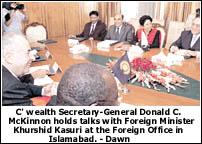
ISLAMABAD, Oct 22: Commonwealth Secretary General Donald Mckinnon on Friday endorsed President Gen Pervez Musharraf retaining his uniform beyond Dec 31 as long as it was done through parliamentary route and not an executive order.
Speaking at a press conference at the Foreign Office here after holding talks with President Musharraf and Foreign Minister Khurshid Kasuri, who also spoke on the occasion, Mr McKinnon said the Commonwealth would respect a parliamentary decision on whether President Musharraf should retain his office of army chief.
"Supremacy of parliament in Pakistan has been the underlying objective of the Commonwealth," he said. "What is important is that President Musharraf has gone to parliament."
Questions regarding the uniform issue dominated the press conference at which Pakistan's High Commissioner to Britain, Dr Maleeha Lodhi, was also present. Mr Mckinnon's responses to pointed questions gave no indication of any concern within the Commonwealth on this issue.
Responding to a question, the secretary-general confirmed that the issue of uniform did come up during his meeting with President Musharraf. Mr Mckinnon said he had conveyed to the president that when the Commonwealth Ministers Action Group met last time they had indicated that they wanted to see some clarity on this area and also underlined that the important issue was to maintain the supremacy of parliament and constitution.
In this context, he emphasized that 'the more underlying factor' was the maintenance and supremacy of parliament itself. "Now the president has done that and the bill has gone to your parliament," Mr Mckinnon said, indicating that it was no longer an issue with the Commonwealth and that Pakistan's status in the world body would remain unaffected if the president continued to hold both offices.
Acknowledging that it remained a contentious issue in parliament, the Commonwealth secretary-general stated that was what parliament was all about. "That is democracy in action. The important thing is that the issue was taken to parliament and parliament debated that issue," he stressed.
Defending the case for the president retaining both the offices, he argued that President Musharraf had gone back to parliament and had the parliamentary consent for it.
Making it clear that the Commonwealth was in no mood to pass a verdict on this controversial issue, he said it was for Pakistani courts to say if it was within the constitution.
The secretary-general was visibly irked when asked to quote one instance in democratic history of any independent parliament accepting an army chief as its president. "I am not going to try and think what 53 governments around the Commonwealth could have done over the last 50 years. Some of them have done some quite extraordinary things," he snapped back.
When his attention was drawn to serious questions raised by opposition members about the working of parliament, the quality of legislation and pressures they had to face, he said that was all part of democracy.
"There isn't a parliament in the world that is not subject to various pressures from time to time, there is not a parliamentarian in the world that from time to time isn't pressured by someone to do something...so nothing that's really happening in your parliament, your assembly here now has not happened somewhere else in the Commonwealth probably in the last five years."
He disagreed with a questioner that the Commonwealth had shed all concerns about democracy. Mr Mckinnon was evasive when asked if he would meet leaders of the opposition parties during his two-day stay in the capital.
The secretary-general, who is on his first visit here after Pakistan's re-admission to the Council of Commonwealth this year after a span of four and a half years, said a key priority would be to speed up on matters and make up for the period of disengagement with Pakistan. "We want to speed up that reconciliation," he said.
In his opening statement, Mr Mckinnon said he wanted to see full engagement of Pakistan back in the Commonwealth. His clear message was that the Commonwealth now meant business with Pakistan.
"I am here to talk about more than just the so-called democratic issues. I am here this time to really ensure that the engagement between the Commonwealth and Pakistan and between the Commonwealth countries and Pakistan reaches once again its full breadth and depth."
He said he had brought with him a senior official of the Commonwealth aid programme area to look at things that can be done in the Commonwealth with Pakistan. He hoped that there would be some very productive exchanges between Pakistan and the Commonwealth countries particularly in vocational training and educational programmes.
At one point he observed: "The challenges of the developing countries in the world today are not just the challenges of democracy and democratic institutions, it's the challenges of economic opportunity for everybody, it's the challenges of social equality for everybody and all of these are probably that made much more difficult in an environment today when terrorism is playing a major part."
Concluding on a lighter note, he said: "My role here now is to ensure that Pakistan once again plays its very rightful and major role in the Commonwealth notwithstanding the fact we cannot believe that a major cricketing nation could stay out of the Commonwealth much longer!"
KASURI: Earlier, in his welcoming remarks, Foreign Minister Khurshid Kasuri said that Pakistan considered the Commonwealth as a valuable North-South forum. He pointed out that Pakistan was among the eight founding members of the modern Commonwealth, the largest Muslim member of the Commonwealth and the second largest state of the organization.
He described his discussions with the secretary-general as useful and comprehensive. The foreign minister said he informed the secretary-general of the efforts made by Pakistan towards democratic transition.