0
0

KARACHI, Oct 10: Paying tributes to Muslim reformer Sir Syed Ahmad Khan at his birth anniversary gathering, speakers said his principles are as valid today as were in the past for the ummah to gain a political and social lead in the world.
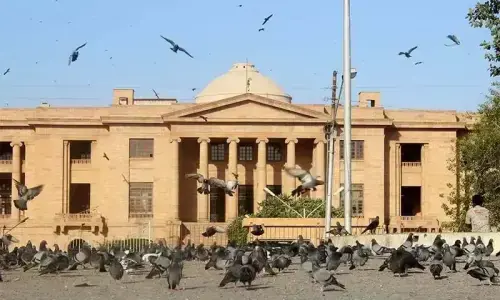
The Aligarh Muslim Old Boys' Association Karachi had arranged the function on Saturday night, which, among others, was also attended by the Chief Justice of the Sindh High Court, Justice Syed Ashhad. The ceremony was held in advance since the birth anniversary of Sir Syed, being October 17, was falling in Ramazan this year.
Justice Ashhad mentioned that he felt proud to belong to an Aligarhian family and heartening to know that the mission of Sir Syed Ahmad Khan, aimed at the promotion of education and science and uplifting of the Muslim society, was being kept alive by his followers in the country. "The nations, which forget their leaders and guides, are also lost gradually," he remarked.
He said that Sir Syed come forth in a situation when Muslims of the sub-continent were very much depressed after the collapse of the Muslim domain in the region. Sir Syed showed the Muslims the path to rejuvenate their society and overcome the shocks and hatred inflicted on them by the British rulers, he added, saying that after the 1857 freedom movement, Muslims were almost detached from the economic stream.
He said that Sir Syed realized the importance of modern education for Muslims of the sub-continent and worked in that direction with an unflinching determination, which led to establishment of the Anglo Oriental College and many other educational activities.
The Aligarh University proved a centre of excellence in the 19th century, with the Muslims aspiring for higher education coming there from various parts of the sub-continent, he said.
He added that graduates of the varsity successfully shared the administrative loads of the new government of Pakistan after 1947 as well. Sardar Mushtaq Ahmad Rahu said that Sir Syed knew that English was not only the language of his era but would be a dominating language in the future as well and that is why he persuaded the Muslims, despite many oppositions, to get education in English.
Lauding the efforts of Aligarhians in the development of educational institutions in Karachi, he urged the association to establish educational institutions in the interior of Sindh as well.
Dr Farman Fatehpuri said that Sir Syed was among the biggest personalities produced in the nineteenth century. What he did on the educational, literary, social and political fronts remained unmatched during the century, he mentioned.
He said that Sir Syed with his literary contributions and books not only wanted to put to rest false impression against Muslims of the sub-continent, but also desired to link the past to the present, which would ultimately pave the way for a brighter future for Muslims.
He was a great success in politics as well. He introduced the two-nation theory in 1867, after the formation of Congress, by saying that Hindus and the Muslim were two nations and could not live together.
Referring to the short sighted ness and lack of education among his opponents, Dr Farman said that Sir Syed never bothered about that and he always kept his eyes on the target.
He was enlightened and sharp, but also had a humorous style of communication, he added, saying the importance of his (Sir Syed) works would continue to increase with the passage of time.
General (retd) Ghulam Umer said that in view of the deteriorated economic conditions and social downfall of Muslims, Sir Syed gave the philosophy of western education and politics of education, which finally shaped up as the Aligarh Movement.
He stressed upon the need of adhering to the policies and teachings of Sir Syed in the present days as well. The president of Aligarh Old Boys Association, Z.A. Nizami, apprised the audience about the works done by the association in the city and its future programme.
He informed the members that the association had decided to grant its "associate membership" to the wards of an aligarhian-father or mother, since the migration of people from Aligarh had now stopped.