0
0

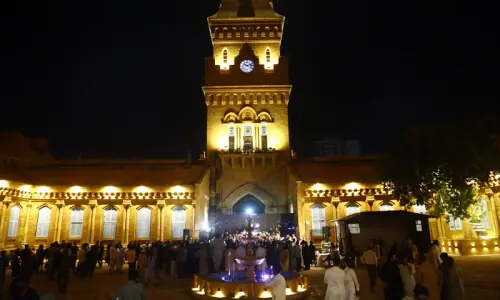
KARACHI, Oct 8: To pay tribute to Karachi, an exhibition entitled Jewel in the Crown opens at the Mohatta Palace Museum today (Saturday).
Organized by the Dawn group of newspapers and sub-titled 'Karachi under the Raj 1843-1947', the exhibition seeks to recapture those golden days of history when Karachi emerged as the premier city of Sindh. And travel across time, when Sindh and Karachi acted as the crucible for the growing nationalist movement - the south in the making of Pakistan and Sindh and Balochistan in the making of the nation.
When Jewel in the Crown originally opened on the occasion of Dawn's December 2003 All About Lifestyles show at Karachi's Expo Centre, it achieved a national record-breaking attendance of over 250,000 visitors in 36 hours.
Now the directors of the Dawn group of newspapers and the trustees of the Mohatta Palace Museum have transformed this phenomenally popular promenade exhibition into a museum exhibit.
Expanded exponentially, it records in great detail the transformation of a dynamic, superbly administered and brilliantly planned port city into the sprawling, chaotic, yet vibrant metropolis that Karachi is today.
"In undertaking an exhibition of the magnitude of Jewel in the Crown," says exhibition co-curator Hameed Haroon, "our intention was to evoke the period in our history that saw Karachi's emergence.
To remember the families, the communities, the public servants, the educational and civic institutions, the men and women, whose selfless commitment to the fortunes of Karachi, secured a meteoric rise. And finally, perhaps to raise an awareness from amongst a new generation of citizens of their city's heritage and why it should, at all costs, be preserved."
Among the thousands of historic exhibits in the exhibition are priceless antiques such as the silver and gold thrones from the former princely state of Kalat and the Quaid-i-Azam's state-of-the-art Rolls Royce. A 19th century fire engine (it still works) graces the museum's drive.
Whole rooms in the museum are filled with the fascinating memorabilia - personal effects and riveting photographs - of the prominent leaders of the freedom movement. The Quaid was born in Kharadar, in the heart of Old Karachi, while Aga Khan-III was born in Honeymoon Lodge, the historic little residence perched on a hillock of what is now the Defence Housing Authority.
Statuary - both marble and bronze - rescued from the dumps of the KMC has been lovingly restored and moved to the museum grounds as permanent displays. According to co-curator Abdul Hamid Akhund, "if one glances at the condition of the statues in this exhibition that once decorated civic monuments, parks and street landscapes in Karachi, one is left with an inescapable conclusion of waste and intolerance.
We spend our time hammering away incessantly at the remnants of the material culture of the Raj - indeed, most of the statues exhibited at this exposition were defaced and buried 20 feet under the ground until a governor of Sindh a few years ago was successfully moved to order their exhumation."
Writing in Karachi Through a Hundred Years, Herbert Feldman had regretted that "By comparison with many cities in the subcontinent, Karachi, it must be admitted, is something of a parvenu.
Unlike Peshawar or Lahore - to name but two - whose origins are lost in the mists of legends, Karachi boasts no ancient lineage." That may be so but Jewel in the Crown: Karachi under the Raj is a veritable treasure trove for anyone with a sense of history.
For those with a passion for the past, this massive attempt to document and archive Karachi's past should be a truly unforgettable experience. Accompanying this comprehensive exposition - the largest museum exhibition to be assembled in the history of Pakistan - are a whole slew of publications.
These range from books of photographs to historical works to Requiem for an Unsung Messiah, an anthology-cum-translation accompanied with four audio CDs of great interpreters such as Madam Noor Jehan, Farida Khanum, Malika Pukhraj, Mehdi Hasan and many other younger vocalists singing the marvellous poems of Faiz Ahmed Faiz. The poet lived for many years in Karachi when he served as principal of the Haji Abdullah Haroon College and looked after the Haji Abdullah Haroon Yatimkhana in Lyari.
The Raj Quartet consists of four companion volumes to the Jewel in the Crown exhibit. It begins with Karachi: Vision of Empire, which charts Karachi's awakening and its transformation from a small coastal village, peopled mostly by fisherfolk, into a prosperous cosmopolitan port city of imposing public buildings, impressive gardens and fine homes - a veritable "jewel" of the East.
Karachi: Pillars of Empire, the second volume of the Quartet, shifts the scene away from the city's urban grandeur, to the dustier plains of Sindh. Here the entrepreneurs, philanthropists and public servants of Karachi: Visions of Empire cede the limelight to an assembly of tribal rulers, chieftains, and landowners, accompanied by their attendants and an assortment of administrators, bankers, dealers, regimental soldiers, purveyors of food and drink, musicians and courtesans. Then the two volumes of Karachi: Beyond Empire bring to a close the Raj Quartet. In these two volumes we find ourselves literally beyond empire, face to face with the post-colonial reality that is Karachi.
A breathtaking portfolio of photographs by one of Karachi's most talented young photographers, Arif Mahmood, Karachi: Beyond Empire is about how we experience Karachi today. More than a superb collection of photographs, it is a permanent record of Karachi's post-colonial legacy, taken during the most vulnerable period of its history.
Any attempt to examine what interests the urban Pakistani most would put public affairs, art and fashion at the top of any list. Like the rest of the world, Pakistan today has caught celebrity fever.
No matter how brief their encounter (fifteen minutes?) with fame, by the favour and interest we bestow upon them, our celebrities have become our very own "haute noblesse."
For newspapers encountering these faces is a matter of routine, the haute noblesse of Pakistan are the staple of our daily reportage, their activities and proclivities fill our national and metropolitan pages.
Now with the book I, Voyeur: Going Places with the Haute Noblesse from the Photo Albums of Tapu Javeri, Dawn brings these portraits to a wider yet equally discerning audience - that of the urban and urbane Pakistani, an audience that forms a significantly large part of this newspaper's constituency of readers. Portrait by brilliant portrait, I, Voyeur unveils a bigger picture. A picture of our times as lived by the haute noblesse and recorded by the voyeur's unblinking eye.
These are only a few of the books that will be available at the inaugural ceremony but by the time the museum exhibition opens for public viewing, there will be a total of some 17 publications.