0
0

ISLAMABAD, Oct 2: All regulatory bodies in Pakistan are working freely to benefit the people and ensuring fair rate of return to attract investment.
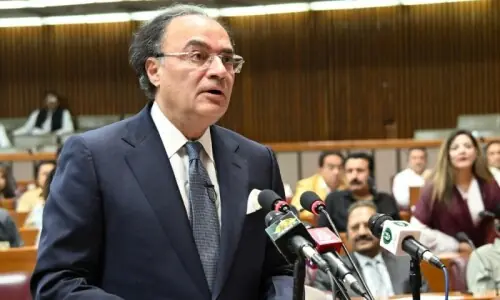
This was stated by Dr. Abdul Hafeez Shaikh Federal Minister for Privatization and Investment while inaugurating the 6th Core Training Programme on Infrastructure Regulation and Reform organized by the South Asia Forum for Infrastructure Regulation (SAFIR) on Saturday.
While giving an overview of Pakistan's regulatory framework the minister underlined the need of separating regulation activity and policy making because of conflict of interest, according to an official handout.
Regulatory bodies in Pakistan were performing effectively and contributing a lot in resolving complex issues like multi-year tariff in case of public sector utilities being processed for privatization, he said.
Dr Shaikh informed the participants that Pakistan had done a reasonably good job in establishing independent regulators for electricity, telecom, banking and other related area.
Seventy participants from nine South Asian countries are attending the course designed to enhance the economic, financial and strategic skills of a select group of senior utility regulators, regulatory specialists, government officials and senior expert staff in regulated companies from the region.
In his keynote address Mr Ian Alexander of South Asia Energy and Infrastructure Unit of the World Bank said that service provisions to the consumers, and to set prices and rules for better competition, were the areas always finalized by the regulators. A lot of work has been done as regard to the electric sector while work was still under way for the gas sector, he added.
Dr R.K. Pachauri, Director General, TERI, India, said that there were common areas of interest, which could be developed through collective efforts. Lt-Gen Saeed uz Zafar, Chairman, Nepra, termed the course as an opportunity to develop inter-personal institutions and to share the experiences of the participating countries.
He said that the course would provide a strong understanding of the theory and the practice of infrastructure reforms.
The chairmanship of SAFIR rests with Nepra for this year.