0
0

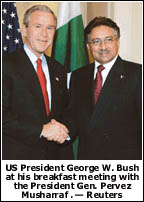
NEW YORK, Sept 22: Cooperation in the war against terror dominated a meeting between President George W. Bush and President Pervez Musharraf on Wednesday with a brief reference to the need for a sustainable democracy in Pakistan.
Neither side raised the most debated dispute in Pakistan whether Gen Musharraf should keep both the positions he holds now or quit one of them. To demonstrate his commitment to stay engaged with Pakistan for the long-haul, Mr Bush assured President Musharraf that his administration would keep its pledge to provide Pakistan $3 billion over a five-year period.
A joint statement issued after the breakfast meeting quotes President Musharraf as reiterating his commitment to democracy and his intent to strengthen the country's democratic institutions.
President Bush emphasized the need for continuing Gen. Musharraf's programme for "enlightened moderation," a phrase the Pakistani leader uses for advocating a gradual strengthening of democracy in the Muslim world.
"The meeting was held in a very cordial atmosphere as meetings between two friends should be," said Information Minister Sheikh Rashid Ahmed while briefing journalists. "The key issue was Pakistan's cooperation against terrorism with also an emphasis on enhancing economic ties," said Mr Rashid. "The US administration appreciates the sacrifices we are making in the war against terror."
The joint statement allays Pakistan's fear that Washington may abandon Islamabad once the war against terror is over. "President Bush once again emphasized the long-term US commitment to Pakistan and to the region," the statement said.
The understanding reached between the two presidents when they met at the US presidential resort of Camp David last year would be followed to broaden and strengthen bilateral relations, the statement said. But there is only one issue that has been repeated throughout the joint statement, the war against terror and the need for Pakistan's cooperation to defeat terrorists.
Besides a general assessment, and appreciation, of Pakistan's role, the two leaders also reviewed the progress of the joint working group on terrorism and law enforcement, indicating that the US president wants to stay engaged with this issue even to the level of the proceedings of a working group.
President Musharraf, however, availed this opportunity to raise an issue that he has been referring to in his speeches and statements during the visit, the need for addressing the underlying causes for terrorism. It was these causes that have given rise to disaffection and frustration in the Islamic world, said the president without mentioning specific issues such as Palestine and Kashmir.
The joint statement also addresses the issue of nuclear proliferation that has occupied policy makers in Washington since February when Dr A.Q. Khan confessed to selling nuclear technology to other nations. "The two leaders noted their cooperation to stop the proliferation of weapons of mass destruction, and committed to sustain full efforts towards this end," the statement said.
The two leaders also discussed the importance of building security and prosperity in South Asia, a phrase often used to underline the need for promoting better relations between India and Pakistan.
They also welcomed the growing cooperation in the area of science and technology under the umbrella agreement signed in June 2003. Sheikh Rashid said that Gen Musharraf's scheduled meeting with the Indian prime minister on Friday was also discussed "but we will talk about it after the event."
"President Musharraf expressed appreciation for the close collaboration and looked forward to building on this solid foundation in the future," said the joint statement. "Both presidents agreed to further expand and deepen bilateral relations to the mutual benefit of the two countries.
US Secretary of State Colin Powell, National Security Adviser Condoleezza Rice, Assistant Secretary of State for South Asian Affairs Christina Rocca, the White House Chief of Staff and a White House anti-terrorism expert assisted President Bush in the meeting.
The Pakistani delegation included Foreign Minister Khurshid Mahmud Kasuri, Information Minister Sheikh Rashid, Pakistan's ambassador-designate Jehangir Karamat, the president's military secretary and the acting Pakistani ambassador in Washington Mohammed Sadiq. Later, the two leaders also had a one-on-one meeting for 10-15 minutes.
WAR ON TERROR: US Secretary of State Colin Powell said on Wednesday that Pakistan was doing everything it could to wage a war against Al Qaeda and terror groups in Afghanistan and the tribal areas.
Asked about President Bush's meeting with his counterpart Pervez Musharraf, Mr Powell told reporters: "President Musharraf had good conversations. He, his military and other security forces have been doing quite a lot in the western part of the country and in the tribal areas along the border."
Asked whether Mr Musharraf would deliver Al Qaeda leader Osama bin Laden before the November elections, Mr Powell said: "We all would like to find Osama bin Laden tomorrow. But he is pretty good at remaining hidden. And he is, I think to some extent, a problem, but is quite isolated in his ability to move around."