0
0

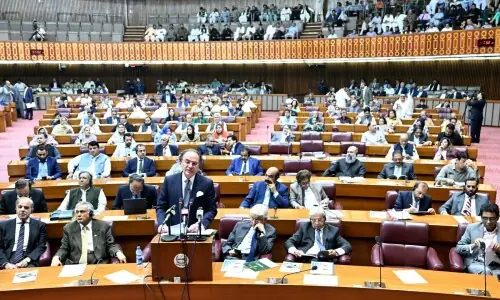
ISLAMABAD, Sept 14: The government on Tuesday rushed through the National Assembly a bill designed to curb nuclear proliferation amid objections by the opposition. The bill bans export of materials or technology related to nuclear and chemical weapons and its violation will be punishable with up to 14 years in prison, a fine of up to Rs5 million and forfeiture of assets.
The opposition objected to the government's rush to have the bill passed without waiting for the report of a National Assembly standing committee, though they said that by and large they supported the aims of the law.
The government rejected appeals by the opposition to refer the draft to a standing committee and amendments moved by the Muttahida Majlis-i-Amal before the ruling coalition passed 'The export control on goods, technologies, material and equipment related to nuclear and biological weapons and their delivery systems bill'.
Some opposition members accused the government of rushing the bill to please the United States. At least two of them linked the move to a visit by US Under-Secretary of State for Economic, Business and Agriculture Affairs Alan Larson.
The government did not agree with demands by several members from the Alliance for the Restoration of Democracy and the MMA for an immediate formation of a standing committee or a select committee to examine the bill.
Minister of State for Foreign Affairs Khusro Bakhtiar said a lot of discussion was held between the ministries concerned and experts before the bill was drafted. He said an illegal network involved in nuclear proliferation had been 'dismantled'.
"As a responsible nuclear weapons state, Pakistan is cognizant of its obligations to prevent proliferation of weapons of mass destruction and related technologies," a statement of objects and reasons accompanying the bill said.
"The bill is an important legislation to regulate and control export, re-export, trans-shipment and transit of goods and technologies, material and equipment related to nuclear and biological weapons and missiles capable of delivering such weapons," it said.
It said the bill would fulfil Pakistan's international obligations under the United Nations Security Council Resolution 1,540, adopted on April 28, and "strengthen its credentials as a responsible nuclear weapons state".
The resolution made it mandatory for each country to strengthen controls over sensitive materials and technologies. The bill said the original trial of a person contravening the law would be held by a sessions court, whose decision would be appealable before a high court.
"Any person who contravenes any provision of this act or any order, rules and regulations framed thereunder, or provides false information concerning matters governed by this act," would face the punishment, it said.
It said any person attempting to commit or abetting an offence under the law "shall be proceeded against in the manner as if he had committed such an offence". "In case the offence is not serious for criminal proceedings, administrative actions, which may be determined from time to time, shall be taken against individuals contravening any provisions of this act," it said.
The quorum broke briefly during the sitting in the afternoon, holding up proceedings before the minister moved for the consideration of the bill after a suspension of rules requiring the day to be devoted to private members' business.
"Why should the government do a good thing in a wrong way?" Aitzaz Ahsan of the People's Party Parliamentarians asked and said the law would require many amendments within months after its deficiencies were realized.
"Now, with the gun pointed to our temples, we are required to pass it," he remarked about the government's hurry which, he said, had "created a suspicion of malice and collateral intent" to meet someone else's desires.
Pakistan Muslim League (Nawaz) parliamentary leader Chaudhry Nisar Ali Khan said the bill was deficient in providing for the security of the country's nuclear programme.
The MMA's Liaquat Baloch said he feared the government's haste in getting the bill passed could be a precursor to US pressure on the country to sign the nuclear Non-Proliferation Treaty and the Comprehensive Test Ban Treaty.