0
0

WASHINGTON, Aug 25: US lawmakers and members of the 9/11 Commission have once again emphasized the need to stay engaged with Pakistan, describing President Pervez Musharraf as an "unquestionable ally" in the war against terrorism.
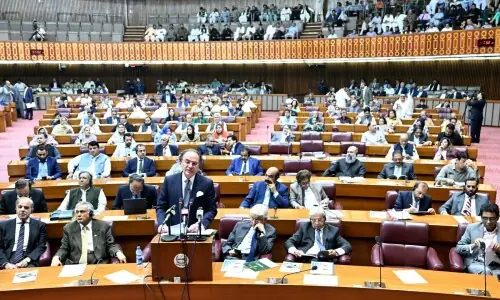
The debate over Pakistan's role in the war against terror dominated a hearing on Tuesday at the US House International Relations Committee, which is reviewing the commission's recommendations on public diplomacy.
The discussion on Pakistan revolved around three major themes, democracy, the need to curb anti-west teachings in madrassahs and nuclear proliferation. As some lawmakers emphasized the need to bring full democracy to Pakistan "pointing out that in some Muslim states America's failure to support representative governments led to a rise in terrorism - the discussion moved to the role President Musharraf is playing, both in his own country and in the US-led war against terror.
"We've also got to work with him, because he is unquestionably an ally in the war on terror," observed Thomas Kean, chairman of the 9/11 Commission. "At the same time helping him to make changes that we think will be beneficial not only to us but to him in the long run in his own country," he said.
At this stage, one of the lawmakers interrupted him, saying that while Mr Musharraf is committed to fight terrorism, his intelligence agencies are not. He then claimed that madrassahs in Pakistan were still spewing hatred against the West.
"I think we've got to help in the schools. There aren't any schools; there are just those madrassahs. There's no alternative. Parents don't have anyplace to send their children," said Mr. Kean.
Referring to the tribal areas where Washington says Al Qaeda terrorists are hiding, Mr. Kean observed that the Musharraf government does not have "control of certain northern regions" but the United States needs to work with him to bring those areas under control. The commission's deputy chairman, Lee Hamilton, however, said that Pakistan "presents a tough problem to American foreign policy today."
And then he used a negative logic, often used by the US media to browbeat Islamabad, for continuing to support Pakistan. "The ultimate nightmare is for an Islamic radical government to get a hold of a nuclear weapon, and that's possible in Pakistan today," said Mr. Hamilton while explaining why Washington needs to stay engaged with Pakistan.
Mr Hamilton claimed that Dr A.Q. Khan had "created the Wal-Mart of nuclear weapons," which was an awesome danger to the world and to the United States. "We have a lot of problems with Musharraf - on terrorism, on proliferation, on a lack of democracy, and other matters, but you have to balance all of these things," he said.
Steve Chabot, a Republican Congressman from Ohio, said he met President Musharraf in January who complained that he did not have the right equipment, such as helicopters, to catch Osama bin Laden and his associates. He urged the US administration to provide the assistance Pakistan needs to deal with the Al Qaeda suspects.
"I believe that we do have to support Musharraf, in every way possible, to seal that border," Mr Hamilton said. "It's a very difficult political problem for Musharraf. Remember, there was an assassination attempt on him not very long ago. So we have to make allowance for that."
The United States, he said, needs to "have the cooperation of Musharraf" to fight terrorism in South Asia. "We can't do it without him. And that's why we're in this difficult spot," he added.
Jointing the discussion, Mr Kean said: "Musharraf is a real ally. You know, when people try to kill you twice, it concentrates your mind wonderfully. And he is devoted to the war on terror, as are we. And he would like to get (Osama) bin Laden just as much as we would."
Ron Paul, a Republican Congressman from Texas, said that America's failure to support democracy in countries like Pakistan had led to a rise in extremism. "In those fatwas (by extremists) are grievances against American foreign policy," agreed Mr Kean.