0
0

The secretary-level trade talks between Pakistan and India, held as last leg of the process of composite dialogue, ended recently without any concrete development. While India pressed for the grant of 'most favoured nation' (MFN) status, Pakistan simply denied the same softly, linking it with progress on other outstanding issues.
Areas now making Pakistan and India respectively constituted a single economic unit for centuries. Business activities flourished freely in those days. Even after independence, we were largest trading partners of each other for some years.
In 1948-49, 32 per cent of Pakistani imports originated from India while a lion's share of its exports, 56 per cent, found destinations there. What happened afterwards? The rising political tensions and subsequent wars crippled economic relations. The bilateral trade stands at very low levels as compared to that period.
South Asia is home to some half a billion poor of the world. One of the major reasons behind this malaise is that we don't trade where we can do it more easily, i.e. with each other. Just have a look at what the countries of other regions of the world have achieved by integrating themselves, economically and politically.
Apart from the glaring example of the European Union, countries of ASEAN and MERCOSUR blocks have catching experiences. Increased trade over there has not only taken them up economically but also helped in improving mutual understandings.
Both India and Pakistan have created hindrances to free movement of goods and services between them. Pakistan restricts imports from India by maintaining a "positive list" of exportable items and has so far denied MFN status to India, a general principal of GATT/WTO.
While India boasts the MFN status it granted to Pakistan in 1995, many a non-tariff barriers (NTBs) are still there, limiting imports from here to abysmal figures.
The National Tariff Commission of Bangla Desh recently identified 10 non-tariff barriers hindering their own exports to India, though we have no study identifying the real impact of NTBs for our exports.
However, it can be gauged from seeing the figures of whatever documented trade we have, as balance has been largely in favour of India, except for the year 1998 when Pakistan exported surplus sugar.
Volume of bilateral trade in recent years ($ million) Year Pakistan's Exports Pakistan's Imports Balance 1997-98 90.575 154.531 -63.96 1998-99 186.232 153.992 +32.24 1999-00 53.648 127.398 -73.75 2000-01 55.410 238.330 -182.92 2001-02 49.340 186.809 -137.44 2002-03 70.664 141.328 -95.845 2003-04 93.68 382.36 -288.68
It is yet another fact that this protectionism has helped neither Pakistan nor India. Go to any major market in any Pakistani city or town and you will have no difficulty in finding goods coming from India. These will include everything, yes literally everything. Retailers claim that Indian tea sells well.
Truckers use "made in India" tyres commonly. Even things like shaving blades manufactured in India attract the poor, as these are cheaper. Products of Indian heavy industry like iron ore, machinery and even cement have a well-established market here. Pakistan goods, mostly food products and synthetic fibres can also be found in Indian markets easily.
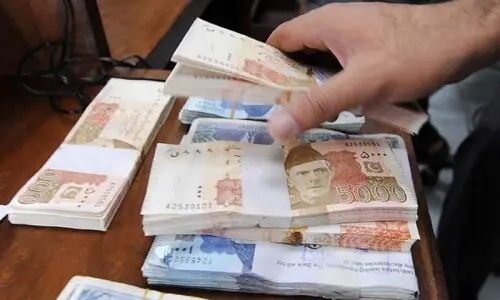
How these commodities reach across border? Behold. While legal trade is around a quarter billion, experts estimate that smuggling between two countries stands at around $2 billion, or even more.
Such a restrictive environment makes the smugglers winners, while legitimate producers, traders and consumers fall in the losers' category. Even bigger losses are the in the shape of government revenues, much needed on both sides.
Pakistani owners of textile plants have to buy Indian machinery via third countries, spending a lot more extra freight charges and importantly, consuming extra time in deliveries. Trade through third countries, mostly Dubai and Singapore, is estimated at another $1-1.5 billion.
Free bilateral trade will hurt no one, it never does. Enhanced trade linkages instead result in up-swinging the economic activities, creating a win-win situation. Analysts believe that trade volume between Pakistan and India has a potential to reach $5 billion mark in quick span of time if restrictions, apparent and hidden, political and non-political are removed.
It is not hard to gauge the economic activity it may generate, jobs this can create, and revenues it can provide to ease the financial hardships of respective governments. Leadership in both India and Pakistan have always served the interests of domestic industry, mostly inefficient and uncompetitive, and let the consumers suffer, at their mercy.
Increased competition will help end this exploitation as well on both sides. Political tensions and disputes have driven the business links for long. It is time to remove these hurdles for the prosperity of our people. What difference can peace and normalcy mean for business in South Asia can be assessed from the following figures.
In last financial year (2003-04), during which the two sides initiated and furthered peace endeavours, volume of bilateral trade reached $476 million, more than hundred percent, from $ 237 million in the last fiscal year.
The time has come to start trading goods and services, not hostilities. Rulers on both sides have to realize that they have to continue the process of normalization. One factor that strengthens hopes in this regard is that both of the archrival countries will have economist government heads soon, as Shaukat Aziz is all poised to take the seat of Prime Minister during this week.
Let the people of Pakistan and India sell and buy what they want and more importantly, what they need freely from each other for mutual benefit. The need of the hour is to lift the millions trapped in absolute poverty in the region out of it.