0
0

Why fiddle with the system?
We are being told once again by worldly-wise and presumably astute men that the Constitution of 1973 is not workable, that our present system of governance is not functional, and that it must be changed.
It is not clear which system it is that is not working. For surely it is evident that we have two mutually incompatible systems in place. There is one that is written out in the books (The Constitution and laws). Then there is the system in actual operation. It does not formally repudiate the constitutionally mandated arrangements, but it perverts them to suit the arbitrary will of certain wielders of power in the state.
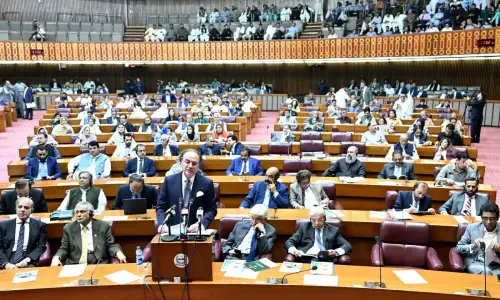
Let us see what the two systems are like. The Constitution calls for government by the consent of the governed to be given through elected representatives. They are to assemble and appoint an executive, consisting of a prime minister and such other ministers as he may want to have.
The executive is made answerable to the National Assembly and serves during its pleasure. The assembly authorizes taxes the executive may levy, approves the subjects on which the proceeds may be spent, and makes such laws as may be needed with the concurrence of a second body of representatives called the Senate.
The Constitution provides for a president to serve as the formal head of state and government. In its original version, the one adopted in March 1973, all of the president's decisions and acts had to have the prime minister's concurrence in order to be valid. The amended versions gave him a measure of discretionary authority in a few designated areas but required him to act upon the prime minister's advice in all other matters.
These arrangements, taken together, are known as the parliamentary system of government. It is assumed that political parties will come into being, that they will manage elections, and that subsequently, either one or a coalition of some of them will form a majority in the assembly and supply the prime minister and his cabinet colleagues. They will be, in fact, responsible to this majority and remain in office as long as they retain its support.
For facility of reference, let us call this package of arrangements our "formal system." The proponents of change allege that it does not work well. That, in my view, is only a half-truth. It worked well between September 1947 and October 1951, when Liaquat Ali Khan was the prime minister, and during the five years when Zulfikar Ali Bhutto held that office.
It has simply not been allowed to work during the rest of our history. First, the higher bureaucracy aided by the army, and then the army aided by the bureaucracy, has either ruled the country directly or manipulated its politics and governance covertly. Army rule, or the army's predominance in governance, may be called our "actual system."
How does this actual system work? During periods of time (1958-62, 1969-71, 1977-85, 1999-2002) it has operated plainly as a dictatorship. Other times, when the army exerted dominant influence from behind the scenes, the situation has been somewhat complex and needs to be elucidated.
Our generals became convinced fairly early in our history that of all the political and governmental institutions in the country the army was the best organized and most coherent, disciplined, and efficient. They went on to reason that they were therefore entitled to rule. They should govern covertly when they could not do so openly. But, in order to legitimize their overlordship, they must discredit the political system by making its functionaries appear incompetent and its institutions dysfunctional.
Their secret agencies, notably the Inter-Services Intelligence (ISI), bribed or intimidated politicians to split political parties into factions. They encouraged and funded factional conflict, sponsored political alliances and counter-alliances, brought new parties into being and, above all, rigged elections. They spread corruption all over the place.
Politicians in the country were not noted for competence, probity, and dedication to the public interest. The army's activities mentioned above made them more undisciplined, lusty of personal gain, devoid of institutional loyalty, and indifferent to their professed mission than they had been ever before. The "agencies" had succeeded in their design. Parties remained or became loose and shifting alliances of self-serving landed aristocrats and other wealthy individuals. Legislators showed little interest in performing their assigned function. They wanted high offices, money, and other good things as the price of their support for the government of the day.
The potential for these attitudes and corrupt practices may have existed all along. But there can be little doubt that the politicians' susceptibility to fickleness and corruption burst forth unabashedly as a result of the ISI's encouragement and manipulations.
We may now ask if the "actual" system (military rule or the military's covert dominance) works well. That depends on who the beneficiary is. If the gratification of the higher-ranking officers is the object in view, the system should be rated highly. But if the country's integrity, domestic peace, internal order, security of life and property, enlightenment, and modernization are also to be taken as worthy goals, then we will have to say that the system is not working well at all. Indeed, it is a disaster.
The above statement of the workings of our formal and actual governmental systems points to the following tendencies as the givens of our situation: (1) the army's aspiration, indeed determination, to have a controlling say in the conduct of our defence, foreign relations, and such other affairs as it may, from time to time, consider deserving of its attention; (2) inclination of both officers and politicians to subordinate the imperatives of public interest to considerations of personal advantage; (3) low level of proficiency among politicians in the arts of associating together in pursuing common goals, and the resulting propensity to factionalism.
Is it rational to expect that these givens will cease to be operative if we change the shape and form of our system (moving from parliamentary to presidential) or institute new balances of power and authority between certain functionaries within the overall framework of parliamentary government (adopting the French system)? I don't think so.
Nor can it be said that in a presidential system it will not matter if the parties are fluid and disorganized, and if their members come and go as expectations of personal gain draw them in or out. If this becomes their standard operating procedure, the system (presidential or any other) will become chaotic and simply collapse.
If the president and his agents are responsible for sponsoring legislation and for bringing a budget to the legislature, as they must be, they will go crazy as well as bankrupt if they have to go after each individual legislator to negotiate his or her support each time they want to get a measure passed.
No one in his right mind will argue that the incidence of corruption is irrelevant to the efficacy of a system of governance, or that a presidential system can work well even if corruption among politicians is rampant. Nor can it be established that a presidential system will mitigate, while a parliamentary system encourages, political corruption.
That the executive in a presidential system does not need the legislature's ongoing support for remaining in office does not change the fact that it does need the latter's cooperation for obtaining access to funds and for implementing its agenda.
An additional word about the army's aspirations for governing authority would seem to be appropriate. We cannot assume that under a presidential or quasi-presidential (French model) system the president will be a serving or even a retired general with the army standing at his beck and call. If he is to reach this office by a popular election, he will most likely be a politician. Again, he will most likely belong to one of the major parties in the country.
What is the likely pattern of interaction between him and the serving generals? Will they stop coveting higher-ranking jobs in the civil services, ambassadorships, lands, plots, licences, businesses, bank loans for bogus enterprises or, if we move to another dimension, stop wanting to direct our defence and foreign policies, or discontinue their multifarious intervention in our domestic politics?
Will the generals undertake these acts of self-denial simply because the country has moved from a parliamentary to a presidential system or adopted one that is a mix of these two? It would be the height of political immaturity to think that, yes, they will.
Let us assume for a moment that we adopt constitutional amendments that bring our president on par with the French president with regard to defence, foreign relations, and appointment to a few designated posts in the government. Will that satisfy our man in the president's house? Will he then let go of internal law and order, extremism and sectarian violence, central-provincial relations, local government and district management, and enterprises of national "reconstruction," to name just a few subjects. I am not at all sure that he will want to remain within the bounds of his constitutionally appointed domain.
Corruption, incompetence, indecisiveness, lack of direction, inadequate commitment to the public interest, timidity in the face of domestic forces of disruption, subservience to foreign powers result largely from our native traditions of personal and authoritarian rule, persistence of a feudalistic ethos, and the incongruity between these elements and our people's aspiration for political participation. The inadequacies of governance in Pakistan have nothing to do with organizational design and the formal distribution of authority between organs of government.
If we are looking for improvement in governance, we must shift our gaze away from forms and find ways of eradicating the feudal ethos of which our ruling elites are possessed. We have also to spread the awareness that personal and authoritarian rule will not go away until all of us begin to respect the relevant institutions and work to enhance their inner vitality.
The writer is professor emeritus of political science at the University of Massachusetts at Amherst, USA.
E-Mail: anwarsyed@cox.net
Political culture unchanged
Has General Musharraf in his five years of rule, three of which untrammelled by a parliament, been able to make a difference to the political culture of the country? Most of the people would say "hardly any" while others would assert it has deteriorated.
The doubts cast on the fairness of the general elections and the calibre of the assemblies it threw up, the devices used to muster a majority, performance of the government, opportunism exhibited by sections of the opposition at turning points crucial to the supremacy of the parliament have all combined together to dampen the enthusiasm of the people in the democratic process and institutions.
The best proof of this waning interest came in the recent byelections in which the voter turn-out fell to less than 25 per cent. Considering that the turn-out in percentage terms was 45 in 1990, 40 in 1993 and 35 in 1997, the compelling conclusion drawn is that the people are now more disillusioned with the conduct of their leaders, whether in the government or in the opposition, than they were in the previous decade. The disillusionment is more with individuals than with the systems or party programmes.
It is hard to recall a good law enacted by the parliament or a bad one repealed. No questions are asked to expose the inefficiency or corruption of the government departments nor resolutions moved to right the wrongs suffered by the people.
The question hour of the prime minister which is a much awaited and exciting moment in the British House of Commons (a model for us), has not been held, perhaps, even once in the two years of the present parliament's existence. Our parliamentarians would be tempted to follow the Westminster example if they were to see Tony Blair face the barrage of trenchant questions on the invasion of Iraq by Michael Howard and Charles Kennedy, and how cheerfully and adroitly he deflects or answers them.
It is such debates in the House of Commons which win or lose the public votes for the contending leaders. Here, the Wana operation has hardly ever found a mention in the parliament. The public learns of it only through the one-sided accounts coming from the army spokesman or press reports based on various sources. Our prime ministers are interested only in "carrying everybody along" not by argument but by bait.
The speaker of the National Assembly and chairman of the Senate invariably enable the treasury benches to ram the important legislation through both Houses suspending the rules of procedure without referring the bills to the committees or circulating them to elicit public opinion. On the other hand, where the government is wary to act, like the repeal or rationalization of the Blasphemy and Hudood laws, the drafts are either not taken up or are handed over to an ideological council (as is the case with these laws) for consideration and remain there for long.
Thus, while the parliament remains a bastion of banter and rowdyism, governance has been made a victim of reforms which are neither implemented nor repealed but are under constant review to accommodate competing interests.
The essential feature of the new police law promulgated two years ago is to transfer the supervision of the police force and its accountability from the provincial government and executive magistrates to a hierarchy of public safety and complaint commissions which have either not been formed at all or are moribund. A retired conscientious civil servant who was appointed to head the complaint commission in Sindh has been told to be content with his pay and perks and not bother about the complaints. He is quitting.
The confusion in the local governments is best illustrated by a recent disclosure by the Hyderabad city nazim that while he was able to spend only Rs 55 million on development, Rs 2,500 million had lapsed. Former prime minister Jamali promised a "package" of Rs 10 billion but not a rupee was sent. Former Governor Soomro committed Rs 500 million but only Rs 120 million were released.
The police and the local government are both caught between the rock of the federal government (which is the author and financier of the new systems) and the hard place of the provincial government (which is unwilling to surrender its authority to the commissions, the councils and the nazims). The conflict is ongoing, damaging and wasteful but not unexpected. The whole scheme was written by a general who was barely aware of the ground realities. Now it is being reviewed by an American business graduate who is even less aware. No doubt the failure has been comprehensive and costly.
As Chaudhry Shujaat's 45-day long populist era draws to a close, Shaukat Aziz must brace himself to tackle the issues of governance leaving Chaudhry Shujaat to revel in the pandemonium of the parliament. The worsening law and order situations and the rising crime may be largely attributed to external pressures and internal stresses but an administration with a clear charter and direction could still make big difference.
A lonely nazim without control over the agencies enforcing the law or over courts punishing its breach is helpless. The safety commissions exist only on paper, if at all. Mr Aziz has to give a new orientation (not a vision) to the affairs of the state and also resolve many contradictions inherent in its Islamic "ideology" and actual practice.
To the people, so far it signifies little more than laws that punish but do not help. To boot, the NWFP government has now taken it upon itself to demolish buildings in which prayers are not held. The people have yet to experience the just and caring touch of Islam through their government.
To introduce Islam with democracy, equity and progress, Pakistan has to look to the counties like Indonesia and Malaysia and not Saudi Arabia where elections are rejected in any form as unIslamic, or Turkey where the western culture predominates, or Sudan which has become a world metaphor for brutality and misery, or even the revolutionary Iran where elections are sternly regulated by the Ayatollahs.
Lastly, here is a counsel for the people of Sindh's Thar desert now that Mr Aziz has been foisted on them. Though he would be seeing his constituents for the first time, he could do more for them than all of their own Ranas and Arbabs put together did in the past.
Thar has one of the largest proven coal deposits of the world. Some 12 years ago, it was given out by the government that a Hong Kong billionaire Gordon Wu by name would be investing billions of dollars to develop a mine, build a road / rail up to it, also build a power station at the mines or cart the mined coal to it if it were to be built elsewhere. Wu has not been heard of since but the huge coal deposit, this government too confirms, is there waiting to be mined and used.
The Tharis should resolve to vote for Mr Aziz only if he undertakes to develop the mines and build a power station within the period he is their prime minister, reserve all unskilled jobs for them and also establish an institute for their training to acquire skills to operate the project in due course of time.
It is a God-sent opportunity for the poor of the Thar to drive a hard bargain for themselves. Their rich masters have been doing it all the time in their name but only for themselves.
How to be remorseless in politics
You can't get the right answer if you ask the wrong question. What is the wrong question: 'How long will the Manmohan Singh government last?' What then is the right question? 'How long will this government function?'
Governments have lasted before without being able to function, so there is no reason why they should not do the same again. This government consists of two kinds of partners. Allies like the DMK and the Telangana Rashtriya Samiti, which have no specific antipathy to the BJP, believe that their political demands will be honoured by this alliance. The TRS is convinced that it will get a separate Telangana state after November, and is ready to wait. The DMK is certain that the present equations will ensure victory in the next assembly elections in Tamil Nadu.
The bulk of partners are united by a single desire, to keep the BJP out of power, and, irrespective of differences, that motivation has not weakened. The Marxists may be genuinely upset by the budget proposal to increase foreign direct investment caps in insurance and telecommunications, but this does not mean that they want to open the door to the BJP.
And yet when an important Marxist like Sitaram Yechury warns the government that it cannot take support from the Left for granted, it is a wake-up call. A familiar of history is the king who reigns but does not rule. A government that functions is obviously something more than a bureaucracy that administers. Its purpose is defined by the direction it sets, with the economy as the key to the future.
The decision to raise FDI caps in selected industries, and divest a further 5 per cent in NTPC was critical in terms of the parameters that the Manmohan Singh government wanted to establish. The signal was that it would not be hostage to the well-known views of the Left.
The Marxist response could have been perfunctory, or vehement without being serious. It became serious because the FDI cap on insurance was raised.
Why is insurance so important? It is common knowledge that a former ambassador of the United States, Frank Wisner, resigned from the State Department after his tenure in Delhi to become a vice-chairman of American International Group (AIG), with a specific brief: to open up the Indian market to American insurance companies. Lobbying is still an impolite word in Delhi, but a perfectly respectable one in America.Wisner has spent substantial chunks of his time in India working the system to influence policy, including during the preparation of this budget.
Insurance companies hold perhaps the largest resource of capital outside banks. This money comes from that well-known person, The Common Man, who has invested against the uncertainty of post-retirement years, or as a legacy to his family in case of death. (Life insurance is a misnomer, or a 'semi-nomer'; death insurance is the more lucrative part of the trade, but the term is not used because of the feel-bad factor.)
A company like LIC sits on massive resources that are an obvious temptation to men who influence the economy by their control of capital. Mrs Indira Gandhi nationalized private banks, to wild applause from the Left, because she wanted to shift control of banking capital from the business elite. What FDI does is to permit foreigners to become significant owners, and decisive managers, of this resource base.
The Marxists may have been unable to choke capitalism, but they balk at the thought that Indian resources are being "gifted" away through the transfer of equity. Moreover, their electoral base will not permit them silence. The working class treats foreign equity in sectors like insurance as the death warrant of its protected rights, for the arrival of foreign ownership is tantamount to harsher working conditions and a threat to job-security.
This is what the Left means when it says that this decision goes against the commitment to continue reforms but with a human face: that human face is the face of the working class.
The Marxists also know that their real strength comes from their monopoly of power in Bengal; if they lose Bengal, the Left movement begins to dissolve. While the post-election difference in seats is generally substantial, the hidden fact is that there is not much difference between the Marxist and anti-Marxist vote in Bengal. The latter vote is conveniently split, but there is no guarantee that it will always remain split.
Nearly one-third of the seats in the Bengal Assembly, from Kolkata towards the north along the Hooghly river, are either directly controlled by the working class, or influenced by them. The Left Front cannot afford to alienate this core constituency.
The insurance market was opened to the world by the last government. Dr Manmohan Singh and finance minister Chidambaram gave a commitment in their budget that this would not be reversed.
Which brings us to a heresy that the ruling alliance will be loath to admit. But the fact is that as far as economic policy is concerned, the Congress is a natural ally of the BJP rather than of the Left. The Congress moved away from the quasi-socialism of Indira Gandhi in the nineties. "Reform" after all was a rebellion against the failed policies of the past, and who had set those policies except the Congress itself? A Congress-BJP government would produce a very smooth budget, heavily endorsed by the stock exchange and Frank Wisner.
The Congress alliance with the Left is built around a shared view of secularism; it is, therefore the Narendra Modi-RSS factor that keeps the Congress and the BJP apart, although in practice the Congress has played footsie with soft Hindutva when it so suited the party. Equally, the Congress-Left amity is vulnerable to economic policy. One side will have to compromise to sort out the tensions of this budget, and it will not be the Left, since compromise for the Marxists is electoral suicide. This is only the beginning.
This in turn is why alliance politics does not easily enter the Congress DNA. The Congress is blocked on both sides. The normal pattern of a five-year term in office is to take the tough decisions, which will bear fruit over a thousand days or more, in the beginning and keep the populism for later, when the government can alleviate voters' pain.
The Congress is trapped in Delhi, but in those states where it has a clear majority there is a marked rush in the reverse direction, towards instant populism. Electricity has become free for farmers in Andhra Pradesh. Such good news has no legs, because free electricity now means no electricity a couple of years down the line. Not a very good idea, therefore, to ask a voter for his invaluable support then.
Similarly, in Punjab, Captain Amarinder Singh, who was swamped in the elections, places a claim on water. It is commonplace in futurology studies that the next generation of wars across the world will be over water rather than oil, but trust Indian democracy to pick up wars from both the past and the future and place them at the service of the here-and-now. Has a calendar been sent to Congress chief ministers indicating that they should get ready for the next round of bloodletting known otherwise as a general election?
Congress chief ministers who lost in Rajasthan and Madhya Pradesh, after doing their best, have been rehabilitated in the party. Digvijay Singh and Ashok Gehlot have been made general secretaries of the AICC to lead the Congress back to victory in their states, now that incumbency is the headache of those who defeated them. One gets the impression of generals being positioned, troops being arrayed, and the political arsenal being stocked with generous handouts. This is sensible war-planning by Sonia Gandhi.
For a while we were led to believe that there would be dual authority in the country, but this is palpably wrong. There is only one authority, and that is Sonia Gandhi. Allies acknowledge it in their speeches in the parliament. Congress chief ministers check out decisions with Mrs Sonia Gandhi before they check, if at all, with the Congress prime minister.
Dr Manmohan Singh accepts the reality by sanctioning, from the PMO budget, an unprecedented throne room for his leader. Sonia Gandhi then sets the agenda for both government and her party. She is not going to make the mistake of initiating conflict. But she is not going to shy away from it either, if pushed once too often.
There is also the worry about unforeseen circumstances: what happens if the Supreme Court rules against Laloo Prasad Yadav, turns down his appeal against the High Court judgment and confirms his guilt? She is preparing for the dangers of incompatibility. Actually, the sooner it comes, the better for her, since the best time for war is when your gathering array is matched by the enemy's disarray.
There is a term in marketing that applies to electoral politics: Buyer's Remorse. This is the difference between the dazzle of the shop window and the look of a purchase in the less glamorous atmosphere at home. In politics this translates to hope before the elections and the reality afterwards. The trick, if you can manage it, is to go back to the voter before remorse sets in. You have to be remorseless to succeed.
The writer is editor-in-chief, Asian Age, New Delhi.