0
0

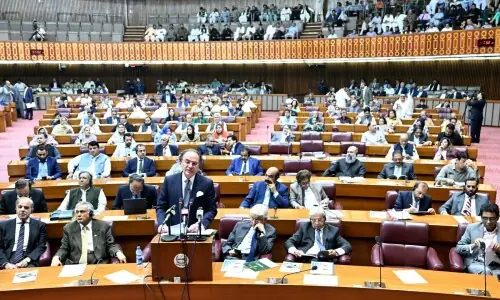
ISLAMABAD, July 19: Ignoring opposition objections, the government on Monday rushed a bill through the National Assembly to allow politicians to hold both government and party offices at the same time.
With a comfortable majority in the 342-house, the ruling coalition got the brief Political Parties (Amendment) Bill passed after the chair suspended a rule that required to give members at least two days to consider the draft.
The coalition ignored the opposition's calls for delaying the bill until after the August 18 by-elections or circulating it to seek public or religious opinion. The bill, which is to become law after its seemingly certain passage by the Senate, will rectify an irregularity to immediately benefit Prime Minister Chaudhry Shujaat Hussain and some government functionaries now holding party offices. It offers even bigger possibilities.
Later, the bill was sent to the Senate which is likely to take it up on Tuesday. Opposition members and other political sources said the new law would also clear the way for President Pervaiz Musharraf - if he so chooses - to head the ruling Pakistan Muslim League after he relinquished the office of the Chief of the Army Staff by the constitutional deadline of Dec 31.
The bill omitted an article in the Political Parties Order (PP0) 2002 that barred holders of elected public office from holding offices in political parties simultaneously.
Opposition members alleged that this restriction was originally placed to keep former prime ministers Benazir Bhutto and Nawaz Sharif from being elected and coming to power and now was being removed because, as stated by Mr Aitzaz Ahsan of the People's Party Parliamentarians, "the shoe is on the other foot and it pinches".
Not all opposition members were against the amendment itself but they opposed the bill because of its timing which they said was chosen to influence the by-elections to two National Assembly seats - one each in Attock and Tharparkar - that Finance Minister Shaukat Aziz is contesting to qualify for the promised office of prime minister.
Chaudhry Shujaat will have the benefit of the bill only for a short period as he holds the prime ministerial office only provisionally until Mr Aziz is elected to the lower house to become the prime minister.
Other beneficiaries include federal ministers Rao Sikandar Iqbal (defence), Aftab Ahmad Khan Sherpao (water and power) and Faisal Saleh Hayat (interior) - chairman, president and secretary-general, respectively, of their newly formed faction of the Pakistan People's Party; Punjab Chief Minister Chaudhry Pervaiz Elahi and Sindh Chief Minister Arbab Ghulam Rahim, both of whom head the PML chapters in their provinces.
The amendment has been given retrospective effect from Dec 13, 2003, the same date when the Legal Framework Order containing controversial amendments to the constitution and protecting President Musharraf's other decrees had got parliamentary approval.
The president and some government functionaries have been taking credit for the PPO 2002 ban on holding both government and party offices simultaneously as a reform to check political parties becoming handmaidens of government functionaries like a president or a prime minister.
But now the government argued in a statement of objects and reasons accompanying the bill that it had become 'expedient in public interest' to remove the restriction that was 'creating a problem and complication for smooth working of the political parties and in strengthening the democratic process'.
Most of over 30 opposition members mainly from the People's Party Parliamentarians, the Muttahida Majlis-i- Amal and the Pakistan Muslim League-N saw what they called mala fide intentions in the amendment to enable the government functionaries to use official resources in the by-elections in the garb of their party offices.
Petroleum and Natural Resources Minister Chaudhry Noraiz Shakoor, who piloted the bill, rejected the charge and said that all government departments had been directed against using official machinery and to ensure free, fair and transparent elections.
He also denied the charge of bulldozing the bill and said the treasury benches had adopted 'proper procedures' for the passage of the bill, which he said would remove problems that arose because of the country's 'peculiar' political culture.
Some opposition members also said that one purpose of the hurried passage of the bill was to remove an existing illegality so that the newly unified PML could be registered by the Election Commission and get the party election symbol for Mr Aziz.
Mr Aitzaz Ahsan, who was main opposition speaker, assured the government of the support for the bill if it brought the draft for passage after the by-elections.
While a majority of the 11-member standing committee on law, justice and human rights, which is dominated by the ruling coalition, recommended the passage of the bill in its original form, three opposition members - PPP's Aitzaz Ahsan and Ms Mehrin Anwar Raja and MMA's Mohammad Usman - gave a dissenting note, saying that both the bill and its parent order (PPO) had been based on 'mala fide intent and purpose'.
It said the prime minister and the two chief ministers needed the protection of the amendment to canvass for Mr Aziz as party officials while still holding the government offices.
The dissenters said that the by-election process had "already been muddied by many a crass and partisan interventions by high officials of the government" and added: "The proposed amendment will indelibly put the stamp of electoral rigging, intervention and fraud upon that solemn process. It also violates the Supreme Court verdicts against retrospectivity."