0
0

ISLAMABAD, June 8: The Anglo-Afghan agreement of 1893 signed between the Kabul ruler, Amir Abdur Rahman, and Sir Mortimar Durand, representing the British Indian government to establish a 'permanent border' between the two countries had not ceased on completion of the treaty's first 100 years in 1993 since no 'shelf life' for the international border agreement was ever stipulated in the agreement, Pakistan's authoritative sources maintain here.
The official sources, making available a copy of the border agreement to Dawn, averred that according to international law treaties of the extinct state concerning boundary lines between states remained valid and all rights and duties arising from such treaties of the extinct state devolved on the absorbing state - Pakistan which is successor state following the transfer of power in 1947 by the colonial government in the defunct British India.
Asked about recent controversy concerning the Pakistan- Afghanistan border, the sources asserted that it was 'Just a canard' motivated by 'vested interests' demanding demarcation of international border.
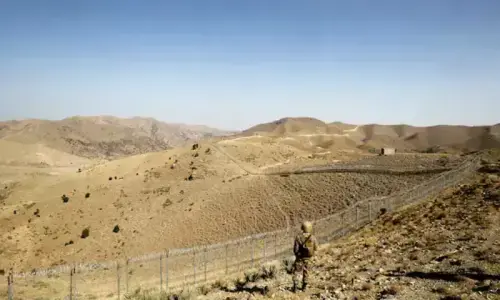
He argued it was "erroneous to describe the international border" between the two countries as the so-called Durand Line, since the term 'line' connotes a temporary or provisional arrangement" non-applicable to the existing border which has lasted for more than 110 years.
The existing Pakistan- Afghanistan border "Is a settled matter and non-negotiable", the sources declared. There was no mention of any time-limit in the 1893 agreement as was apparent in a perusal of the text of the agreement.
This issue apparently cropped up at a recent tribal Jirga in South Waziristan agency where the government had launched a political-cum-military offensive to weed out from the tribal territory wanted foreign criminal elements who had unlawfully taken refuge in the tribal areas evading legal registration or surrender to the authorities concerned.
Elaborating the border agreement, the sources said it was an international border between Afghanistan and Pakistan based on the map signed by Amir Abdur Rahman and Sir Mortimar, which is attached with the original agreement, Clause 6 of the agreement clearly stated that the agreement was regarded by both the parties as "a full and satisfactory settlement of all the principal differences of opinion" which arose between them.
Subsequently, the treaty with Mir Habibullah Khan continuing the agreement which had existed between the British Indian government and Amir Abdur Rehman Khan-1905, paragraph 2 pledged: "I also have acted, am acting and will act upon the same agreement and compact and I will not contravene them in any dealing or in any promise."
Article 5 of the treaty states that "The Afghan government accepts the Indo-Afghan frontier accepted by the late Amir Abdur Rahman" and the Article 5 concerning the friendly and commercial relations between the Great Britain and Afghanistan, at Kabul on Nov 22nd 1921.
Article 2 of the treaty states: "The two High Contracting parties accept the Indo-Afghan frontier as accepted by Afghan government under article V of the Treaty concluded at Rawalpindi on 8th August 1919".
The notes exchanged between His Majesty's government and the Afghan minister in London 1930 (HH Gen Shah Wali Khan to Arthur Henderson with its agreed translation) at the Afghan Legation in London on 6th May 1930, both parties agreed that it was their understanding that the treaty of Kabul of November 22, 1921 continued to have full force and effect.
Later, Shah Wali Khan as Afghan envoy to Pakistan on June 13, 1948, after Pakistan gained independence, declared: "Our King has already stated that Afghanistan has no claims on frontier territory and if there were any, they have been given up in favour of Pakistan".
The sources further elaborated that according to international law, treaties of the extinct state concerning boundary lines remain valid and all rights and duties arising from such treaties of the extinct state devolve on the absorbing state- Pakistan which is the successor state of British India.
The sources argued that the transfer of sovereignty to Pakistan from the British did not entitle Afghanistan to assert that the Anglo-Afghan treaty of Kabul, 1921, was no longer valid.
Under para 2 Article 62 of the Vienna convention on the Law of Treaties 1969 which states "a fundamental change of circumstances may not be invoked as a ground for terminating or withdrawing from the treaty", it was pointed out.