0
0

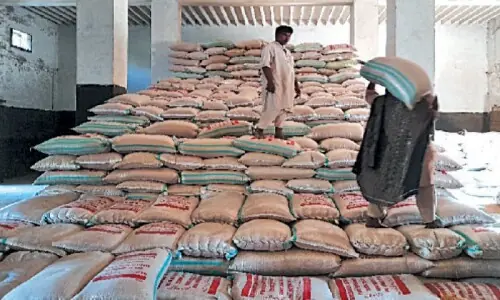
LAHORE, May 9: The Punjab says the 'real issue' haunting the federating units is not wheat but hoarding and business interests of the private sector. Briefing newsmen on the wheat controversy here on Sunday , an official spokesman said the provincial government was ready to meet requirements of any federating unit on an urgent basis.
"But it will, under no circumstances, allow hoarders from any part of the country to procure wheat from the Punjab and hoard it to fleece the general public." He said the NWFP government which was yet to approach the Punjab officially for the provision of wheat was, under influence of its millers, "pressing us to lift ban on the movement of the commodity."
During the last three years, he said, the Punjab had provided 3.2 million tons of wheat to other provinces. "It can do it again provided other units come clean on the issue rather than acting under duress from hoarders and stockists."
He said every year the Punjab government (food department) procured wheat with two main objectives; ensuring fair price for growers and availability of flour at affordable price to mainly urban consumers.
Provincial food departments and the Pakistan Agriculture Services and Storage Corporation (Passco) at the federal level helped achieve the above objectives. Absence of both agencies could result in a market crash during the harvesting season and price escalation during the winter.
The whole official effort was aimed at preempting this possibility, he said. He said: "The Punjab not only has to ensure food security to its citizens, but also supplement the requirements of public and private sectors of the other provinces, both with flour and wheat.
This is in addition to the quantities purchased by Passco from 13 areas (tehsils) and one district of the Punjab (Hafizabad) exclusively earmarked for it." It was a bumper crop in the year 2000-O1, and the food department procured 6.3 million tons against its target of 2.5 million.
This huge quantity not only supplemented the food security requirement of the next two years, fulfilled the needs of other provincial agencies, placed Pakistan on the list of wheat exporting countries, but also helped in gradual induction of the private sector in the wheat procurement process.
Liberal commodity financing, under the government policy, generated a competitive price in the market and brought partial benefits to the growers. But major beneficiaries were traders.
They became so powerful in the process that last year the government was forced to import 300,000 tons of wheat at a time 300,000 tons was still available with the private sector.
He said luckily the Punjab government had sufficient stocks which kept the flour prices reasonably stable throughout the country because there was no ban on inter-provincial movement of wheat and its products.
More than 500,000 tons of wheat in the form of wheat and wheat products went out of the Punjab from Oct 15, 2003, to April 30, 2004, he said, and added: "It was in this background that the Punjab government decided to place a ban on inter-district movement of wheat."
During the current year, the Punjab government initially imposed no restrictions on wheat movement in any district. However, during the procurement drive it was realized that the stockists and hoarders were proactive and procuring maximum wheat.
It was apprehended that these stockists would leave no room for the government agencies to procure wheat necessary for ensuring food security. In fact, it was feared that if the government failed to procure wheat needed to maintain food reserves, the country would have to face a severe crisis during high demand period of wheat and flour in the next year.
He said in this situation, the Punjab government very reluctantly had to take the decision of imposing restrictions on its movement. However, there was no ban on the movement of flour and other products.
Approximately wheat products equivalent to 3,000 million tons were still going to the NWFP on a daily basis, while more than 1,000 million tons of flour was moving out of the Punjab to Sindh and Balochistan.
The Punjab government had allowed the procurement of 1.5 million tons of wheat to Passco for the requirement of other provinces throughout the year. So far, Passco had procured over 500,000 million tons.
All this wheat was being procured for the other provinces, including the NWFP. Therefore, the hue and cry being voiced in media by the stockists and hoarders was not justified, he insisted.
He said the Punjab government followed federal instructions regarding free inter-provincial movement of wheat and its products. It was because of this policy the provincial government imposed no restrictions on the outflow of wheat and its products to other provinces during the last year and first quarter of the current year, despite pressure of short supplies and increasing price of flour in various cities of the province. It was heartening to note that the NWFP faced no flour and wheat crisis during the last year, he claimed.
He said everybody in the country was aware of the fact that Sindh had to face a severe wheat and flour crisis while the Punjab also came under crunch in big urban areas like Rawalpindi and Lahore.
"Irony of the situation was that in this crisis, the role of the private sector left much to be desired. When the entire country was in the grip of wheat and flour crisis, the private sector hoarded the commodity for maximizing profits."
Quoting the figures of the Ministry of Food, Agriculture and Livestock, the spokesman said the NWFP also produced 1.1 million tons of wheat. Its food department has presently reserves of 75,000 million tons.
Therefore, during this temporary period of restriction, it can easily meet requirements of its mills from its own available wheat stocks, both in private and public sectors, he said.
"Punjab's effort to ensure food security of Pakistan must not be mistrusted. The ban on wheat is only in the national interest and will be lifted as soon as the government agencies meet the food security requirement."