0
0

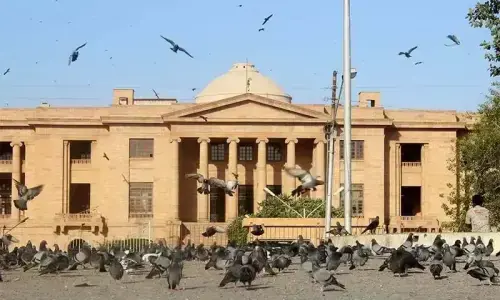
KARACHI, March 19: The Sindh High Court allowed an appeal by former land utilization secretary Ramesh M. Udeshi and ordered his release forthwith in a criminal reference, if not required in any other case.
The appellant was convicted by an accountability court in May 2000 for moving a summary in 1994 seeking conversion of leases held by a number of people, including co-accused Abu Bakar, at a rates much below the prevailing market price, thereby causing loss to the public exchequer.
Abu Bakar, son of Daud Jat, had approached the then chief minister, Syed Abdullah Shah, for conversion of four acres, leased out to him for 30 years at Deh Gangrio (Malir) for poultry farming, into a 99-year commercial-cum-residential-cum-industrial lease.
The CM, who was also convicted in the reference in absentia for evading the trial, accepted the application "in relaxation of the existing rules and the ban on conversions."
The former secretary was sentenced to seven years' rigorous imprisonment and a fine of Rs200,000 or, in default, RI for another year. He challenged his conviction and sentence and an SHC division bench comprising Justices Sarmad Jalal Osmany and M. Mujibullah Siddiqui accepted his appeal by a short order on Friday.
Co-convict Abu Bakar, who has served out his sentence, had also moved an appeal which is pending before the high court. Arguing the ex-secretary's case, Advocates Ismet Mehdi and Arshad Hussain submitted that the appellant did not act in violation of the Sindh government rules of business by moving the summary.
In fact, instead of carrying out the CM's order to convert the lease on payment of Rs25,000 per acre, he doubled the conversion charges. The CM held the portfolio of land utilization in addition to those of finance & services and general administration.
Besides, the counsels argued, no wrongful gain accrued to the appellant from CM's conversion order. The prosecution also failed to establish criminal intent or guilty mind, they submitted.
NOTICES ISSUED: A division bench of the Sindh High Court issued notices to the Election Commission and an election tribunal in a petition challenging the election of a union council nazim and naib nazim for having been voted on the basis of joint electorate.
Petitioners Arshad Ali Khan and Tahiruddin Ahmad Siddiqui, who were defeated in the election for nazim and naib nazim, respectively, of UC-8, Liaquatabad Town, Karachi, in the local bodies polls 2001, sought to assail the decision of an election tribunal comprising the district and sessions judge (central). Relying upon a Supreme Court judgment of 2001, the DSJ dismissed their election petitions.
In their petition before the high court, the candidates submitted through Advocate M. Nawaz Shaikh that under the local government ordinance and rules, non-Muslim voters could vote only for the seats reserved for minorities.
A union council consisted of 12 Muslim councillors, including four women, six representatives of workers and peasants, including two women, one nazim and one naib nazim.
All of them were directly elected by voters. One seat (of councillor) was reserved for minorities in a union council if the number of non-Muslims in that council amounted to 10 per cent of its population. More seats could be reserved if the number of non-Muslims so warranted.
However, according to the petitioners, elections were to be held on the basis of separate electorates even for general (Muslim) seats. The number of non-Muslims in UC-8 of Liaquatabad Town was much less than 10 per cent and no seat was reserved for minorities. However, despite the objection raised by them, non-Muslim voters were allowed to cast their ballots for Muslim (general) seats by the polling staff.
The participation of non-Muslim voters vitiated the electoral process. Their rivals, UC-8 Nazim Basharat Ali and Naib Nazim Zafar Iqbal, were, therefore, elected in violation of the law and rules. The Supreme Court judgment relied upon by the election tribunal (the DSJ) related to the election of non-Muslim candidates and not of the Muslim candidates.
The division bench comprising Justices Anwar Zaheer Jamali and S. Ali Aslam Jafri issued notices to the respondent commission and tribunal for a date in office.