0
0

The Quetta massacre
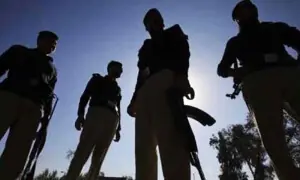
The horrific attack on the Ashura procession in Quetta on March 2 left some 47 killed and hundreds injured. It was followed by anti-administration riots in which a considerable loss was caused to property and some five policemen were killed. No party has claimed responsibility for the attack so far.
A judicial inquiry has been ordered. It is to be hoped that this inquiry will be conducted with complete impartiality and great speed and that it will be made public quickly.
In the meanwhile going by the published reports it would appear that the principal suspect is the outlawed Lashkar-i-Jhangvi party. The guns and the casings of the bullets used in perpetrating the tragedy carried the name of this organization.
As the militant wing of the Sipah-i-Sahaba, the fanatic party spawned in Jhang, it has been responsible perhaps for more killings and mayhem during the last 20 years of sectarian strife in the country than any other group.
All observers appear to be convinced that this tragedy had no link with the equally gruesome massacre of Shia worshippers in Karbala and Baghdad. Most are prepared to discount also the speculation that there was any connection with the Al Qaeda or with the ongoing troubles in Afghanistan.
The sad, if implicit, conclusion appears to be that sectarian strife in Pakistan has acquired, over the past two decades, substantial enough roots and requires no external impetus to erupt into the sort of violence that we witnessed in Quetta.
Perhaps this is true. Quetta was the site of one of the worst acts of sectarian violence in years in Pakistan when armed militants stormed a Shia mosque last July, killing 50 people who were praying inside.
Even this year when the president and his government had identified sectarian strife as the principal enemy and when the administration should have been fully geared to prevent sectarian incidents during the sensitive Muharram period we had a suicide bomber attack on a Shia mosque in Rawalpindi on the 8th of Muharram and coinciding with the Quetta tragedy a similar albeit less bloody incident in Phalia, a small city in Punjab left two killed and several people injured.
The state of panic to which Shias were reduced all over the country was tragically highlighted by the stampede of Shia worshippers in the mosque in Parachinar in the Kurram Agency. The stampede, triggered by the mistaken belief that the power failure which darkened the mosque was a prelude to a sectarian attack, took the lives of 13 women and children.
But is this the whole truth? I have a strong suspicion that the events in other parts of the Islamic world, particularly in Afghanistan, are fanning the flames of sectarianism in Pakistan and are at least partly responsible for the carnage in Quetta and panic in Parachinar.
Though no official figures have been released so far, it appears that the majority of the victims in Quetta were Hazaras. The Hazara community has been a part of Quetta's social fabric for many generations.
They have contributed significantly to its development and even while not too many of them have risen to positions of prominence there are certainly notable families among them including, perhaps most prominently the late General Musa, who rose from the ranks to become commander in chief of the Pakistan Army.
The Hazaras however trace their origin to Afghanistan, where they make up the bulk of the 10 to 12 per cent of the Afghan population that follows the Shia faith. They were the downtrodden minority - the hewers of wood and the drawers of water - assigned the most menial tasks and looked down upon by all sections of Afghan society.
In the struggle against the Soviet occupation they were at one with the rest of the Afghans but with the notable difference that while the other Mujahideen looked to Pakistan and its allies for support, the Hazaras sought and received the bulk of their support from their co-religionists in Iran.
It is often said that Pakistan's clumsy efforts to fashion a Mujahideen government in Afghanistan after the Soviet withdrawal was frustrated at least in part by the insistence of Iran on securing 30 per cent representation for the Shias in such a government even when the Shias made up only 10 to 12 per cent of the population.
When the Taliban were mounting their onslaught on Kabul they found, at least initially, willing allies among the Hazaras who had been subject to ruthless bombing by the Ahmad Shah Masood forces. But the Hazaras soon found the Taliban to be even more strongly prejudiced against them than the Northern Alliance.
They then became part of the Northern Alliance not because of any love for Ahmad Shah Masood or any of the other Tajik or Uzbek leaders but because this they perceived to be the lesser evil. The Tajiks and Uzbeks reviled them because of their lowly status but the Taliban treated them as apostates.
When Northern Alliance forces marched into Kabul after the routing of the Taliban the Tajik leaders ensured that Hazara forces were not allowed into the city.
They insisted however on retaining their forces on the outskirts since they believed that this was necessary to ensure the safety of the substantial Hazara and other Shia population in Kabul. Implicit in this demand was the assumption that the Shias would be under threat on religious grounds even from their erstwhile allies.
Sectarian strife may be dormant in Afghanistan but, whatever the current Afghan situation, there is no doubt that the extremist Afghans currently part of the refugee population in Pakistan and particularly those of them that are in Balochistan, view the Hazaras, be they Pakistani or Afghan nationals, as heretics replicating the Lashkar-i-Jhangvi view of the Shias throughout Pakistan.
There is no evidence yet that Afghan refugees had anything to do with the Quetta attack but if one were to talk of Lashkar sympathizers in Quetta it would be de rigueur to include among them large numbers of the Afghan refugees spread throughout Quetta.
On another plane it is important for us to recognize that the emerging political dispensation in Iraq which will give the Shia majority greater power than they ever had before has caused new ripples of resentment throughout the largely Sunni Arab world.
This resentment is accentuated by the apprehension that the Iraqi Shia will be inordinately influenced by their co-religionists in Iran. In my view this is a mistaken apprehension.
The Iraqi Shias believe that the holy cities of Najaf and Karbala and not Qom or Mashahad are the holy sites of Shias. It is the Marjah-i-Taqleeds resident in the seminaries of Najaf and Karbala who are the authoritative interpreters of Shia doctrine.
It is the Iraqi Shia clergy who remains true to the original Shia belief that the clergy must remain the guardians of the interests of the people but they must not form part of the government. In all these respects they are at odds with the Iranians. Above all they remain Arabs with historical memories of the past Arab-Iran relationship.
And yet there is no doubt that in Iraq particularly, and in the Arab world generally there is a growing anti-Shia sentiment that the Al Qaeda and other terrorist groups have tried to tap.
It is interesting to note that in the 17-page letter purportedly written by Zarqawi, the Jordanian origin terrorist currently thought of as the man behind the Karbala and Baghdad bombings, the Shias are labelled as "the lurking snake, the crafty and malicious scorpion, the spying enemy" and a strategy is outlined for fomenting discord between the Sunnis and these "snakes" as one means of bringing down the American occupation forces and their "Iraqi puppets".
There is no doubt that many of the extremist parties in Pakistan received massive funding from groups and individuals in the Arab world and that much of this funding started when the war between Iraq and Iran was seen not only as a war between the Arab and the Ajmain but between the Sunni and the "apostate" Shia.
If truth be told sectarian strife of the violent variety that Pakistan has seen in the last two decades was a direct result of foreign instigation. It is, of course, also true that such foreign intervention, aimed at conversion of Pakistan into an alternate battlefield was encouraged and covertly abetted by the Pakistani leaders of that time.
In these circumstances it would be naive to believe that the ferment in the Islamic world created by the events in Iraq has not had an influence on the sectarian situation in Pakistan even though it may be difficult to speak with certitude about the role foreign influences played in the Quetta incident. I believe that these external factors are at play and unless corrective measures are taken, incidents like the recent Quetta tragedy will continue to occur with sickening regularity.
In saying so, however, we must not lose sight of the role that needlessly provocative and unwise discussions on religious issues in the newly liberated and greatly expanded media can also play.
It is notable that in the riots that followed the Quetta incident Shia demonstrators burned down the office of a television channel accused of telecasting an incendiary discussion on the permissible forms of mourning.
There is a need, an urgent need for our strategists and planners to recognize that more than mere words will be needed to neutralize foreign influences and to curb the provocateurs within Pakistan.
The moderation and tolerance of the vast majority of the populace is being eroded under the onslaught of external factors but largely by some internal developments which, rightly or wrongly are perceived to be aided and abetted by the "establishment". The establishment has to take actions that prove the inaccuracy of this perception.
The writer is a former foreign secretary of Pakistan.
Signing of the constitution
BAGHDAD: They used King Feisel's old table to sign the document, the desk upon which Winston Churchill's choice as monarch once tried - not very successfully, it has to be said - to rule Iraq. It was, of course, supposed to be a special day in Iraqi history.
Twenty-five local leaders - most television reports spared viewers that uncomfortable and all-important qualification 'American-appointed' - dutifully signed their new and temporary constitution. Veiled ladies and tribal sheikhs, some good men and true but also a convicted fraudster, Ahmed Chalabi, scribbled their signatures in front of US proconsul Paul Bremer.
You could almost hear him sighing in relief. For the constitution - it is only temporary and contains plenty of unanswered questions - is supposed to be America's get-out clause.
As long as the 25 men and women signed their names, Washington could hand over 'sovereignty' to them on June 30, well before the US presidential elections in November. That, at least, is the plan. On Monday, we were spared the string quartet and the children's choir of last week's aborted ceremony - but not the violence.
For many Baghdadis, the day began as it did for me, instinctively ducking as a tremendous explosion clappered over the city. I was trying to make a phone call on my new and inefficient mobile phone when the first rocket exploded on the police station near Andalos Square.
I heard the firing of the weapon, a dull thump, and then the swish of the missile overhead. By the time I reached the cops' headquarters, the road was packed with angry young men and screaming ambulances. There was another thump and another powerful impact as a second rocket hit a civilian home in a cloud of grey smoke.
At the Ibn el-Nafis Hospital, the little boy wounded in the house was writhing on his bed in agony, next to Sergeant Abbas Jalil Hussein of the Iraqi police force. "I was just washing my hands in order to say my morning prayers," he said. "I heard this tremendous noise, and then I felt my blood on my leg and realized I was wounded."
At this point, a member of the hospital's management - under the standing instructions of the American-appointed health minister - interrupted to say I had no business to be in the ward.
This wasn't the day to be reporting on suffering Iraqis - certainly not a day on which dangerous folk like journalists should be counting the statistics of violence.
So I set off to the home of an Iraqi businessman, a middle-aged Christian, to watch America's dreams come true, praying he would have electricity to power his television set. His generator thumped out just enough juice to run the television.
The screen dipped and waved and shimmered, but there they were, one by one, stepping up to King Feisel's chair, applauded and beaming, unelected men and women of the 'Governing Council' signing a temporary constitution which, in theory at least, guarantees freedom of speech and assembly: a flurry of brown robes, sparkling pens, blue suits and veils.
Most Iraqis are more interested in electricity than constitutions - which may be one reason why the details of this particular document have not exactly been discussed in the street. They should have been.
We still don't know, for example, whether the Kurds will have a veto on any new government decisions. The original document stipulated that two-thirds of voters in any three provinces could have a veto. The Kurds control three provinces in the north, two of which - according to the dominant Shia population, contain only a majority of 500,000 people.
This was one of the reasons why old Ayatollah Ali al-Sistani objected to last week's signing. Will the Shia community's 60 per cent of the entire Iraqi population really be represented by a new government? Will they get three members of their particular faith into a five-man rotating presidency or one in a three-man presidency which the signing seemed to represent.
Iraqis have been puzzled by the clause allowing the Iraqis two passports and the right of restitution of property if they had been exiled. Did this refer to opponents of Saddam or the tens of thousands of Jewish Iraqis driven from Baghdad more than four decades ago? Were Israelis born in Baghdad to be given Iraqi passports and return? Why shouldn't they, I asked my Christian friend? Fair enough, he said. But would the Americans then support the return of the Palestinians driven from their homes in what is now Israel in 1948?
In the end, the signing ceremony was pomp without much circumstance. Mr Bremer, the man who was supposed to be an expert in "counter-terrorism" when he was appointed by President Bush and is reported as saying that he will retire to "private life" on June 30, sent a letter of congratulations to the 25 men and women.
Then came the usual off-the-record briefings from his spokespersons. We could expect more violence now that the document had been signed. There would be an increase in attacks up to June 30. It was the same old story: the better things are, the worse they get.- (c) The Independent
New hope, new optimism
Do we really believe that all this hype and hurrah about Indo-Pakistan talks is going to lead to a settlement of the Kashmir dispute? Let us remember that that is the only worrisome dispute between the two countries.
The other differences are as minor and insignificant as, say, our differences with Upper Volta or Outer Mongolia. Every tension, every provocation, every trigger-happy stance and sabre-rattling, both here and across the border, comes from that basic quarrel.
All around me I see people agog with a new expectation, a new hope, simply oozing with optimism, and shouting "Thank God! At last India is ready to talk". But such talks have been going on ever since the Kashmir war ended on December 31, 1948. What is so different this time? The Indian stand on Kashmir remains the same, its treatment of the freedom fighters has not altered a bit. So what's new?
As I see it India and Pakistan hold the same views on this issue which they have held for the past 56 years. The real new factor that has come in is the United States of America which has told the two to stop behaving like naughty boys and settle the dispute between them, otherwise... Pakistan could never afford the 'otherwise', and now India too with its new-found love for the US can't afford it.
True, there has been a perceptive lessening of the inflexibility on Kashmir in both countries, but even that is due to the honest(?) broker from Washington. They need not take the credit for it.
After these grumpy remarks, I'll go on to my topic of today to cover some of my old predictions for which my wife used to call me a Cassandra. But before that, a flash of memory, since that too relates to Kashmir.
In 1951, sitting in a Public Service Commission test I was required to write an essay on "How would you resolve the Kashmir problem?" I thought I was being very clever when I wrote that neither I nor anyone else in Pakistan, nor the UN for that matter, could resolve the impasse.
Only the Kashmiris themselves could do so by fighting their way out of Indian subjugation, as all captive peoples do everywhere. The UN can only help, and that is all.
While that has turned out to be correct as evident from the militancy in the occupied state, I do want to make another prediction. If somehow the people of the state, the Muslim population that is, do succeed in forcing India to leave them to their fate (India will never agree to a plebiscite because the result will be too humiliating for it) at some crucial stage, nationalism, which is already making itself evident, will take over to achieve an independent state.
I know how violently some people in Pakistan react to this eventuality, now called the 'Third Option'. Their loud reaction somehow makes me feel that we are more interested in owning the Kashmiris than seeing them out of the clutches of India and letting them exercise their own free will. If you ask me, the 'Third Option' will not be bad at all.
If we could digest Bangladesh, why not a sovereign Kashmir? Sentimentalism apart, we in Pakistan haven't given too good an account of ourselves as a democratic country, sensible enough to manage our own affairs without making a hash of it. Our only achievement has been the nuclear bomb, but look at the dirty charges we are earning about exporting its know-how.
What then shall we give to the Kashmiris? An effete and corrupt administration, an undependable political system, a distorted democracy, a press ever fearful of state oppression, ethnic strife leading to intolerance and bloodshed, and promises of periodic martial law? For long years they got a better deal from the Indians who could have continued there forever if they had more sense and had not foolishly insisted on making Occupied Kashmir a province instead of constitutionally letting it remain a separate territorial entity with its own prime minister and sadr-i-riasat.
Readers may recall the veiled allusion of Khushwant Singh (although a liberal Indian) during a visit to Lahore some years ago, to the possible fate of Indian Muslims if India were to be ousted from Kashmir.
He seemed to believe that the majority community would vent its anger at the loss of Kashmir on the hapless Muslim minority. Was he trying to tell us to advise the Muslims in Kashmir not to struggle so seriously for their freedom?
Would you like me to tell you why my wife used to be afraid of my prognostications and called me a Cassandra? Whether you want to hear or not, here it goes. She asked me in the early sixties what I thought was the future of Pakistan. I said, "My dear, if we go on like this, East Pakistan will be lost to us in ten years." It went earlier than my expectation.
After that (I said to her) it will be the turn of West Pakistan. The Pathans are already enamoured of Pukhtoonistan and want to strike out on their own in collusion with the Afghans. In the changed circumstances - (what happened in Afghanistan, thanks to Soviet Russia) - I was proved wrong, but only because of the advent of a communist regime in our neighbourhood, which cured the Pathans of their delusions.
I confess that I was not serious, though the words uttered in jest did clothe an element of grim truth, and horror of horrors! I was shocked to read some time ago of an exactly identical scenario drawn up by an American expert on the subcontinent, down to the formation of a joint Muslim-Sikh Punjab.
I used to tell my wife not to set much store by my prophecies, for if I were such a good forecaster I should also have been able to anticipate the dissolution of innumerable elected governments in Pakistan and the two wars with India. But her fears were not allayed. She would say, "I know you always add the words 'If we go on like this.' And we are going on like this, aren't we?"
The UN is not a morality play
"It may well be that under international law as presently constituted a regime can systematically brutalise and oppress its own people and there is nothing anyone can do.... This may be the law, but should it be?" asked Prime Minister Tony Blair last Friday in a speech that tried to persuade sceptical British voters that he was right to attack Iraq at President George W. Bush's side.
He didn't answer his own question, assuming that everybody agrees the answer is yes. The correct answer, however, is no.
Mr Blair and Mr Bush have both ended up arguing the moral case for invading Iraq, though it didn't get mentioned much before the war. Having found no 'weapons of mass destruction' nor any connection between Saddam Hussein and the Islamist terrorists who attacked the United States, their sole remaining justification for the invasion is the fact that it removed a vicious dictator. The problem is that it is not a legal justification.
It seems so obvious: there's a wicked regime; we have the power to destroy it; let's do those people a favour and invade. We need to change international law so that we can legally invade "when a nation's people are subject to a regime such as Saddam's," as Mr Blair put it.
Who would be the targets? Any regime that is judged to "systematically brutalise and oppress its own people" - North Korea, or Burma, or Zimbabwe, or even China, depending on which countries set themselves up as the judges. That should keep us all busy until the End of Time.
Mr Blair's argument has a strong emotional appeal. It would be nice if there were some impartial and all-powerful force in the world that would unerringly punish all the wicked while sparing all the innocent.
The traditional name for this force, however, is God, and even He has chosen not to act within history in quite so hyper-active a way, postponing the sorting out of the good and the evil to a time shortly after the End of Time. Mr Blair's offer to bring the Last Judgment forward by a billion years or so is doubtless well-meant, but it is ill-advised.
Even well-educated people like Mr Blair profoundly misunderstand the nature of the United Nations. They imagine that it is a sword of justice, and maybe even an instrument of Love.
They do not understand that the heart of the United Nations enterprise is a brutally realistic attempt to change international law in order to prevent World War III. The UN is a nuclear blast shelter, not the international equivalent of a battered women's shelter.
When was the UN founded? 1945. What was the situation in 1945? The biggest war in history had just ended: 45 million people were dead, most of the cities of the industrialised world had been bombed flat, and nuclear weapons had just been dropped on cities for the first time.
What was the prognosis? Another world war eventually, with every great power holding hundreds or thousands of nuclear weapons on Day One. Five hundred million dead in the first week.
So right there, in 1945, the countries of the world decided to try to change that future. They created the United Nations, a new institution whose Charter declared that henceforth war is illegal.
It did not say that henceforth tyranny is illegal, because enforcing such a rule would mean endless war. (First we attack Stalin, then Mao, then....) It was a hundred-year project at the very least, since human beings have been fighting wars since the dawn of civilisation eight thousand years ago, or even before. But it was necessary, because the only alternative, sooner or later, was World War III with nuclear weapons.
The basic UN rule is that you can no longer legally attack another country, and no excuses are accepted. The fact that their ancestors stole some of your country's territory a hundred years ago doesn't justify it, nor does a suspicion that they are planning to attack you, nor even the fact that their government wickedly oppresses its own people. Allow those exceptions, and clever lawyers will find a way to argue that every aggression is legal. So the law says no exceptions.
During the 1990s, when the international environment was relatively benign, attempts were made to get round this rule in order justify humanitarian military interventions to stop genocides in Bosnia and Kosovo.
-Copyright