0
0

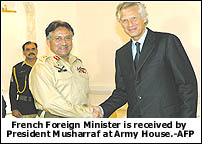
ISLAMABAD, Feb 28: France on Saturday proposed greater transparency for Pakistan's nuclear programme and tightening of export controls while the Pakistani leadership assured France of full cooperation on the issue of nuclear non-proliferation.
French Foreign Minister Dominique de Villepin put forth his proposals during meetings with President Gen Pervez Musharraf, Prime Minister Mir Zafarullah Jamali and Foreign Minister Khurshid Kasuri.
At a joint news conference with Mr Kasuri, Mr Villepin said France and its partners were ready to open a concrete dialogue with Pakistan on strengthening its nuclear export controls, greater transparency of nuclear activities with a close cooperation of the International Atomic Energy Agency and Islamabad's participation in global non-proliferation efforts, particularly within the framework of a UN Security Council resolution now being prepared.
He said Pakistan should attend a meeting of heads of state on the proliferation issue to be held in the next few months.
"A positive move by Pakistan will reinforce its position within the international community and I must say that we had a very positive and constructive dialogue today," Mr Villepin said.
He said France was anxious to find solutions to the problems arising from nuclear proliferation. "I think our discussions with President Musharraf and Foreign Minister Kasuri today have been very fruitful," he added.
President Musharraf met the French foreign minister earlier in the day in Rawalpindi and reiterated Pakistan's abiding commitment to non-proliferation.
Mr Kasuri said the president and he himself assured the French minister that non-proliferation was as much in Pakistan's interest as in the interest of France or any other country. "I explained to Dominique in great detail about the A.Q. Khan affair and how it was an act of an individual and some of his collaborators," Mr Kasuri said.
Reaffirming Pakistan's status as a declared nuclear power, Mr Kasuri said there was no question of rollback or any compromise on the nuclear programme. He reiterated that Pakistan's nuclear programme was for defensive purposes and was in reaction to Indian detonations dating back to 1974.
He said Pakistan would go "all out" to support the international community efforts for non-proliferation.
Asked about recognition of Pakistan as a nuclear power and holding of dialogue as a member of the nuclear club, Mr Villepin said it was an important problem to try to stick to principles and face the reality at the same time. "Facing reality means Pakistan has nuclear capability. That's a fact. Principles mean that we look for the best order possible...," he said. Mr Kasuri said the world would be better served if the reality of Pakistan, India and Israel were accepted as nuclear powers.
Paying tribute to President Musharraf's determination to open a new phase in Pakistan's history, Mr Villepin said he visited Islamabad to express France's commitment to work with the Pakistani authorities to develop a political dialogue and strengthen cooperation between the two countries.
He said his talks with President Musharraf and Foreign Minister Kasuri confirmed what he called excellent relations between the two countries in political, economic, cultural, education and defence fields.
He said France supported President Musharraf's stance about stopping any kind of proliferation activity coming from Pakistan.
He said Pakistan deserved a strong support for taking important and courageous decisions to show its sense of international responsibilities, especially in dismantling terrorist networks on its own territory.
About relations between Pakistan and the European Union, the French foreign minister said the EU was closely following steps taken by Islamabad to fight proliferation, terrorism, dialogue with India and the situation in Afghanistan.
INDIA-PAKISTAN TALKS: He welcomed the resumption of Pakistan-India dialogues, which he said, was the only way to remove misunderstandings and mistrust between the two countries.
Asked about fears that increased French military sales to India would disturb the regional balance of power, Mr Villepin said India was a strategic partner of France, while at the same time, Paris wanted to increase its cooperation with Pakistan in all fields.
"I don't think there is any incompatibility between the two, may be less today than ever because we see we are all heading in the same direction," he said.
Replying to a question about India's quest to become a permanent member of the UN Security Council, Mr Villepin said the decision to expand and make the Council more representative rested with the international community.
He said in the search for more Security Council members, important countries like Brazil, and some countries in Africa and Asia, including Japan and India, were mentioned as the most likely future permanent members.
"So what I am saying is just a fact," he said, adding: "Having more countries is more beneficial for all of us."
BAN ON SCARF: Mr Villepin said France did not at all forbid the use of scarf by Muslims in France. He said the recent law was applicable only to public schools and not directed against Islam or any other religion.
Mr Kasuri said the issue of prisoners held at Guantanamo Bay was also raised with Mr Villepin.
He said 20 Pakistanis had been released from Guantanamo Bay while 38 or 40 were still there.
Mr Villepin said seven French nationals were also in Guantanamo Bay for which the French government was holding talks with the US to find a legal solution to the problem.
UN ROLE IN IRAQ: About the role of the United Nations in Iraq, Mr Villepin said the international community should stick to the decision to restore full sovereignty of Iraq by the end of June.
Earlier, reading from a written statement, Mr Kasuri said Pakistan's engagement with France was on three important planes - bilateral relations, the European Union and the United Nations.
He said he and his French counterpart had exchanged views on recent developments in Pakistan-India relations, nuclear non-proliferation, Afghanistan, Iraq and UN-related issues.