Gen A. A. K. (Tiger) Niazi: an appraisal
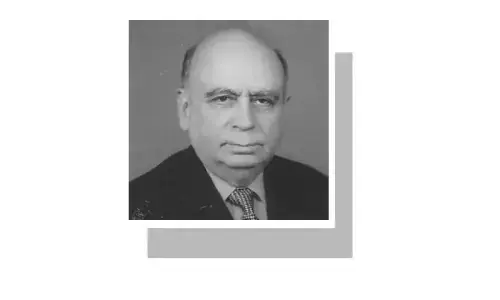
LT. GEN. Amir Abdullah Khan (Tiger) Niazi died on February 1. The proud winner of the Military Cross (MC) during the Second World War and of the Hilal-i-Jurat in the 1965 India-Pakistan war, Niazi was haunted through his career as a war hero to a vanquished general by his surrender to his Indian counterpart, Lt. Gen. Jagjit Singh Aurora. This was to stick to him like a stigma.
In an essentially obituary note like this, it would be difficult to offer a critical assessment of Niazi's wayward conduct of operations in East Pakistan. Nevertheless, a brief appraisal of his personal and professional behaviour as the supreme force commander in the eastern theatre would be in order.
Niazi arrived in Dhaka on April 4, 1971, to assume command of the Eastern Command on April 11 vice Lt. Gen. Tikka Khan, the initiator of Operation Search Light on March 25.
Preoccupied with his civilian duties as governor and martial law administrator, Tikka might not have had the time his role as military commander demanded: hence, the GHQ decision to appoint a full-time commander.
Known for much personal bravado, General Niazi opted for transfer to East Pakistan only when Lieut-Gen. Bahadur Sher, like Nazi the holder of the MC, had chosen to decline the posting.
Asked to exercise their option two or more generals, had also refused to go. Niazi said 'yes' without necessarily realizing the risks involved and how to counter them.
From day one as commander of all theatre forces - the army, navy and the air force - he would brook no interference or entertain advice from his predecessor and senior General Tikka Khan.
This would lead to a tense equation between two serving generals posted in the same place and saddled with the same job of bringing peace to East Pakistan.
Niazi's eight months, April 11 to December 16, as the General Officer Commander-in-Chief (GOC-in-C) in the Eastern Theatre were marked by ad-hocism and tactical improvizations outside anything like a strategic framework. He lived and fought for the day without much thought or concern for the next, except perhaps as part of some ongoing action at company or battalion level.
Where he made his costliest blunder was to have militarized the normalization campaign wholly to the exclusion of the civilian side and concerns and nuances that the campaign demanded.
He placed his operations on a war footing and found an enemy both within (the East Bengal Regiment deserters and the Mukti Bahini guerillas) and without (India).
Two Pakistani journalists were attached to him as war correspondents. Trapped in his tactical calculus, he would shrug off any suggestion of the developing strategic threat from India; rather, he bragged about his resolve to drive a five a or six-mile salient across to secure his rail-road traffic and communications.
Without a security zone like that, he said, his communications would always be vulnerable to Indian and Mukti Bahini incursions. The question was whether the 'enemy' would let him do that at all.
Dismissive of the strategic dimension of the tasks ahead, Niazi deployed, rather dispersed, his forces all over and around the province to create a string of over 300 border outposts and lose local superiority at any given point for the final last- ditch battle. His main objective was to deny the enemy any space on home ground to establish a government-in-exile.
Granted that this was the task assigned to him by GHQ, he could nevertheless have exercised his own initiative as force commander to make the high command see through the untenability of their plan and modify it accordingly. The high command had also directed him to "hold his force (division/corps) in being" and not to let it disintegrate in any circumstance.
When I last met him on September 30, 1971, at his force headquarters in Kurmitola, he was full of beans. Thumping his thighs in his characteristic, over-confident way, he said: "You just wait and see that I am going to make it to Calcutta one day..." He did indeed live up to his words, and made it to Calcutta less than three months later, but only as a prisoner of war.
Niazi's personal courage notwithstanding, his higher conduct of war and his dealings with his senior commanders left a lot to be desired. Maj-Gen. Shaukat Riza, GOC, 9 Division, refused to serve under his command.
He asked the GOS, General Abdul Hamid, on his visit to his formation in Jessore, to either transfer him back to West Pakistan or let him resign.
I happened to be there as a part of the COS's entourage at the time the sorry event took place. It was a serious crack in the glass house of mutual trust between two general officers in a war zone. Shaukat Riza's successor, Maj.-Gen. Ansari, was equally critical of Niazi's personal behaviour as a man and a soldier.
In the midst of it all the loud whispers reflecting on his role as commander, Niazi summoned Islamic lore to his rescue. Towards the close of his tragic drift to surrender, he made daily helicopter trips to his forces scattered all over and around the province to buck them up in the name of Islam.
After his retirement, he joined the ranks of the Nizam-i- Mustafa movement under the banner of the Pakistan National Alliance. Costumed as a typecast mujahid with a turban, he went on to address public meetings organized by the PNA. He also wrote a book, 'Betrayal of East Pakistan', which is a worthwhile contribution. However, the book is more of a mea culpa than a sober record of the events that led to December 16, 1971.
The writer is a retired brigadier of the Pakistan Army.
Violence against women
We are a violent society and recourse to violence is quite commonplace. In spite of our adherence to the convention on the elimination of all forms of discrimination against women, 1979, we continue to regard women as lesser creation of God. Violence takes various forms.
Violence against women should not be construed in its narrow sense of physical harm to women. Even verbal abuse constitutes violence. It's a word of wider import than force.
Domestic violence against women is one of the issues occupying the minds of sensitive people in this country. This problem has to be placed in an overall national context for a realistic appraisal of where we stand and what we should do.
Afflicted with such a large number of problems, it becomes difficult at times to place the issue of violence against women on top of the agenda. But that is not to belittle the significance of the problem.
Violence against women is a deeply ingrained cultural habit among the people inhabiting this part of the world, even those who champion democracy very vociferously.
It has to be understood that violence in its wider connotation is used routinely against the weak to settle an argument. Women being physically weaker, therefore, are at greater risk.
The prevalence or the magnitude of the problem has not been documented and like everything else the data both quantitative and qualitative, is either lacking or unreliable. One can base only value judgment on anecdotal evidence. Some glaring cases reported recently in the press are symptomatic of the malaise:
A mother of three by the name of Bilqees died in police custody in Karachi. Twenty-five years old, she is supposed to have hanged herself in the police lockup. Who would believe this story? And what could be worse than this kind of violence? According to her sister the victim worked as a domestic help in some house of posh Defence Housing Authority.
She reportedly refused to work for longer hours; her employers lodged a case of theft against her. The police not only picked her up but also four or five other members of her family. The police must have tortured and humiliated her to cause her death. But it denied the allegation.
According to ASP she being a woman prisoner, she had been handed over to women's police station on November 11. Maybe after she died in their custody, she was handed over to the female police! This kind of violence against women is much worse than the unreported routine violence at home which a woman suffers without complaining.
Whether the society should express its outrage at institutional violence by government agency, otherwise responsible for the safety and security of the citizens, or wife-beating at home?
Another recent report is from Attock district where a member of Tehrik-ul-Mujahideen threw acid on the face of a girl because her parents had refused to give her to him in marriage.
She was admitted in the hospital in a serious condition with deep burns. Her chances of survival are remote. The offender and the victim are relations and are no strangers.
The offender, with a defect in his leg, stayed as a guest in the victim's house and at about 7'O Clock in the morning after 'sehri' and his morning prayers committed this horrendous act. He thought a disfigured girl would perhaps agree to marry him.
Yet another case is that of Islamabad where one 13 year old Noreen, died after she had allegedly been cremated alive by her husband and her father-in-law. It is not the husband alone at whose hands women suffer violence in silence. Mothers in law enjoy a pestilential reputation.
There is another report from Swabi district where two days before Ramazan at about 2.00 in the morning a powerful bomb went off killing one Sher Mohammad and injuring his two sons. The story begins three years ago when a dispute between Sher Mohammad and Zafir Mohammad arose over the marriage of Zafir's daughter. In the dispute the girl is of no consequence.
There was yet another brazenly monstrous case. About four decades ago, a friend of this writer was posted at Wana, South Waziristan. One of his Pathan employees tried to sell his widowed mother in marriage.
He had no other use for her. She begged her son but his greed for money was far stronger. When my friend got to know of this, he had the servant jailed until he could see reason.
India is no different. According to a BBC report rape and murder are commonplace there. The basic cause of the dispute is dowry, which the in laws want that girl's parents to give whether they have to beg, borrow or steal. In extreme cases death occurs.
Normally such a death is characterized as suicide caused by explosion of a stove. Mothers-in-law are the worst perpetrators of this crime. There is a special ward for them in the infamous Tihar Jail in New Delhi. Most of them are obviously very old and are undergoing life imprisonment.
Women are treated as no more than a chattel or piece of furniture, although their contribution to the GDP is grossly underestimated. They are busy running their households from morning till evening taking care of cooking, cleaning and caring for the family and a score of other chores.
In the rural setting they contribute to the economy by working on crop production, livestock and cottage industry. According to a survey in five districts of NWFP, 82 per cent of women participate in agricultural work.
Another sample survey indicates that out of 14 livestock production operations covering a complete range of activities, women have primary responsibility for at least eight and are active in the other six. A sample survey in rural Punjab indicates that 63.5 per cent women are engaged in unpaid work in farm households.
Poverty underlies the ugly saga of violence against women. It has placed almost on-third of the population of Pakistan at serious risk. Forty per cent of adult women in the country suffer from anaemia.
Gender bias ensures that households of middle and lower income groups spend considerably less on women than on men in the event of illness. As a result they suffer from chronic post-natal infections.
Fertility rates remain high reflecting lack of education for girls and women. Having to bear eight to 10 children happens to be the fate of most of them. Maternal health also suffers because women have little access to education or health care.
A national survey on gender disaggregated poverty data is required for a meaningful analysis. However, according to the UNDP Report 2003 on Pakistan national human development, scattered evidence that is available suggests that due to unequal access of women to productive resources coupled with the prevailing gender norms, they bear a disproportionately higher burden of poverty's impact.
Discrimination against women extends to denial of access over markets, institutions and resources. They also lack autonomy within the household, which restrains them from increasing or consuming income from the limited market opportunities. Poor women in Pakistan have to bear a double burden: the poverty burden and the gender bias.
Denied education and opportunities of gainful employment, she is the greatest untapped resource. Lack of access to education is the single most important ingredient of poverty and is a serious impediment to progress.
Women from poor households are subject not only to stress from economic deprivation but also to loneliness, violence and fear of violence. Restrictions on their mobility and segregation reinforce the cruel behaviour towards them.
If a wife is beaten black and blue, she literally suffers in solitude because of 'purdah' restrictions, which limit the possibilities of her being seen in bruises or bandage.
It is significant that paid employment of women enhance their position in the household with regard to taking decisions. Paid employment and women's contribution to family income emerge as the most important determinant of women's intra-household decision making authority.
Education is the most powerful prophylactic against violence. Educated girls have a better chance of evading violence. They can assert their rights to marriage, to bear or not to bear children or to seek job in formal sectors of the economy.
They can overcome the absurd notion that once they are married off, they have to suffer in silence until their 'Arthi' is carried. They are more likely to stand up to their abusive husbands and the in-laws whose cultural level has not risen above the primordial. An educated girl could seek better medical care and sooner for her and children.
By bearing fewer children, and increasing probability of their survival through better care and nutrition for them, she can bring forth a healthier population. Without social progress economic progress is inconceivable.
Without action to increase women's capabilities in health and education, and denying equality of opportunity they will continue to have limited prospects for working outside their homes to earn independent income.
An earning wife commands greater respect in the household and receives better treatment. Pakistan's performance in providing education to its population in general and to women in particular is dismal, and any prospect of achieving change in attitudes, under the circumstances, looks remote.
Most of the resources are locked in our security concerns. According to human development report 2003 (UNDP) Pakistan ranks at 144 among 175 countries in adult illiteracy and it ranks 65th amongst 94 developing countries.
India has increased its expenditure on education substantially to reach 3.6 as a percentage of GDP whereas Pakistan is down at 1.7 per cent from 2.4 before the military took over in 1999.
e-mail: sshusain@hotmali.com.
More converts to anti-dam cause?
The organizers of the anti-Kalabagh Dam rally on Tuesday must now ask themselves whether they have won more converts to their cause? Put this question to those who were trapped in the traffic logjam for hours that day, and the answer most probably will be in the negative.
Tuesday's traffic chaos wasn't Karachi's worst - we have the memory of last July's rain-jam bedlam that was a class by itself. But still Tuesday's shemozzle was harrowing in its dimension.
Since hundreds of thousands of cars, buses, rickshaws, motorcycles, delivery vans and vehicles of all sorts were stranded for hours, one can safely assume that the traffic chaos and the attending misery must have upset the day's schedule for more than a million people.
But that is not all. If one takes into account the fact that the victims of the road drama were also those waiting for cars to return home and buses to reach their destinations and delivery vans to disgorge their cargo, then literally millions of people were affected - trapped, stranded, abandoned, waiting.
A patient with a coronary attack must be clutching at his heart, women in labour must be praying; anxious parents waiting for their children to return. Did it occur to those who organized the rally that while agitating for a certain, maybe laudable, cause, they had unwittingly persecuted millions of people - their potential voters?
Among those blaming the organizers must have been citizens who perhaps shared the parties' anti-Kalabagh Dam sentiments. But they must be wondering whether, by making them inhale those toxic fumes for hours, the organizers of the rally had really advanced the anti-KBD cause.
Holding rallies and processions is one's democratic right. But it is also one's democratic right to move about freely in his city and not be circumscribed in movement by anyone else. Did it occur to the brains behind the rally that, while exercising their democratic right, they were interfering with others' freedom while the police stood by?
All over the civilized world, rallies are so organized that citizens are not disturbed. Invariably, participants in rallies walk on one side of the road. Traffic moves normally. The philosophy behind this way of protest is laudable: a certain cause may be dear to you; it may not be to another citizen, who reserves the right to maintain his normal work schedule, open his shop, go to his office.
In Pakistan, however, political parties, labour unions, students' groups and religious elements organize demonstrations - even carnivals on independence day - in utter disregard of the inconvenience and misery they cause to fellow citizens. In fact, as things have evolved over the decades, the reigning philosophy is: cause maximum chaos so as to create maximum impact. This is absurd.
No political cause can be advanced by creating mayhem on roads if one is operating in a democratic milieu. Ours is far from a democratic milieu, but in theory at least all of Pakistan's political parties are committed to democracy and constitutionalism. From that point of view, Tuesday's rally, and the kind held every now and then, negate the fundamentals of democracy.
Politicians who organized the anti-KBD rallies did not all belong to the opposition; many of them have had a taste of power; some of them are in power even now in a couple of provinces. For that reason, irresponsible and undemocratic behaviour is something nobody expects of them.
It is time all political parties agreed to a code of conduct which inter alia must look into Pakistan's bizarre procession phenomenon. To wit, processions must be organized in a little more civilized way, and the interests and convenience of millions of citizens not sacrificed on the altar of political showbiz.
Our political leaders forget that it is their duty to dedicate themselves to the cause of making the people of Pakistan happy and prosperous. If this is not possible in a third world setting, then the least they can do is not to make things more difficult for them.