0
0

SEOUL, Feb 11: North Korea must be prepared to discuss its uranium-based nuclear arms programme in negotiations this month with the United States and neighbouring countries , South Korea's ambassador to Washington said on Wednesday.
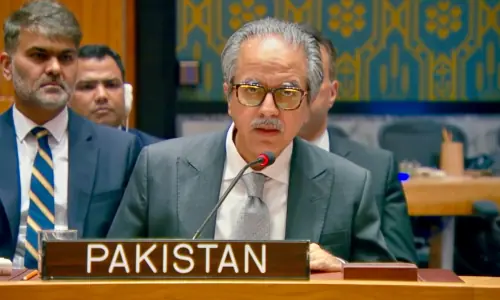
Ambassador Han Sung-joo told reporters in Seoul that the confession by Pakistan's top nuclear scientist that he had sold nuclear arms technology to Pyongyang had "further confirmed" the existence of the North's highly enriched uranium (HEU) programme.
Pyongyang said on Tuesday that statements by Abdul Qadeer Khan that he had sold nuclear secrets to North Korea, Libya and Iran were a "sheer lie" cooked up by the United States to justify an invasion.
Analysts said the combative North Korean reaction was designed to prevent discussion of the issue in negotiations aimed at ending a crisis that erupted in October 2002 when US officials said that Pyongyang had admitted to pursuing an HEU programme.
Pyongyang has since denied it had made such an admission. But Mr Han said such denials wouldn't fly when North Korea sits down with the United States, South Korea, China, Japan and Russia for a second round of six-party talks beginning on Feb 25.
"Even among U.S. domestic critics of the Bush administration, nobody who has seen the evidence doubts that North Korea has a highly enriched uranium programme," Mr Han said in a briefing with reporters.
"Previous intelligence, what has emerged from Pakistan and other information are more than enough to outweigh (doubts about US intelligence) in the Kay report," he said. The Kay Report said that the United States invaded Iraq based on faulty intelligence about that country's weapons of mass destruction.
The HEU programme makes North Korea's offer to freeze its plutonium-based nuclear programme in exchange for compensation unacceptable to the South Korea, the United States and Japan, Mr Han said.
"From the point of view of South Korea, the United States and Japan, North Korea has in the past already agreed to do that, and it will be difficult to compensate them for it," he said.
North Korea had frozen its plutonium-based programme under a bilateral agreement with the United States in 1994 in exchange for energy aid. That deal unravelled last year and North Korea says it has reprocessed more plutonium for a "nuclear deterrent".
Dismantling the plutonium programme, the HEU programme and any atomic bombs North Korea made before the 1994 freeze was the ultimate goal of the United States and its allies, Mr Han said.
The US has said a verifiable commitment by North Korea to end all those programmes would be met by "corresponding measures", include assurances against an American attack and measures to address the North's energy and economic problems.
"The U.S. stance is not that no compensation will be offered until the programmes are entirely dismantled, but that North Korea will get aid from the parties at the six-way talks and other countries when it confirms it will do that and begins that process," the ambassador said.
The six countries met in Beijing in August, but failed to go beyond stating their respective positions in the dispute. -Reuters