0
0

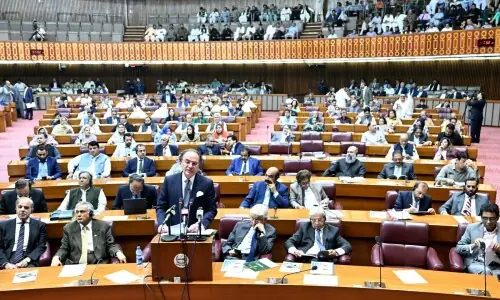
ISLAMABAD, Dec 28: The National Assembly appeared set on Sunday night to pass the government’s constitution amendment bill by more than the required two-thirds majority in a landmark deal by the opposition Muttahida Majlis-i-Amal (MMA) to accept President Pervez Musharraf with sweeping powers.
But the final voting on the Constitution (Seventeenth Amendment) Bill was put off until Monday morning after a past-midnight opposition walkout to protest against alleged misbehaviour by police in preventing some members from leaving or entering the parliament building.
Ruling coalition and MMA members voted together to give a big support to the Constitution (Seventeenth Amendment) Bill after overcoming some legal wrangling with the opposition’s main Alliance for the Restoration of Democracy (ARD) and its allies.
The bill’s passage needed 228 votes — two-thirds of the 342-seat house — but initial voting gave the government-MMA combine up to 236 votes versus 46 as the second reading of the legislation began late in the evening.
In effect, the bill amends President Musharraf’s Legal Framework Order (LFO) that the government said had become part of the Constitution when enforced last year but was rejected by all opposition parties on grounds of their objections to some of the decrees forming the document and that only parliament could amend the Constitution.
The MMA succeeded to extract some concessions in the deal in return for its commitment to vote for the bill and not to oppose the president in a vote of confidence he will seek from parliament and the four provincial assemblies as a substitute for election by the parliamentary electoral college.
But the bill largely retains the presidential powers such as the sacking of a prime minister, dissolution of the National Assembly and appointment of armed forces’ chiefs and provincial governors, and allows him to retain the office of army chief for one more year.
At the start of the proceedings, speaker Chaudhry Amir Hussain rejected an argument of Mr Aitzaz Ahsan of the People’s Party Parliamentarians (PPP) that voting on each clause of the bill be held by division as in the final vote and ruled that members would stand in their seats for separate voting on clauses.
He also refused to entertain an opposition amendment seeking deletion of a bill’s clause providing for the president to seek a vote of confidence from both houses of parliament and the four provincial assemblies for a “further affirmation” of the office, which he has taken on the basis of a referendum held last year.
Several other opposition amendments were rejected after heated arguments, including one seeking the deletion of the Constitution’s LFO-inserted article 58 (2) (b) that empowers the president to dismiss a prime minister and dissolve the National Assembly, but which has been amended by the new bill to provide for a reference of the matter to the Supreme Court within 15 day of a dissolution.
But there was a unanimous vote — with ARD and its allies also supporting — for omitting the LFO-inserted article 152A of the constitution that provided for the creation of a military-civilian National Security Council (NSC) to be chaired by the president.
But the MMA has committed in its deal with the government to support the creation of such a consultative council through an act of parliament.
The ARD and its allies also had no objection to an amendment nullifying the extension in service given to Supreme Court and high court judges by restoring the previous retirement ages: 65 (instead of 68) for a Supreme Court judge and 62 (instead of 65) for a high court judge.
The ARD, which includes the PPP and PML-N, and its allies called the bill an endorsement of the LFO that they said had made parliament and the office prime minister subservient to the presidency.
They also criticized the role of the MMA in making a deal with the government after a 13-month joint anti-LFO protest with ARD in parliament. That led to some angry rebuttals from MMA.
“I am sorry to say that his package...is an unholy alliance between holy people and the government,” PPP chairman Amin Fahim said as he appealed without success to the religious alliance to review its stance.
PML-N parliamentary leader Chaudhry Nisar Ali Khan told the assembly members that “your will cut the branch on which you are sitting” by giving the president discretionary powers of article 58 (2) (b), which he said would also make the president’s house a centre of conspiracies against an elected government.
PPP secretary-general Raja Pervez Ashraf described the article as a strangulation of democracy and said history would not forgive its supporters.
But Minister of State for Law and Parliamentary Affairs, while winding up discussion on opposition amendment against article 85 (2) (b), said this was necessary for the survival of democracy.
He said former prime minister Benazir Bhutto, during her second tenure in office, did not heed then president Farooq Khan Leghari’s suggestion to review the controversial article.
Mr Aitzaz Ahsan said article 58 (2) (b) would be a sword which no elected prime minister could escape without bending to presidential wishes and that reference of a dissolution of assembly to the Supreme Court would be of no relief as shown by Pakistan’s past experience.
He said powers of similar powers given to provincial governors under another clause to dissolve provincial assemblies with the president’s consent could be used against the MMA government in the NWFP and hit provincial autonomy.
The house went into a brief recess at midnight to reassemble later as the government appeared determined to get the bill through before dawn.
But a noisy furore developed in the hall after a pro-government independent member from Punjab, Ms Saima Akhtar Bharwana, said she was blocked by security staff from leaving the parliament building during the recess and complained of a breach of her privilege.
Her cause was taken by the opposition members as PPP chief whip Khurshid Ahmed Shah complained that members were being “imprisoned” on the directives of Prime Minister’s aide to ensure maximum voting on the bill.
Prime Minister Zafarullah Khan Jamali personally went to Ms Bharwana’s desk to assuage her anger but she was not ready to budge while she sought an explanation, saying that the prime minister should remember that he was elected by a one-vote margin because of her vote.
After shouting from both sides of the houses, members of ARD parties walked out and held a protest meeting in a committee room.
In the opposition’s absence, at least two of their amendments lapsed while the treasury benches completed the second reading of the bill while only PKMAP leader Mahmood Khan Achakzai, who had not joined the walkout, stood up against government motions in support of the bill’s last clauses.
On a motion from MMA’s Liaqat Baluch, the speaker, who had issued a new agenda after midnight for the passage of the bill, agreed to adjourn the house until 10am on Monday to enable the opposition members to join the final third reading of the bill.