0
0

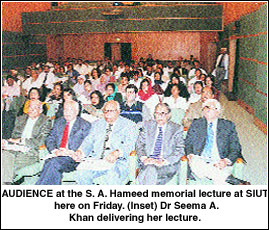 KARACHI, Dec 26: The Sindh Institute of Urology and Transplantation hosted S. A. Hameed memorial lecture at its new premises on Friday.
The citation on Prof Hameed was read out by Dr Ali Muhammad Ansari, a senior orthopaedic surgeon.
Dr Hameed was the head of surgery department at the Jinnah Post Graduate Medical Centre, till 1987. He was a great teacher and most of the professors in the province had been trained by him.
Speaking on the occasion, Dr Seema Khan, a graduate of the Dow Medical College, who specialised in breast cancer detection and surgery, especially among high-risk women, gave statistics of breast cancer, showing a higher prevalence of the ailment among the European women as compared to that in the American women.
She recommended lifestyle modifications to reduce breast cancer risk, by avoiding hormone replacement therapy and post menopausal weight gain. Regular aerobic exercise, use of fresh fruits and vegetables and avoiding animal fats could prove helpful in this regard, she said.
She spoke on breast cancer risk estimation by various statistical methods. The Gail Model estimated sporadic breast cancer risk in women undergoing annual screening. Major predicting factors of breast cancer in this model were found to be age at start of menstruation, age at first pregnancy, number of breast biopsies and number of first degree relatives affected with the disease, she said.
Epithelial sampling by random Fine Needle Aspiration of the breast, was another method of assessing the risk, which was a simple as well as inexpensive method, she said.
Dr Seema suggested that women in the high-risk group should monitor their health through surveillance by semi annual breast examination and annual mammogram.
The medical prevention of breast cancer has had a breakthrough with the drug, tamoxifen, which decreased breast cancer incidence by 49 per cent, she said, adding that the other drug, Raloxifene, was still being tried out with encouraging results and less side effects.
Surgical prevention could reduce the risk more than 90 per cent, but the emotional impact of this method was considerable. Removal of both ovaries had shown breast cancer risk reduction by 50 per cent in women with a strong family history, she said.
Dr Seema said that the past decade had seen significant advance in the identification and management of the ailment among the women with increased risk of breast cancer.
Early identification and close surveillance should decrease the fear that this ailment created among the high-risk women, she said, adding that younger women benefited more with prophylaxis and surgical prevention was the main option for them.
Prof Anwar Naqvi, thanking the guest speaker on behalf of SIUT, said that Pakistani graduates had achieved highest honours in western countries, especially USA, adding that the local students could benefit a lot from their experiences.—APP