0
0

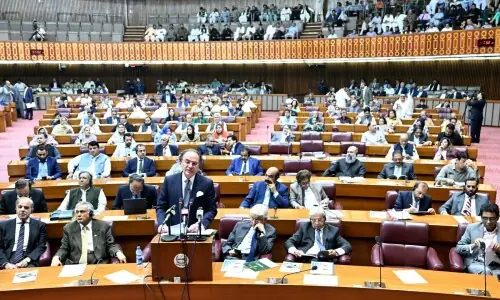
KABUL, Dec 21: The constitutional loya jirga on Sunday entered its second phase as delegates to most of the 10 sub-committees forwarded their recommendations to a reconciliation body for further deliberations.
“Eight of the 10 sub-committees have completed their deliberations and forwarded their recommendations to the reconciliation committee for further discussions,” Safia Siddiqi, spokesperson for the jirga, told Dawn at the close of the day.
“One sub-committee would complete its work later this evening and we hope that the remaining one would also finish its discussions and forward recommendations latest by tomorrow,” she said.
Former Afghan president Prof Burhanuddin Rabbani heads the committee that has yet to complete its deliberations on the 162-article draft constitution.
“His committee should have been assigned the last number,” Sibghatullah Mujaddidi, loya jirga chairman, remarked in a lighter vein evoking laughter amongst the audience.
“I will ask him why he is so slow,” Mr Mujaddidi replied when asked about the reason for the delay.
Safia Siddiqi said the reconciliation committee comprising heads of the 10 subcommittees and their 10 secretaries, besides eight members from the commission that drafted the new constitution and law experts, would try and wind up its discussions “in a day or two”.
The reconciliation body would then forward its recommendations, points of agreements and disagreements to the 502-member constitutional loya jirga for final approval.
“If everything goes well, we should be able to finish the entire proceedings by Thursday,” she remarked.
Mr Mujaddidi said that under a presidential decree the jirga had to complete its work within 10 days. Sunday was the eighth day of the grand assembly.
But, Safia Siddiqi said, the delegates had the right to express their opinion and take as much time as they needed to discuss the draft constitution which, if adopted, would be Afghanistan’s ninth constitution.
The country that has been ravaged by decades of civil war and foreign occupation is presently being governed under the 1964 constitution of former Afghan king Muhammad Zahir Shah.
Ms Safia confirmed that most delegates favoured a strong president to steer the country out of the present delicate situation. “There is a general support to the proposal,” she said.
President Hamid Karzai had said he would contest the June 2004 presidential elections only if the loya jirga endorsed the presidential system.
Under the rules framed for the jirga, President Karzai needs simple majority to push through the draft constitution in its present form.
But while Mr Karzai would get what he wants, delegates supporting the presidential system acknowledged that they would have to empower parliament to allay apprehensions regarding a strong presidential system.
One proposal being discussed is giving parliament the right to impeach the president, something absent in the draft constitution, and making the future head accountable to the elected body. “There has to be some give and take,” a delegate told Dawn.
At the press briefing at a local hotel, Mr Mujaddidi played down reports of ethnic divide on key issues. He played down reports of differences over whether Afghanistan’s national anthem should be in Pashto or Dari (a variant of Persian). “There is total freedom of expression. There has been no such instances of tension or people getting angry at each other,” he said, avoiding giving a direct answer. “Nobody can impose his will on others.”
Afghanistan’s national anthem had always been in Pashto until when Prof Burhanuddin Rabbani as president in early 1990s changed it into Dari.
Afghanistan under the Taliban was the only country in the world without a national anthem.
Despite optimism, there were concerns that groups opposed to presidential system might cause a last-minute deadlock by refusing to back the draft constitution.