



 0
0

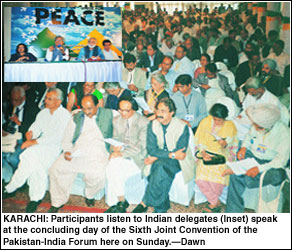 KARACHI, Dec 14: The sixth convention of the Pakistan-India People’s Forum for Peace and Democracy on Sunday called upon the two countries to settle the Kashmir dispute while respecting the aspirations of the people of Jammu and Kashmir on both sides of the LoC.
The Karachi Declaration, which was adopted on the last day of the three-day convention, also called for withdrawal of armed forces and armed groups on both sides, establishment of an effective and accountable mechanism to ensure protection of life and liberty of the people, particularly the women, of J&K.
During three days of deliberations delegates from the two countries appreciated the current efforts at rapprochement and called for building the people’s movement to remove obstacles in the way of peace.
Delegates from the two countries unanimously declared that the future of the people of Pakistan and India as independent countries was contingent upon permanent peace and harmony so that they fought the imperialist machinations of subjugating and exploiting “the resources and the people of our countries.”
The Karachi Declaration also reiterated call for global nuclear disarmament, and immediate ‘de-alert’ and subsequent destruction of all nuclear weapons by the two countries, a 25 per cent reduction in conventional forces, and an end to the use of landmines. It also called upon the two countries to become signatory to the UN documents in this regard.
The convention also constituted joint committees to ensure systematic and concerted pursuit of the objectives of the Forum.
The committee on Kashmir has been mandated to arrange for, and facilitate, a dialogue between people from both sides of the LoC, and interact with all organizations involved in the efforts to achieve a peaceful and democratic resolution of the Kashmir issue.
The delegates from India and Pakistan were convinced that the people of the world in general and South Asia in particular faced new forms of imperialistic globalization.
The committee would prepare an immediate and short-term people’s plan for confidence-building and normalcy in the region and a long-term strategy for a just and durable peace in the subcontinent.
It would visit different parts of India and Pakistan and hold extended discussions with the various sections of society, including political parties, business community, workers and farmer’s organizations, media professionals, women and minority groups, and representatives of the people’s movements.
The convention also decided to constitute a joint committee on minorities to deal with the issue relating to the protection of minorities and their rights in the two countries.
It was of the considered view that there would be no justice without granting redress to the victims of human rights abuses, especially with the connivance of the state as in Gujarat.
The conference was convinced that people of the world in general and South Asia in particular were confronted with new forms of imperialistic globalization, that was increasingly aided and abetted by local interests and constituencies; imposed an iniquitous system on the developing countries; destroyed the livelihood of common people; undermined the political and economic independence of counties; directed violence against societies with different political and social ideals, particularly Muslim people; and terrorized entire countries in the name of fighting terrorism.
The conference also called for building “resistance against the IMF, World Bank and WTO..., and promoting strong trade and economic cooperation between the two countries and in entire South Asia to foster independent development”.
The Karachi Declaration also held that “persistence of majoritarian politics and increasing communalization of the polity, pitting one disadvantaged section against another deprives the people of their right to self-realization.”
It was of the view that without adequate protection of religious, cultural and political minorities, and women, there would be no democracy.
The convention also resolved that all regimes and laws that deny human rights of the person without citizenship status, such as migrant workers and those who cross the border by mistake must be scrapped.
It also exhorted Pakistan and India to sign a protocol on exchange of prisoners and respecting the rights of refugees.
It demanded immediate cessation of the harassment of fishermen. Those arrested must be repatriated immediately with their boats, equipment and property, it added.
The convention also called upon the two governments to remove all restrictions on travel between the two countries, and put in place a regime of issuing of visa on arrival.
It also emphasized the need for recognizing the universal right of divided families to reunion, and allow cultural exchanges and interaction between civil society organisations to counter the atmosphere of hate and distrust, remove restrictions on exchange of literature, films, music, and other art forms.





























