



 0
0

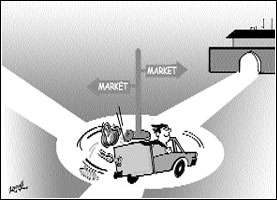 The present agricultural marketing system in Pakistan has developed over last several decades from a primitive and traditional way of marketing produce to that characterized with a certain degree of scientific approach.
As such the marketing structure is both diversified and flexible in nature depending upon the problems of different commodities, and the conditions prevailing in various parts of the country. The present marketing arrangements, therefore, comprise those where private enterprise is free to operate, on the one extreme, and those which are subjected to government interventions. These measures include the fixation of ceiling and floor prices of certain commodities, their procurement quotas and prices, the export rules and regulations, the institutional credit control, etc.
Despite efforts to streamline the marketing of agricultural produce, it is still based on the age-old customs and traditions. The village traders, itinerant merchants and commission agents, even today, occupy an important position among the market functionaries in handling the produce. In the absence of alternative/competitive agencies, they always have an upper-hand in dictating their own terms to the grower in the disposal of his produce.
Besides, rules and regulations which are enforced from time to time, there are two statutary Acts which presently are in operation. One is styled as the Agricultural Produces (Grading and Marking) Act 1937, and the other as Agricultural Produce (Markets) Act 1939. Both these legislations were enacted in pre- independence days and were operative in the undivided India. Pakistan has adapted them. The former is a Federal Act and relates to the grading and standarization of the agricultural produce and the latter is a Provincial Act which provides for the regulation of agricultural wholesale markets.
The Grading and Marking Act enables the federal government to prescribe and enforce the grading of exportable commodities on compulsory basis.
Under the market legislation, the wholesale markets of agriculture produce are regulated where all market functionaries are licensed and their charges fixed. It safeguards the growers against the fraudulent practices of middle men.
About 180 markets have been regulated in Punjab, 87 in Sindh and one each in the NWFP and Balochistan. The provincial governments, particularly, in the NWFP and Balochistan, are actively at work to bring more markets under the preview of Markets Acts.
As a result of the introduction of grading of exportable commodities through a statutary Act has brought about a beneficial impact on the marketing of commodities graded. Its benefits are:
1. The sale and purchase of commodities brought under the umbrella of statutary grading is now being done in the domestic market also, on the quality basis unlike the mixed lots transactions in the past enabling the producer to earn more as graded stuff is sold at premium prices.
2. The export of citrus fruits, mango, and dates have increased manifold both in volume and value because of better quality and improved packing and packaging.
3. Better market preparation techniques have been made available to the producer.
4. In the case of wool, after the introduction of its grading, the clean wool contents of the graded wool consignments presented for sale in the domestic market by the producers have increased considerably.
5. The yield of clean wool meant for the export has far exceeded the mandatory minimum limit of 70 per cent, thus the cost of its transport has also reduced to the extent of decrease in extraneous matter.
6. Further, to obtain better result, mechanical and chemical cleaning of raw wool has been introduced.
7. Improved methods of plucking and packaging of fruits have been introduced through guidance by the field grading staff.
The favourable impact points of regulation of agricultural wholesale markets are briefly mentioned below:
1. Malpractice such as adulteration, deliberate short weighing, excessive deduction for substandard produce, delayed payment, charity deduction etc., have been eliminated to a great extent.
2. Trade practices have been regulated in accordance with the legally prescribed standards.
3. Exploitation of growers at the hands of unscrupulous traders and commission agents has been done away with to a great extent.
4. Specific charges are prescribed for various services such as commission, weight, cleaning, bagging etc. these charges are much less than those rampant in unregulated markets.
5. No market fee is charged from the grower/seller, while wholesalers/commission agents are required to pay the same. 6. Various efficiencies viz-a-viz physical, operational, movement, pricing and innovations are far better in the regulated markets than those in the unregulated ones.
The above discussion shows that the legislation in respect of various aspects of marketing does improve things. But it may also be realized that no undue hindrances are placed on the smooth working of various marketing operations. As a matter of fact the objective of the legislation is to bring under discipline various market operations which are being, or likely to be, misused in future. Therefore, a very cautious approach is required in this regard.
Suggestions: As the agriculture, including, its marketing is a provincial subject, it is suggested that the provinces may establish marketing boards for the commodities or group of commodities which they produce in plenty. For instance, an apple marketing board in Balochistan, a citrus fruits marketing board in Punjab, a banana marketing board in Sindh, a pears marketing board in the NWFP need to be set up.
However, for nationally important commodities like wheat, cotton, oilseed, etc., national marketing boards may be established. For this purpose legislation shall be required for which provincial and federal governments may take necessary steps. Similarly, marketing of livestock and its products may be brought under a legal umbrella by means of enactment of a livestock and live stock products act.






























