



 0
0

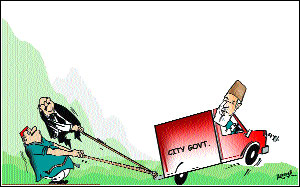 In the recent events, scores of important development-related decisions are being contemplated by the authorities in the most disjointed manner. On 29th November 2003, the Chairman of National Highway Authority (NHA) agreed with the City Nazim to consider the doubling of Northern Bypass Project from single to double lanes on each side of the carriage way.
Another report informs that KBCA is planning the removal of cabins from around Bazar-e-Faisal and Meena Bazar in Karimabad area despite the contention of the hawkers that they have been paying land utilization charges.
The City Nazim is relentlessly trying to establish his writ by taking a position against the alleged interference in the local affair by the Sindh Government. Several key questions crop up in response to these and similar events. Who is the ultimate authority to decide about the city affairs - the City Nazim, Chief Minister/Governor of Sindh or the President? How are the various perfectly whimsical decisions justified? What scientific basis or any other kind of logic is cited for the projects that cost billions of rupees and affect thousands of lives? And above all, is there an overall picture frame of the city to which these random actions fit in a bid to complete the puzzle?
The saner responses shall obviously reflect a very disappointing state of affairs. In brief, the upper tiers of government undoubtedly prevail on the lower tiers, entirely depriving them of their legitimate autonomy. Devolution of power is reduced to a farce. Decision making related to developmental and managerial activities is whimsical and adhoc, to say the least. And most of all, there is not larger (or even shorter) vision for the city to coordinate its developmental affairs. This established, it must also be understood that all progressive urban centres of the world in developed and developing countries essentially subscribe to a city vision and planning exercise and management set-up that translates the aspirations of stakeholders and needs of the various sections of the society. Whether London, New York, Kuala Lumpur or Mumbai, a city planning framework continuously guides the urban development and management of urban centres.
It is a common place logic to establish a vision about the city in reference to the existing realities and anticipated changeovers. The draft document of Karachi Development Plan 1986-2000 consisted of six distinctly worked out scenarios for development. In filling and consolidating developed areas, assuming a low-to-moderate urban growth, predicting (conservatively) no growth and aiming to upgrade infrastructure; focusing on the development of low income settlements; planning exclusively for the later development and providing services to cantonments and housing societies were the planning strategies worked out in this reference. However none of these strategies could be considered for implementation as the said development plan could never be notified.
The prevailing situation greatly demands that a conceptual vision of the city must be developed through the consultations with all the cross-sections of the society. That vision may get gradually and periodically translated into development and management plans covering tangible time and space parameters. Needless to say that without a concept, details of any kind of development cannot be scientifically evolved.
Planning process and consequent plans are a safeguard against the rising influence of market forces, consumerism and negative fall-outs of globalization. The market forces are striking hard to obtain optimum conditions to expand their basis, maximize investors profits, unscrupulously extend trading and engage into all kind of activities that offer lucrative returns. They collude with all types of stakeholders in any overt or covert set of operations that can create profits to the windfall extents. Be it real estate or trading, consulting services or contracting, brokerage or banking, health or education, every sector and area is exploited to the maximum. The market mechanisms are apparently ruthless in characteristics. The fittest can only survive leaving trails of masses to suffer from the negative repercussions. Employment, safeguard of environmental assets and survival of the enterprises themselves are of little consideration and importance. These forces and their agents do not even care in evicting people from stable settlements in a bid to create a high yielding enterprise or obtain a mundane contractual assignment. A legally validated plan, however, poses a check on these vulpine ventures. It questions the launch of any such project or programme which is not duly incorporated in its stipulations.
It is found that public funds are carelessly allocated towards projects or programmes of little relevance. Currently several such dubious initiatives are underway costing enormously to the public exchequer.The Lyari Expressway at the cost of Rs. 5 billion, Mass Transit Programme at an estimate of Rs. 66 billion, several projects under Mera Gher Housing Scheme - running into billions of rupees - are a few examples. While the extent of need, relevance, benefits, appropriateness of design, cost estimates, execution procedures and locational parameters require detailed analysis for each case, the logic of decisions to go ahead with these projects and corresponding funds allocation remain debatable issues. Under civilized circumstances, the decisions about launching programmes or projects are guided by city plans. Provisions of fund allocations, mechanisms of the award of projects and their overall monitoring are few aspects directly stipulated through the plan. Besides, since each plan is instituted around an overall urban management mechanism, the routine matters of applications are undertaken in a smooth and frictionless fashion. Incidences such as the ugly standoff between the City Nazim and provincial administration on cabins / hawkers issue seldom arise.
A civilized planning process is structured around just, democratic and transparent procedures. Let us take an example of a problem solving scheme for traffic re-routing in any urban area. When the local government of any civilized city decides to undertake such a scheme it develops a technically sound and socially viable proposal on its own accord. Thereafter it puts up the blue print and details of the schemes on public display with proper publicity. People are invited to review the scheme and cite their objections in writing. This process continues for some time. After this stage, the concerned authorities revise the proposal after addressing the objections. The proposal is floated back to people for public review and hearings leading to eventual finalization of the plan.
As this whole process is transparent and open to people, no question of manipulations or underhand dealings arises. Such a process was partially attempted in one instance in Karachi. A group of professionals prepared a draft document of building and town planning regulations for Karachi. The draft was publicly debated for several weeks with several controversial aspects thrashed out. However the final outcome reflected a very different version - not directly commensurate with what was original draft stipulated.
The planning processes and approaches that were attempted have not yielded the desired results. There have been several attempts that generated development plans in various forms. The most worthwhile were the Karachi Development Plans (1973-1985) and (1986-2000). Although both the plans were different in their approaches, contents and outputs, both met with the same fate. They were never officially notified despite the fact that sizable funds and professionals inputs had gone into their making.
It was obvious that the notification of plans would have caused an obstacle in the way of such quarters who believe and function under adhocist approach. Nowadays there is neither any potent planning body nor a will to generate a valid plan. In other words the city is growing in a rudderless manner with a flaccid administration unable to check the offenders. The most distressing aspect is the fact that the city government, which is directly affected by this amorphous situation, is not paying any heed to this pressing need.
Several aspects need to be considered in this respect. Lines of policy making prerogative and execution must be clearly drawn between federal, provincial and city governments. It must be understood that the upper tiers of government shall have to voluntarily delegate their existing powers to the city government to improve its working capacity. The CDGK on its own must structure a planning agency with its jurisdiction extended to the entire city. Without a competent institution, no sustainable exercise can evolve. This agency may draw up its own working priorities some of which may include review of the past planning exercises, analysis of urban needs, synchronization of ongoing development projects and development of a city vision for future. Suggestions pertinent to urban management may also be put forward by this agency to safeguard land, assets and investments belonging to the city and inhabitants. This perhaps is one of the ways to avert ugly scuffles between government functionaries - and also to put the urban development on a proper track.






























