



 0
0

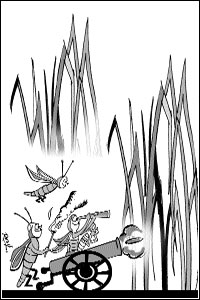 During the Kharif 2003 cotton crop which is the backbone of Pakistan’s economy was invaded by insect pests, especially the armyworm, both in Sindh and southern Punjab. Farmers fought the pests with a variety of weapons, but they destroyed thousands of acres of cotton both in Punjab and upper Sindh.
The most shocking scenario was that the much-publicized and costly-ventured National IPM Programme of the Pakistan Agricultural Research Centre (Parc), launched in Sindh with foreign funded-loans failed completely to contain the onslaught of armyworm even in the areas like Thari Mirwah of District Khairpur.
The Integrated Pest Management (IPM) programme control was in practice here for last couple of years and has been claimed the most successful by officials running the said programme.
The gravity of the cotton crop damage in Taluka Thari Mirwah could be gauged from the fact that the Nazim of this Taluka demanded tax relief for the affected growers from Federal Minister of State for Food, Agriculture and Livestock Sikandar Hayat Khan Bosan.
As a matter of fact armyworm managed to damage other crops too, in some other parts of the country but for want of proper monitoring at official levels its ravages goes unattended, both in print and electronic media. For example, during Kharif 2003 armyworm inflicted significant damage to sorghum, kharif pulses, tomato seedlings, and many vegetables in districts Bolan, Jhal Magsi, Jaffrabad, and Nasirabad of Balochistan.
Similarly, it also caused massive damage to lotus, groundnut, young maize crop and variety of vegetables both on left and right bank command area of Sukkur and Guddu barrage in upper Sindh. Yet, the irony was that no official quarters concerned bothered to attend to the plight of affected growers of these crops.
On the contrary, cotton crop damage received attention both in print and electronic media. So much so that the MNAs of the ruling coalition raised a storm of protest in the National Assembly over what it called heavy damage to their cotton crop by pest attack.
Presently vanishing larval population of armyworm on cotton plants standing in the fields has given a general impression among the farming community that menace of armyworm has gone. Where as the fact is that armyworm still exists in millions in its advance larval stage on the ground, under dried cotton leaves, and under the soil in pupal stage.
Survey of some armyworm affected cotton crop fields, especially adjoining wheat crop fields in districts Khairpur and Shikarpur (paddy growing belt) during the first week of December indicated the presence of three armyworm larvae of advance stages and two pupae per square metre.
Besides, light trapping indicated the emergence of armyworm moths. It is evident that despite natural control some population of this menace may remain viable during the Rabi season and may in turn pose a serious threat to the standing wheat crop particularly at post milky to early grain formation stages, almost in the entire upper Sindh region, especially the desert belts of districts Khairpur, Sukkur, and Ghotki.
Armyworm alert call for wheat crop at national level is necessary because after damaging cotton crop in September, its next generation of moths has spread in far flung areas of the province, particularly in the upper Sindh.
After egg laying its new hatching (larvae) caused severe damage to the early sown lucern (fodder crop) and some vegetables. Gravity of the situation could be gauged from the fact that during the first week of November a prominent grower of Taluka Kingri of Khairpur District, reported that about 40 acres of lucern crop sown during mid October in Kachho area was almost completely wiped out by the armyworm larvae which were in swarming form.
Moreover, this is not the first time that early sown (October) lucern crop has been damaged by the armyworm. In 2002 also, lucern and some vegetable crops in districts Ghotki and Khairpur grown on area of over 2000 acres were severely damaged by this menace.
As a matter of fact it was in 1996 when the armyworm had caused significant damage to wheat crop in districts Khairpur and Sukkur, which are semi-arid to arid climatically.
A review of literature has indicated that armyworm has been found causing damage of major economic importance in the semi-arid and arid region of north America and said to have destroyed 1,000,000 acres of winter wheat in one year in Montana (US) alone.
1. Since the standing cotton crop in the invasion areas harbour high larval and pupal population of armyworm on the ground under dried leaves and in the soil, respectively, growers should be advised through the field force of the agriculture extension to remove cotton plants from the fields as soon as possible. Removal of cotton sticks should follow the burning of refuge of cotton and deep ploughing and flooding of the field prior to undertaking wheat cultivation.
2. For timely detection of insurgence of armyworm wheat crop 2003-04 should be taken under regular surveillance, particularly, from the booting stage by the provincial agriculture extension government of Sindh.
3. In case of plant protection measures against the armyworm use of highly toxic and broad-spectrum pesticides should be discouraged. This is necessary in order to protect the long established wheat agro-ecosystem in this part of Sindh province.






























