0
0

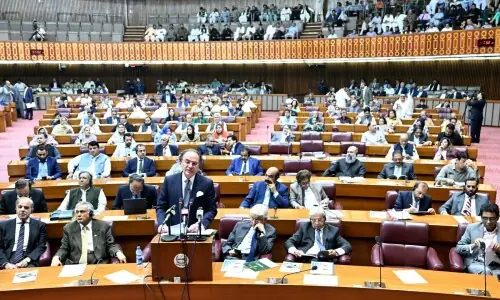
KARACHI, Dec 12: The sixth convention of the Pakistan-India People’s Forum for Peace and Democracy began here with a call for disarmament and respect for fundamental human rights.
The focus was on disarmament, the rise of neo-colonialism in the form of the WTO and liberalization of the visa policy of the two countries.
Speakers at the opening day of the three-day-long convention said unless people break the logjam created by the rulers of the two countries, peace and democracy would remain threatened and the people’s capacity to withstand the imperialist onslaught would be compromised.
They called for doing away with the current restrictive visa and travel regimes and urged coordinated mass action in this connection by the forum and like-minded organizations in the two countries.
It was suggested that Kashmir was not a territorial issue but a people’s issue in which Kashmiris were the principal party whose opinion should be given priority.
They were of the view that while the globalization agenda was pushing for relaxing fiscal barriers and allowing commodity flows, domestically governments were attempting to control the public and private lives of the people.
Dr Mubashir Hassan was critical of the plight and exploitation of Kashmiris, who, he said, must have the decisive role in determining their future.
He said the human rights of Kashmiris were being violated and called upon both India and Pakistan to respect them. He also called for arms reductions and making the region safe for its over a billion people.
Forum chairperson Afrasiab Khattak said the people of the two countries would bring peace to the region. Similar views were also expressed by Dr Ashok Mitra, Mr Khatak’s Indian counterpart. In his keynote address, Dr Nirmal K. Chandra dealt with imperialism and globalization.
Globalization, Dr Chandra said, was a crucial component of the new strategy of imperialism in the present phase. It represented inequalities everywhere in income and wealth, he said.
All nations lose a good part of political and economic sovereignty, but the rich and powerful countries are able to retain their decision-making authority to a far greater extent than the rest of the world.
He was of the view that many of the elite groups in developing countries had become beneficiaries of globalization, thus strengthened the imperialists in creating a new world order.
Why was the free traders’ win-win strategy not followed by the US or its allies vis-a-vis countries in Latin America, Africa or Asia, he asked.
Dr Chandra also referred to neo-liberalism and said that inequalities in income and wealth had shot up exponentially in the last three decades, surpassing recorded levels of the past two centuries. A partial, but nevertheless revealing, indicator was the ratio of the earnings of top executives to the those of the average employee in major US firms, which had jumped over the past three decades from 40:1 to 500:1; the latter in real terms (inflation-adjusted) had virtually stagnated.
Many developing countries, including India, he said, had witnessed developments similar to those in the US. Taxes were cut although fiscal deficits showed no signs of amelioration. “Scandals in different shapes and sizes are abundant. Inequalities are hitting the roof,” he said.
Whether there was formal democracy or not, rising inequalities remained a major concern at the global level, Dr Chandra said. He had little doubt that once political institutions were refashioned to mirror more accurately the aspirations of the vast majority in different parts of the world, it would spell disaster for the forces of imperialism and globalization.
At the outset of the convention in which over 500 delegates are participating, Takhti/painting exhibition, a prayer dance and excerpts from a play were organized.
The Indian delegates, comprising over 260 members, include former finance minister from West Bengal Dr Ashok Mitra, ex-naval chief Admiral Ramdas, film artistes Suhasini Mulay, Ratna Pathak, film producer Tapan Bose and lyricist Gulzar.
Earlier, when the delegates arrived by train via Lahore, they were accorded a warm welcome at the Karachi Cantonment station.