0
0

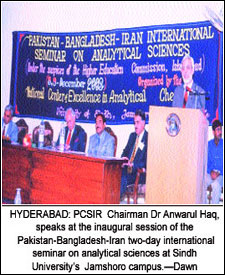 HYDERABAD, Dec 8: Pakistan Council of Scientific Industrial Research chairman Dr Anwarul Haq has urged scientists to make efforts to promote research in different fields and develop a linkage among universities, research and development and industries.
He was speaking as chief guest at the inaugural session of a two-day “Pakistan-Bangladesh-Iran International Seminar on Analytical Sciences”, being held under the auspices of the Higher Education Commission, Islamabad, and organized by the National Centre of Excellence in Analytical Chemistry, University of Sindh, on Monday.
Dr Haq said chemistry was an important subject and it was the duty of scientists to produce research work which could be implemented in industries.
He hoped that scientists of the country would continue their efforts in the research work.
He hailed the Sindh University and its Centre of Excellence for organizing the seminar and expressed the hope that the moot would achieve its goals.
Dr Haq said the PCSIR had developed 226 processes, obtained 23 technological patents and published 325 scientific papers during the last three years. He said it had also arranged 20 training courses, supervised 50 scientists for M.Phil and Ph.D degrees and assisted more than 5,000 industries.
He said the government had approved 37 projects of national importance, valued at Rs 3.3 billion, out of which 16 projects had been completed up to June 2003.
The PCSIR chairman stressed the need for interaction between industries and research-oriented organizations to improve productivity for the benefit of the society.
He said the seminar would not only benefit the Sindh University but also extend the area of collaboration from national to international level.
Allama Iqbal Open University Vice-Chancellor Dr Syed Altaf Hussain, who was the guest of honour, said scientists and scholars should work for promotion of science.
He hoped that the University of Sindh would continue its efforts to promote higher education and research on key issues. He said the AIOU had established a research complex and added that scholars would be involved in research and their expertise would be utilized.
Sindh University Vice-Chancellor Mazharul Haq Siddiqui said the Muslim world was facing a host of problems, including poverty, higher population growth rate, illiteracy, lack of modern education and failure to make science and technology compatible with their life styles and beliefs.
He said to excel in producing indigenous technology in the Muslim world would take a long time. However, he added, the Muslim world had institutions, professionals and expertise to meet the challenges.
He stressed the need for a network of various disciplines, specially analytical sciences, in Muslim countries.
Mr Siddiqui said the university’s Centre of Excellence was well equipped and it would be upgraded in due course of time.