0
0

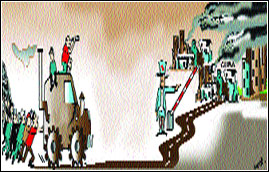 The Second World War was global in scope and total in nature. It helped bring about fundamental changes in world politics after 1945.Before 1939 Europe had been the arbiter of world affairs, and both the Soviet Union and the United States remained, for different reasons, pre-occupied with internal development at the expense of any significant global role.
The war brought the Soviets and American militarily and politically deep into Europe, and helped transform their relation with each other. This transformation was soon reflected in their relation outside Europe where various confrontations developed. Like the Second World War, the Cold War had its origins in Europe, but quickly spread, with enormous consequences for countries and people around the world.
The era of Cold War, which had started in 1945 and ended with the collapse of the Soviet Union in December 1991, seen several hostilities/ wars between “client states” of the USSR and the USA. In brief following are the cold war crises
However, well before collapse of the Soviet Union a new era of confrontation had emerged when Iraq invaded Kuwait in August 2, 1990. The idea of “The Clash of Civilization” by Samual Huntington provided foundation to invent post-Cold War useful enemy. And we have seen that new enemy (Islamic World in general and Arab World in particular) provided justification for its continued hegemony in a post-Soviet world. The global political agenda of the USA is rooted from its domestic economic conditions. Capitalism, as economic system has horrifying past due to its inherent phenomenon of business cycles. However, fears of recurrence of “Black October of 1929,” that triggered the great depression of 1930s, have not been completely wiped out. Arthur Okun, one of the leading analysts of business cycles, viewed business cycles as follow:
“Recessions are now generally considered to be fundamentally preventable, like air plane crashes and unlike hurricanes. But we have not banished air crashes from the land, and it is not clear that we have the wisdom or the ability to eliminate recession. The danger has not disappeared. The forces that produce recurrent recession are still in the wings, merely waiting for their cue.”
After World War II, reflecting both the increasing influence of Keynesian views and the fear of another depression, Congress formally proclaimed federal responsibility for macroeconomic performance. It enacted the landmark Employment Act of 1946, which stated:
“The Congress hereby declares that it is the continuing policy and responsibility of the federal government to use all practicable means consistent with its needs and obligations....to promote maximum employment, production, and purchasing power.”
In the following paragraph, we will read how wisely the US managed to prevent its economy from recessions. Impact of defence spending on the US economy
The government expenditure multiplier at work is seen in the economic impact of the US defence budget. In the early 1980’s the United States undertook a tremendous expansion of defence spending under President Regan. The defence budget (in constant dollars) soured from $ 271 billion in 1979 to $ 409 billion in 1987, when it reached 7.5 per cent of the GDP. After that peak, defence spending as a share of GDP started drifting down.
The cuts in defense spending accelerated beginning in 1990, when it became clear that the cold war was finally over and Soviet communism was no longer a military danger. President Bush and President Clinton both proposed budgets calling for further reductions in military spending, and by the mid-1990s defense spending had declined to under 5 per cent of the GDP.
According to the multiplier theory, the defense build-up of the early 1980s should have exerted a strong stimulative impact on the economy, and that is exactly what happened. As defense spending rose, it helped pull the country out of the recession of 1981-82 and helped propel the boom of the mid 1980s. To some regions like Southern California, where many aerospace companies were based, the influx of defense dollars brought tremendous prosperity. A newspaper article noted that one well-paid defense job would spin off other jobs, such as “ the metal shop supplying some specialized parts, the cleaners to keep the jumsuits white, and the paper company making the pasteboard boxes for the doughnuts that someone picks up on the way to the office.
At the end of the cold war, the multiplier worked in reverse. As defense spending declined, it became an overall drag on the economy. Defense cuts contributed to the sluggish growth in output during the early 1990s. To take one example, from 1990 to 1993 the aircraft manufacturing industry lost 170,000 jobs, mainly because of defense cuts. And Southern California, which had benefited from defense spending a decade earlier, ended up being stuck in recession much longer than the rest of the country as defense lay-offs showed growth in that region.
We can sum up, government purchases of goods and services are an important force in determining output and employment. In the multiplier model, if F increases, output will rise by increase in G times the expenditure multiplier. Government purchases therefore have the potential to stabilize or destabilize output over the business cycle.
Vietnam war started in the year 1965 and lasted up to 1975. American economy grew on average 4.2 per cent throughout from 1965 to 1973; even taking into account of negative growth of 1974-75 (-0.6 p.c.and -0.4 p.c. respectively) on average US economy grew by 3.7 per cent during this period and without serious recessionary trend.
In the 3rd quarter of 1990,the American economy went into recession and there was negative growth in GDP by 0.7 per cent. On the other side Iraq invaded Kuwait on 2nd August 1990 and on 7th August 1990 operations Desert Shield begins. American economy gets out of the recession in the 1st quarter of 1991 and, therefore cease-fire took effect in 11th April 1991.
Year 2001 brought the recessionary trend for American economy and 1st quarter, 2nd quarter and 3rd quarter consecutively had negative GDP growth of -0.6p.c., -1.6 p.c. and -0.3 p.c. respectively. However in the last month of 3rd quarter 9/11 happened that resulted in massive twin military attacks on Afghanistan then on Iraq. As a result of which American economy grew 2.7 per cent in the 4th quarter of 2001 to robust growth of 7.1 per cent in the 3rd quarter of 2003.
Another peculiarity of the American economy is that its economic and financial markets actually benefited from trade deficit. As the deficit zoomed, so did American prosperity. A rising deficit meant an ever-increasing hoard of dollars in international hands; people abroad didn’t know what to do with all that foreign currency. Foreign governments or central banks ploughed the dollar right back into American assets, US interest rates fell again, and a virtuous circle, sparked by the 1990 crash in Japan, turned into gusher. In 1997, Asian currencies went into tailspin, spurring a big rise in America’s already enduring a large trade deficit. But that only helped the United States, because a larger inflow of external capital meant even lower interest rates.
The falling interest rates fuel a housing boom and when a person buys a residence he also like to purchase many other things— appliances, furniture, paintings, rugs and so on. Thus a housing boom is the best thing that can happen to the economy.
Following table depicts that there is fairly strong negative correlation (correlation coefficient -79 p.c.) between Current Account Deficit and Net Capital Inflow. The countries having surplus in their trade balance, plough back dollars into American’s assets. Whereas, the interest rates is pulled down by flow of foreign investment into American assets. The relationship between mortgage rates and Net Capital Inflow has negative correlation coefficient of -68 p.c. It means, as Net Capital inflow increases rates of interest decrease. Balance on current account, net, capital inflow and mortgage rates
CONCLUSION: It is in the greatest interest of the USA to have an excuse to intervene militarily for the sake of its war machine industry. Economy is like wheel within wheel, when the bigger wheel starts moving all other wheels automatically start moving. Therefore, the bloodshed in the name of the Cold War or Terrorism greases wheels of American economy.
On the other hand, as we have seen that removal of trade barriers are in the interest of the USA. No matter how big would be its current account deficit.