0
0

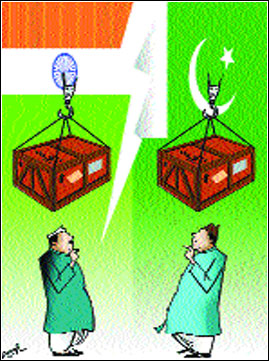 We have long thought that any kind of dissension between any number of nations has more to do with the personal relations of the spokespersons and leadership of those countries than the populace.
The government officials push the proverbial (and quite often nowadays, literally) buttons that affect the economies of their respective nations; the people have cordial relations with each other, oblivious to the others’ existence as they are caught up in their own concerns. India and Pakistan are a classic case in point.
The world as a whole and the entire Asian region feel uncomfortable with the ebbs and flows of the economic, political and social relations of the two countries. There is just too much going on and the politicians and policy-makers are the ones taking actions and passing the blame along. The common man for both nations is led to believe whatever the controlled media depicts. Among the common man are traders, merchants and businessmen. No wonder, and quite ironically then, the economic relations of the countries suffer. If these nations were to cooperate as one, the cliche - the world would be a better place - would be applicable to a great extent. “While the cold war has ended and many countries of the world have embraced the concept of globalization, frosty relations between India and Pakistan have remained unchanged for the last 50 years.” (Lawson, Alastair, BBC.)
“A lagging GDP growth rate and mounting fiscal deficit - a fallout of the burgeoning foreign and domestic interest payment liabilities and defence expenditure have had a perilous impact on the country’s (Pakistan’s) finances. There is an urgent need to revive domestic demand, accelerate industrial production and tap foreign markets to boost export earnings. In this context, Pakistan’s external economic relations, particularly with India, come into sharp focus.” (Vachhani, 2001.) The barriers to trade between Pakistan and its ‘enemy’ across the border is mainly due to political and economic barriers. Consider the chronology of the issue here. Before partition and immediately after independence, India was Pakistan’s most important trading partner. “In 1948-49, 56 per cent of Pakistan’s total exports were directed to the Indian market, and 32 per cent of its imports came from India. Lahore and Amritsar were important economic hubs, as trade flourished with a free flow of goods and services. However, by the early 1950s trade between the countries reduced to a trickle ...and...has not revived since.” (Sangani and Schaffer, 2003.) “Since the 1960s, there has been a steady decline in India’s official share in Pakistan’s total trade and is now less than one per cent. This happened despite the increase in the list of freely importable items from 42 in 1975 to 601 in 1998.” (Vachhani, 2001.) According to official figures both the countries during 2000-2001, had exchanged goods worth $293.74 million through official channels. Out of this Pakistan exported goods having a value of $55.41 million and imported goods worth $238.33 million from India. The tables show the current situation:
Pakistan officials said exports to India went up by 7.38 per cent and imports from New Delhi during the first half increased by 17.87 per cent. During December 2001 exports increased by 2.15 per cent. On the other hand, imports from India surged by 17.87 per cent.
India is at the heart of the trade routes of Asia, that is, 80 percent of intra-regional trade takes place through or from India. There is no denying then that any country having cordial relations with India can only prosper economically. India and Pakistan having been part of the other and the people having so much of culture in common is still insipid in their behaviour and perception of each other. Decades of mutual political hostility and suspicion compound the challenges in trying to build strong trade relations between India and Pakistan. Both sides tend to see progress on issues like trade as a favour to the other country rather a benefit to one’s own country. Pakistan, moreover, is reluctant to move too fast toward normalization of trade and other relations with India lest the issue of Kashmir get sidetracked. There are legendary political benefits to the underlying issue of “heaven on earth”. Note that our constitutions do not have a clause that prevents a government or a leader(s) to be re-elected. Any party that absolves, resolves or settles the dispute - one way or the other - will go down in the annals of history as the greatest the modern world has witnessed. That is why there is a deadlock between these two countries, and unfortunately the repercussions are far-reaching.
In the decades following partition, both India and Pakistan adopted inward-looking economic policies that discouraged imports of consumer goods or of anything that could be made locally. The practical impact was to skew trade in favor of developed countries. Partly as a result, there is considerable overlap in both countries’ exports. Textiles are the best known example. From the economic viewpoint, this means that expanded trade will create rather than divert trade, and will therefore improve efficiency. However, this also makes trade politically controversial: cheaper imports compete with local production whose producers are well connected and whose facilities generate local jobs. “Pakistan does not extend normal GATT/WTO rights or the Most Favoured Nation (MFN) principle to India, but maintains a “positive list” of 600 goods that may be legally imported from India.
India in principle granted MFN treatment to Pakistan in 1995-1996 and has no list of permitted or forbidden products, but the meager imports from Pakistan suggest that India has found ways of imposing a de facto ban on most imports from Pakistan. Informal trade between the two countries is much larger, estimated at $1 - $2 billion annually, involving such goods as chemicals, medicines, videotapes, cosmetics, and viscose fiber. These goods find their way either through third markets, such as Dubai and Singapore, or through smuggling.” (Sangani and Schaffer, 2003.) It is interesting to note here that informal trade between the two countries is and has been quite measurable. The overall economic interaction between India and Pakistan is restricted to small-time merchandise trade.
There are three components to the bilateral trade: Formal import and export of merchandise, circular or informal trade through ‘third’ countries, and the illegal, or suppressed, trade transacted unofficially across the borders. “A study by the Benazir Bhutto government indicated the money value of the illegal trade across the border to be as high as Rs 20 million annually for both countries.” (Vachhani, 2001.)
These facts hint at the existence of vested political and business interest groups in Pakistan, for whom it is financially advantageous to continue with the present system of illegal trade, notwithstanding the loss of revenue to their governments. Hence the recent talks and approaches made by the leaders to their counterparts across the border to formalize the movements to and from the countries within.
It is essential the countries reap the benefits of such corporate endeavours in the name of growth and development, and not just for revenue purposes but corporate governance and mutual economic growth and development. “The cross-border listing could well be an efficient tool to expand the exposure of the local equities on the international platform eventually leading to a bigger client base”, hopes a leading stock analyst at the W.E. Financial Services. The PTCL GDR, for instance, which are being sold on the foreign markets in dollars through agents may not need marketing mechanism as they will be open for any prospective investor the world over, they added.
In addition to the formalization of the informal trade of about $3 billion, the exchange of surplus industrial productions where one of the trading partners is deficient on barter basis could open a new vista of two-way trade between the close neighbours. The plan has been drawn on the pattern of cross-border listing in some of the European countries, which results a massive two-way inflow and outflow from one country to the other provides enough manoeuvring leverage to employ the heavy cash amount for expansion and modernization programmes.
Most of the leading MNCs, notably Lever Brothers, Siemens, auto and pharmaceutical shares sponsored by their overseas principal companies are listed on both the stock exchanges and their respective roles could be supplementary to each other. However, the chances of speculative price manipulation by the “big bulls or bears” are always there despite the presence of regulatory rules and circuit breakers. But they too are the part of the game as they add to real value of the share in trade after the speculative run is defused.
In consumer goods manufacturers, Muhammad Sohail, head of research at InvestCap Securities says, in the manufacturing of all commodities, the rule of ‘economy of scale’ applies. Pakistan’s entire demand of cement at around 10 to I1 million tons, is currently met by over two dozen cement plants in the country. But just one or two giant cement plants in the neighbouring country could fulfil all that demand for they have such large installed production capacities. Cheaper labour is another plus for Indian industries.
In the short run the country will suffer but later it will prove beneficial. Freight costing is an essential ingredient of bulk commodities, which is why if Pakistani producers are able to deliver the product at cheaper delivery costs at destinations nearer the border, they may be able to wrest a market share from Indian producers.
Analysts say that Pakistan has strong gas reserves and a telecom infrastructure, which is one of the best in the region. If the country can exploit the two advantageously, it could earn market share in the neighbouring country as well. The big benefit is energy. It will become a cost-effective, feasible undertaking for both countries if they cooperate. “India is one of the most rapidly growing energy markets in the world and will be able to absorb new sources of supply as they materialize in the region. Pakistan’s potential role in fulfilling this need is not as a supplier but as a potential transit route for energy from Iran and Central Asia. This would require construction of one or more new pipelines, a major capital investment that makes sense only if the political stability and economic feasibility of the project can be counted on.
A project proposal submitted by Iran this past January to both countries estimated that Pakistan would gain between $600 to $800 million per year in transit fees. It would also be able to use the pipelines to fulfill its own energy needs. India would benefit from diversified sources of pipeline gas and lower dependence on more expensive liquid natural gas (LNG). Even with LNG prices dropping, industry sources believe that there would be a significant cost advantage, especially to a pipeline from Iran.” (Sangani and Schaffer, 2003.) But only if the relations can be sustained. Keep in mind, India might not feel comfortable, with its being dubious of Pakistan’s intent, in being dependent on others for power. That would indeed be ironic, considering in probable retaliation and vindication it did the same with our water supply earlier in our histories.
As regards the pharmaceutical and consumer goods, in which multinationals are active players in both the countries, it would be the parent company that would devise strategy that suits best its own interests. Over the long term, analysts say, excess of supply of all consumer products on both sides, would reduce prices and as economic theory says, it could go to boost demand. Another pressing concern is the indefinite termination of road, rail and wagon and air links and trading and transport between the countries.
The mutual complementing in the structure of the two economies, price advantages, low freight costs on account contiguous land borders and cultural and linguistic similarities, provide the rationale for enhanced trade and commerce between the two sides. The agriculture sector, which constitutes the most important component of GDP and is the single largest source of employment in both countries, provides numerous avenues for extensive cooperation. Increased business in food and agro-products has a very positive ripple effect on other sectors of the economy.
Similarly, Pakistan has distinct advantages in electric power, cotton and textile production, while India can make a positive contribution in engineering industries and supply of household goods. The political sensitivity of India-Pakistan trade makes it especially important to sequence liberalization so as to minimize its political fall-out. Pakistan might start by extending normal, or MFN, treatment to a much expanded list of eligible Indian products. The choice of products, and the choice of products for any reciprocal step from India, should be based on worldwide export competitiveness. “Trade liberalization, in other words, should be treated as an opportunity to expand the market for each country’s “stars,” and it should avoid, at least in the early stages, giving the other country treatment that is more favourable than that received by exporters from outside the region.” (Sangani and Schaffer, 2003.)
Besides trade liberalization, it would be useful to expand professional ties between professional counterparts in the Indian and Pakistani ministries that deal with general economic problems. Environmental problems, health, and water management are only three examples of critical economic problems that can more easily be tackled in a regional context. Expanded trade is likely to be in India’s favor in dollar terms. Because the current level is so low, trade liberalization is unlikely to have much macroeconomic impact in either country. The impact on Pakistan is likely to be greater in relative terms, but the political sensitivity will also be higher. Some of Pakistan’s traditional exports of small manufacturers (such as sporting equipment and surgical instruments) may be well placed to take advantage of a new market opening up. The cost of ‘suppressing’ dynamic trade between the two countries has made Pakistan an artificially high-cost economy and deprived the consumers an access to competitively priced commodities.
One potential area of mutual advantage is information technology. There is considerable interest in Pakistan in moving into IT. A fledgling Pakistani industry is unlikely to provide serious competition to the enormous Indian industry, but there could be some mutually beneficial business-to-business links that could be cultivated if the political context became more favourable to mutual trade. Since this industry does not depend on the movement of goods, it may have an easier time moving ahead than some other industries.
Beyond these trade-specific benefits, increased trade between the two countries could strengthen the outward orientation of both countries’ market policies. Here too, Pakistan, with the smaller economy and the more fragile external links, would especially stand to gain.
Trade opening is one of the things that investors in both markets are looking for; again, Pakistan’s more difficult economic circumstances mean that it would stand to gain the most. Arguably, however, the greatest dividend of India-Pakistan trade would lie in growing business on both sides of the border, thereby giving people a stake in the other country.
The notion behind everything is psychology. They just don’t want to do it. They would rather suffer an enema than ask the enemy to help. But if not for the sake of familiarity then for mutual national progress, petty differences must be set aside for the greater good.