



 0
0

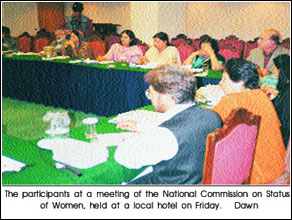 KARACHI, Dec 5: Speakers at a meeting on Friday unanimously called for repeal of the Qisas and Diyat Ordinance, saying it did not reflect true spirit of Islam.
They were speaking on the second day of a three-day consultation, organized by the National Commission on the Status of Women (NCSW) to seek comments from different sections of the society on the ordinance and review it in the light of the opinions expressed.
The commission is holding such consultations all over the country, and a meeting had already been held in Punjab, while after the consultation here, such meetings would be held in Balochistan and NWFP as well.
NCSW chief Justice (retd) Majida Rizvi said that after getting the input through holding consultations all over the country, a report would be prepared, which would be discussed and reviewed at a central meeting to be held, most probably, in Islamabad, after which the commission would prepare its recommendations, which would be sent to the government.
She said that the commission had been receiving complaints that a large number of people in general, and women in particular, were suffering due to the Qisas and Diyat Ordinances, so the commission had taken up the task to get views of different people and review the ordinance, after which it would formulate its recommendations.
She said that in certain cases under this law, the women were not treated equal with men, and that not a single witness had been punished for giving false evidence, adding that honour killing, vani, sawara etc, were all customary practices and had nothing to do with Islam.
Shamim Siddiqui of the Muttahida Quaimi Movement (MQM) suggested that an awareness campaign be launched to sensitize the people regarding the issue. He also suggested that the ordinance needed to be abolished.
Bilquis Mukhtar (MPA) of the MQM said that out of over 50 Islamic countries, only a few had Islamic laws.
Ms Mehreen Bhutto of the Pakistan People’s Party said that the ordinance was a source of suffering of a lot of people, especially in the rural areas, where the influential usually prevailed over the poor aggrieved parties to enter a compromise with the influential aggressors.
Ms Nargis Rehman of the Karachi Women’s Peace Committee said that the people had been encouraged to commit crimes as they knew that they would be able to get away with it in presence of the Qisas and Diyat Ordinance, demanding that the ordinance be abolished.
Ms Nuzhat Shirin of the Aurat Foundation said that her organization had been working on these laws for a long time and had carried out in depth research in this regard. She said that besides carrying out awareness campaigns among the masses, it was also assisting the members of the parliament to move resolution and also to draft relevant laws to be tabled in the parliament for approval.
A religious scholar, Dr Mohammad Farooq, said that the ordinance was not according to the Islam and it should be abolished.
Dr Salima Ahmad of the Pakistan Federation of Business and Professional Women said that the ordinance was being grossly misused and it had become a law that benefited the rich and the influential and the poor were further victimized.
Senior columnist Ardeshir Cowasjee said that the Qisas and Diyat Ordinance should be repealed and pointed out that if it was not done during the present government, it might be very difficult for the future governments, for a long time, to repeal it.
Mr Karamat Ali of the Pakistan Institute of Labour education and Research (PILER) said that the practices of the vani and swara were a kind of slavery and should be dealt with anti-slavery laws. He said that he believed that the country should be made secular, and that the state should not interfere with the individual’s religious matters. He suggested that social issues be left to be dealt by the state without the interference of religion.
Mr Arif Hassan of the Urban Resource Centre said that certain interest groups were trying to take the society back to the tribalism, and suggested that this ordinance be abolished.
Mr Mohammad Yusuf of the Citizen-Police Liaison Committee said that many women were suffering in jails owing to the Hudood, Qisas and Diyat laws. He said that the mind set of the lawmakers needed to be changed.
Senior bureaucrat Niaz Siddiqui said that the legislation on the Qisas and Diyat Ordinance was faulty and the insensitivity on the part of certain members of the administration, police and judiciary had further complicated the matter, so it was better that such laws were completely reviewed.
Rasheda Patel of the Pakistan Women Lawyers Association (PAWLA) said that not only this law, but a Supreme Court judgement given on the issue, also needed to be reviewed carefully before forwarding any recommendations.




























