0
0

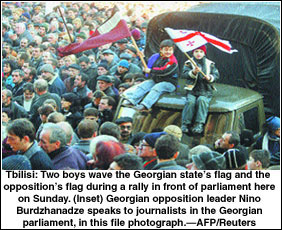 TBILISI, Nov 23: Georgian President Eduard Shevardnadze announced his resignation on Sunday, bowing to opposition protesters who stormed parliament and declared a “velvet revolution” in the former Soviet republic.
“I see that all this cannot simply go on. If I was forced tomorrow to use my authority it would lead to a lot of bloodshed. I have never betrayed my country and so it is better that the president resigns,” Shevardnadze said on television.
After resigning, Mr Shevardnadze flew out of Georgia. He flew out on his presidential plane, which had been made ready hours earlier.
Mr Shevardnadze’s white-haired head was bowed as he walked away, but the former Soviet foreign minister — accused in mass protests in the poverty-plagued country of vote-rigging — gave a strained smile and lifted his hand to wave goodbye.
His resignation followed talks with Russian Foreign Minister Igor Ivanov, main opposition leader Mikhail Saakashvili and fellow opposition activist Zurab Zhvania at the veteran Georgian president’s suburban residence in the capital Tbilisi.
Tens of thousands of opposition supporters outside parliament exploded in rapturous celebrations when Mr Shevardnadze gave up 11 years of power in a country closely watched by the West and investors because of a pipeline project to take Caspian oil to the Mediterranean Sea. Fireworks ripped into the sky.
ELECTION FRAUD: Mr Saakashvili told CNN that the speaker of the outgoing parliament, kNino Burdzhanadze, would take over as acting president from Mr Shevardnadze, 75. The constitution provides for her to remain interim president for 45 days pending elections.
“Now it is important that... Shevardnadze and the police of Georgia and the armed forces, as well as the acting president, preserve stability and calm in the country,” said Mr Saakashvili.
He urged protesters to remove their barricades in Tbilisi.
He had called on supporters to march on Shevardnadze’s residence to force him to resign after a three-week protest campaign against alleged rigging in a Nov 2 parliamentary election.
The crowds outside parliament shouted “Victory, our victory”.
Mr Saakashvili led a parade of vehicles from Shevardnadze’s residence to chants of “We won, we won”. Many people waved red-and-white opposition flags out of car windows.
He beamed as he addressed reporters, in sharp contrast to an exhausted Shevardnadze, who spoke slowly but clearly. Mr Shevardnadze had said earlier in the day he was ready to discuss opposition demands, but opponents said it was too late for talks.
BLOODY CIVIL WAR: His resignation occurred amid signs that some security forces were moving over to the opposition side in Georgia, where a bloody civil war was fought in the early 1990s and two regions have broken away from central government rule.
Mr Shevardnadze, who officially had 1-1/2 years left in office, had been widely blamed for the country’s grinding poverty. He survived two assassination attempts in the 1990s.
On Saturday, protesters seized the parliament building. As with the “people’s power” protests that swept Eastern Europe in 1989, the military stood aside. Mr Shevardnadze was forced to flee.
“Shevardnadze’s regime is bankrupt. His time has been exhausted,” said Mr Saakashvili, a 35-year-old US-trained lawyer groomed by Shevardnadze.
A group of up to 200 men and women, saying they were members of the national guard, had joined the opposition supporters before Shevardnadze quit.
As Soviet leader Mikhail Gorbachev’s foreign minister, Mr Shevardnadze strode across continents, playing a key role in negotiations with the West and Eastern European states that ushered in the end of the Cold War and the collapse of communism.
For the last decade he had been in charge of what had become an impoverished, violent and unstable Caucasus mountain state with a population of about five million.—Reuters