



 0
0

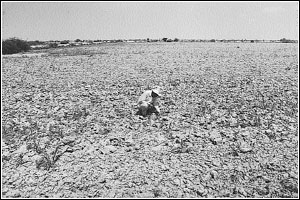 This year’s monso.on were unusually generous for the rain fed areas of Balochistan.This is because excessive and prolonged monsoon rain enabled growers to undertake cultivation of jowar [sorghum] and kharif pulses on vast acreage as an un irrigated crop.
As per Agriculture Statistics Directorate General of Agriculture [Extension] Balochistan during 1999-2000 area under un irrigated jowar was 4300 hectares, mung 5101 hectares, mash 976 hectares, and moth 388 hectares.
But this year following excessive rain many fold increase in the cultivation of these crops are expected. During kharif 2003 season this very scribe had the opportunity to survey the kharif crops in the District Bolan, Jhal Magsi, Nasirabad and Jaffarabad. Here it would be proper to mention that vast areas areas of these districts comprises special type of soils and ecological conditions.
The soil is alluvial . The top layer being soft clay up to a depth of 3-4 inches,with hard clay below. No sand is found even up to a depth of fifty feet. . When the land is dry after irrigation or rainfall, cracks as deep as 9 inches appear throughout.
The climate of this part of Balochistan province resembles that of the upper Sindh that has been described driest tract in the world. There are generally two marked seasons, with small spells of rains and high humidity, during July -August only.
The mean monthly temperature in cold season ranges from 12 C to 25 C and that of the hot season from 30 C to 43 C. The maximum temperature in summer frequently goes above 44 C reaching as high as 50 C.
The rainfall is scanty and varies from three to five inches during the whole year. Main crops of these special zones are oilseeds, wheat, sorghum, paddy and kharif pulses. However, cultivation of cotton on large scale was initiated in this area under the technical guidance of Cotton Research Institute Sakrand in late 1 s.
But unfortunately cotton development project of Patfeeder Command Area failed to give the desired result hence the very project was terminated after kharif 2002 season. This year too cotton cultivation has been under taken in the area bur it is restricted to a few hundred acres.
The irony of the fact was that prior to initiating cotton cultivation in this special area previous ravages of black- headed cricket was not taken into account by the expert of cotton research institute.
As mentioned earliar because of special type of soil and ecological condition the entire area is prone to blackheaded cricket for centuries. In this respect cultivation of cotton by the British Cotton Growing Association soon after the opening of Lloyed Barrage [Sukkur Barrage] in 1935 in the special zone of upper Sindh and Nasserabad [Balochistan ] may be recalled. Review of literature has revealed that cultivation of cotton in this area constantly came under cricket attack.
Damage was so serious and constant that British Cotton Growing Association had to give up the enterprise. However, another reason , particularly in the paddy growing belt of districts Jaffarabad and Nasirabad [Dera Murad Jamali] was failure of the revenue department to implement rice ordinance , which did not permit cultivation of paddy more than 1o per cent on the patfeeder command area.
This free for all like situation, as a matter of fact, also discouraged growers to undertake cotton cultivation in the rice belt this is because under seepage and waterlogged condition economical yield of cotton is difficult.
During Kharif season 2003 this year survey of cotton crop in Tehsil Dhadhar of district Bolan indicated wide spread damage of cotton by black-headed field cricket. Because of damage of seed in the seed bed and at the seedling stage plant population was too low to obtain economical.
During survey majority of the cotton growers reported re-sowing of the very crop because of eating of cotton seed by the field cricket. Unfortunately fate of Jowar and Kharif pulses viz; mung, moth, and mash was not different than that of cotton. Survey of these crops in Tehsil Bhagnarhi of District Bolan [Kachi] and Lehri of Naseerabad, and many areas of Jhalmagsi indicated that because of eating of seeds of these un -irrigated kharif crops, while in the seed- bed /or at the seedling stage, by the black -headed cricket, loss of plants in the field were from 609 to per cent which was certainly devastating.
Moreover, the most haunting scenario, as observed by this scribe during the subsequent survey next month in August was invasion of armyworm on these crops.Both jowar and kharif pulses were under attack but jowar[sorghum] was the worst victim of armyworm. In Bhagnari, Belpat,and Lehri areas almost 6o per cent jowar crop was under attack of this menace .Mung and moth crops which were mostly intercropped with the jowar were also under armyworm attack but the intensity of infestation was not so serious like that of jowar.
Infestation on mung osnd moth was visible due to leaves damage by the armyworm larvae. Since survey was restricted to the early stage of these crops damage inflicted by armyworm and its impact on yield could not be ascertained.
However, the most pathetic aspect of these un-irrigated kharif crops of Balochistan , as observed during survey , was careless attitude of the provincial agriculture department. Majority of the growers rather 1OO per cent growers were found ignorant of the armyworm problem .So far as black headed cricket problem was concerned it was known to them but non reported chemical control measures taken to control the menace. Instead many reported spreading of purified rakh [dust] obtained from pious people [faqir], around the infected field.
What a pity? However to take some more detail about the un-irrigated crops, its damage by insect pests as well as plant protection measures used to be taken in general, one notable area Sardar Chakar Khan Domki was approached by this scribe.
According to Sardar Domki spraying of thousands of acres of crop, where there is no water to drink , was not possible, which was of course true where E C. formulation of pesticide is used .But the very land lord was not aware that to control field cricket water was not required and to control armyworm other option was very much within his reach . But unfortunately, extension wing of the provincial agriculture department, which has become wingless probably because of resources constrain, is much to be blamed instead of the very farming community of the province.
Suggestions: To protect crops particularly kharif crops from the ravages of black-headed cricket a separate project to this effect should be initiated in the special zone of Balochistan, by the provincial agriculture extension department of the province. The project should be aimed at controlling the very field cricket through baiting friendly to the environment.






























