0
0

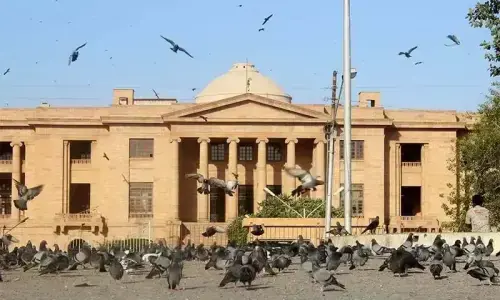
KARACHI, Nov 9: Few people driving along M.A. Jinnah Road could ignore the building of the Karachi Theosophical Society. However, the message of the organization that stands for religious tolerance and pluralism has been largely ignored. Isn’t it strange that in a city of 14 million people the society, founded more than a hundred years ago, has 100 plus members only?
It was the heart-felt oratory of Annie Besant which played an important role in the establishment of the Karachi Theosophical Society. She visited Karachi and Hyderabad in 1896 and delivered a number of lectures. Since she was short of stature, she had to stand on a table to be seen and heard. One of her lectures delivered in Karachi was titled “Man the master of his destiny”. Inspired by her soul-stirring talks, a handful of Karachiites — public figures such as Cowashaw E. Anklesaria, Dhunjishaw P. Kotwal, Feramroze B. Limki, Jamshed Nusserwanjee, Dayaram Jethmal, etc — formed the society and helped it become a potent force.
Speaking about the establishment of the Karachi Theosophical Society, the president, Dara F. Mirza, said the Theosophical Society had been formed in New York on Nov 17, 1875. He added that the Karachi Theosophical Society, which was a branch of the Theosophical Society, had been formed on Dec 21, 1896.
The three declared aims of the Theosophical Society are: to form a nucleus of the universal brotherhood of humanity, without distinction of race, creed, sex, caste or colour; to encourage the study of comparative religion, philosophy and science; to investigate unexplained laws of nature and the powers latent in man.
Mr Mirza admitted that the Karachi Theosophical Society placed a great deal of emphasis on lofty idealism. He recalled that it had been Helena Petrovna Blavatsky (1831-1891) who had been one of the founders of the Theosophical Society.
“Ms Blavatsky was born of a noble family in Russia. From earliest childhood she attracted attention with her ability to produce psychic phenomena at will. Yet she was not interested in such powers for their own sake, but for the principles and law of nature that govern them. She became a student of metaphysical lore and travelled to many lands, including Tibet, in search of hidden knowledge. These were extraordinary travels for a lone woman in the nineteenth century. In the 1870s, Ms Blavatsky came to New York and, with Colonel H.S. Olcott and others, formed the Theosophical Society in 1896.”
The works of Ms Blavatsky include The secret doctrine (two volumes), Isis unveiled (two volumes) and The voice of silence.
Speaking of lofty idealism, Mr Mirza quoted lines from Ms Blavatsky which are inscribed at a prominent place at the Karachi Theosophical Society. She laid down the code of conduct a theosophist should live by.
She wrote: “A clean life, an open mind, a pure heart, an eager intellect, an unveiled spiritual perception, a brotherliness for all, a readiness to give and receive advice and instruction, a courageous endurance of personal injustice, a brave declaration of those who are unjustly attacked, and a constant eye to the ideal of human progression, and perfection which the sacred science depicts: these are the golden stairs, up the stairs of which the learner may climb to the temple of divine wisdom.”
The Karachi Theosophical Society has a well-kept library which contains over 10,000 volumes on different religions and theosophy. Anybody interested in the subject could read any book in the reading hall without having to pay a fee. However, one has to become a member of the library to borrow books. The society also organizes functions and talks.